

Request a demo specialized to your need.
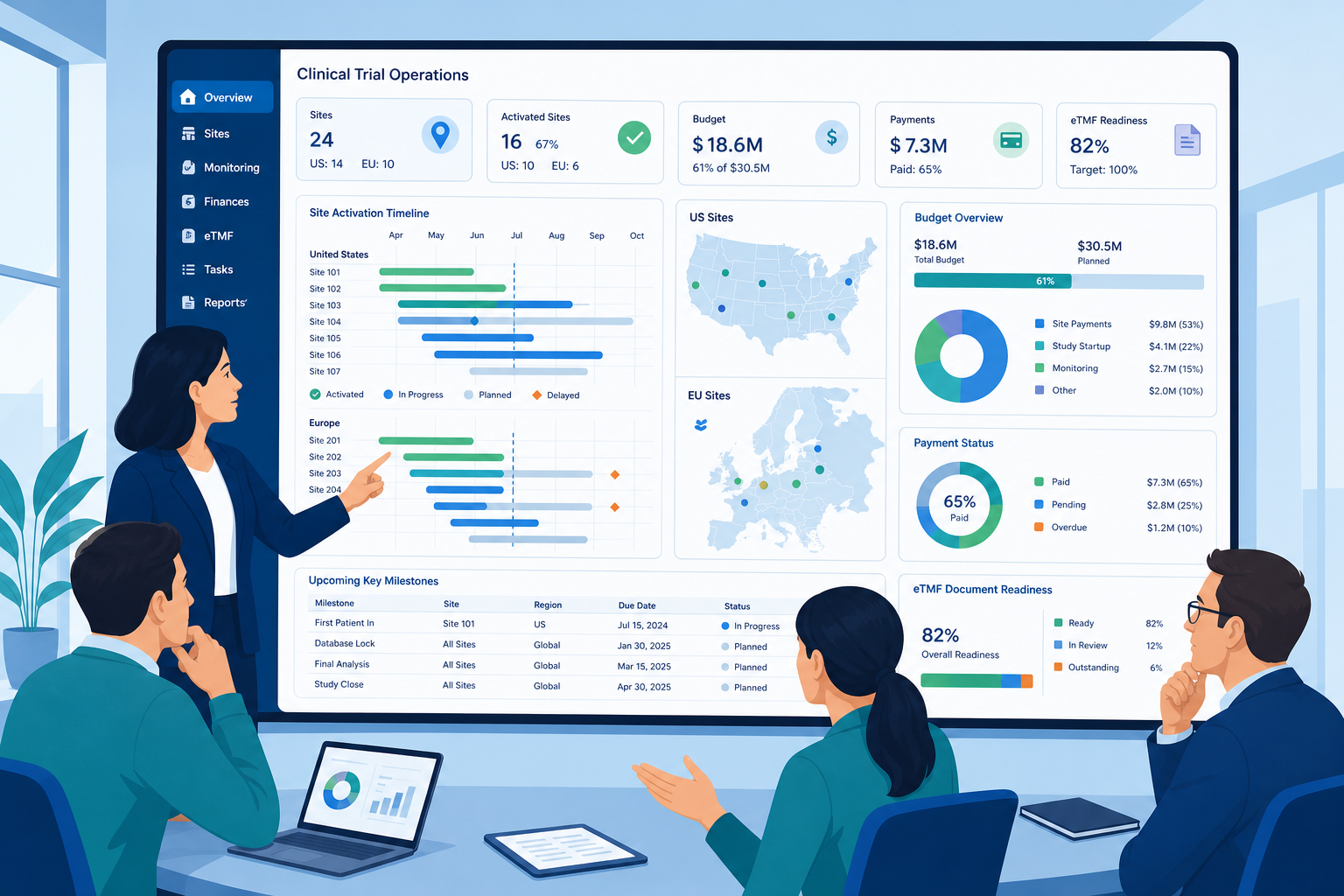
Why site activation delays grow when CTMS, budgets, and eTMF stay disconnected—and how a unified platform helps teams intervene earlier.
Why approval does not equal true site readiness
A site can look close to activation in one system and still be weeks away from actually going live. That is one of the most expensive blind spots in clinical operations today. CTMS may show that a country package is progressing, contracts appear to be moving, and a site initiation visit is in view. But somewhere else, startup fees are still unresolved, accrual assumptions are already drifting, or essential records are incomplete in eTMF. By the time those gaps become visible across teams, the delay is already embedded in the study timeline.
For VPs, Directors, and Heads of Clinical Operations at biotech companies and CROs, this is not just a workflow nuisance. It is a portfolio problem. Site activation is the moment when regulatory status, operational readiness, financial readiness, and document readiness finally align. If CTMS, financial management, and eTMF live in separate systems, that alignment becomes hard to see and even harder to manage. Leaders may know that a site is “almost ready,” yet still lack a dependable answer to whether startup costs should accrue, whether payments can move, or whether the trial master file can support inspection-ready activation.
The cost of that disconnect compounds across US sites and EU member states. A one-week delay in one country may sound manageable, but the ripple effect reaches startup fees, site availability, accrual quality, and first-patient-in timing. Multiply that by several countries and multiple studies, and a local activation issue becomes a study-level budget problem. That is why activation speed should never be discussed in isolation from finance and documentation.
Recent European targets make the pressure more explicit. EMA, the European Commission, and the Heads of Medicines Agencies set a goal that two thirds of clinical trials should begin recruiting within 200 calendar days or less from application submission, as explained at this EMA page. In May 2026, EMA reported that only 40.5% of trials were recruiting within 200 days, shown at this follow-up report. Those numbers highlight the same challenge Clinical Ops leaders already feel: approval speed and true activation readiness are not the same thing.
Cloudbyz CTMS is built for that gap. Cloudbyz is the only 100% Salesforce-native unified eClinical platform. It is not a point solution layered beside finance and documentation. It is a unifier that breaks data silos across clinical operations. When CTMS is natively integrated with Clinical Trial Financial Management and eTMF on Salesforce, site activation becomes a connected business process rather than a series of disconnected status updates. That is the difference between tracking startup and actually controlling it.
Connect site activation, budgets, and eTMF on one platform
Site activation becomes easier to manage when the operating model reflects how trials really run. A startup date is not just an operational marker. It is the point where regulatory progress, contracting readiness, budget control, startup payments, and essential records finally converge. In many organisations, those pieces are still split across separate systems, so leaders see only fragments. CTMS reports milestone movement. Finance reports budget variance later. eTMF teams report missing records on a different cadence. Each team is right inside its own system, but leadership still lacks one dependable answer to a basic question: is this site truly ready to go live?
Cloudbyz addresses that problem by giving Clinical Operations one Salesforce-native operating spine. Cloudbyz CTMS is natively integrated with Clinical Trial Financial Management and eTMF on the same platform. That means a site activation milestone can be evaluated alongside startup budget assumptions, payment readiness, accrual impact, and document completeness in real time. If a US site is operationally close but startup-fee prerequisites are incomplete, the financial consequence is visible immediately. If a study in Europe clears one authority checkpoint but still lacks a contract attachment or an essential startup record, the milestone no longer hides the risk.
This matters because site activation delays do not stay operational for long. They become financial. A slipping contract cycle affects startup fees, accrual timing, and forecast confidence. A missing document in eTMF can hold back site readiness even when other indicators look green. If those signals are separated, teams waste time reconciling status rather than correcting it. On a unified platform, leaders can track days from application to approval, days from approval to contract completion, days from contract completion to site initiation, and readiness for first patient in, all while understanding the financial and document consequences of each delay.
The European regulatory environment makes this even more important. EMA has publicly tied competitiveness to faster trial starts. Its 2025 target announcement states that two thirds of trials should begin recruiting within 200 calendar days or less from application submission, described at this EMA update. In 2026, EMA reported that only 40.5% of clinical trials were recruiting within 200 days, shown at this EMA progress report. Those public benchmarks reinforce what Clinical Ops leaders already know privately: activation speed is now a visible performance issue.
For biotech companies and CROs, the practical value of a unified platform is not just cleaner reporting. It is faster, earlier intervention. A country team can see whether lag is coming from contracting, startup payments, missing essential records, or weak operational follow-through. Leadership can decide where to escalate before another week disappears. That is the real reason to connect CTMS, financial management, and eTMF on Salesforce: not to create another dashboard, but to turn startup visibility into usable control.
Use unified dashboards to support risk-based quality action
Updated quality expectations raise the stakes even further. Under ICH E6(R3), sponsors are expected to apply risk-proportionate quality management and to review meaningful trial data and metadata in a planned, documented way. The final guideline is available at this ICH guideline. For Clinical Operations leaders, that means site activation delays should not be treated as isolated schedule notes. They should be understood as quality signals that may affect participant access, financial control, and inspection readiness.
On a disconnected technology stack, that is difficult to operationalise. CTMS may show timeline slippage. Finance may show unexplained variance. eTMF may show incomplete records. But no one view connects cause and consequence quickly enough to guide action. Teams compensate with meetings, trackers, and manual escalation paths. That slows intervention and makes sponsor oversight harder to defend, especially when running studies across US and European sites with different local requirements and startup dependencies.
A unified Salesforce-native CTMS changes that. Real-time views can combine activation timing, startup payment readiness, accrual movement, and essential-record completeness on one platform. A VP or Director of Clinical Operations can review which sites are truly activation-ready, which ones are drifting into budget exposure, and where eTMF gaps threaten downstream compliance. Because the workflow and the evidence live in the same system, corrective actions can be documented directly: escalate a contract bottleneck, resequence sites, intervene with a CRO, or reset startup priorities by country.
The system architecture behind that control matters. EMA’s 2020 notice on validation and qualification of computerised systems used in clinical trials, available at this EMA notice, reinforces sponsor accountability for trustworthy digital environments. In the US, 21 CFR Part 11 remains foundational for electronic records and signatures, described at this resource. When CTMS, CTFM, and eTMF operate on one platform instead of a patchwork of exports and reconciliations, it becomes much easier to support validated workflows, auditable decisions, and defensible oversight.
Cloudbyz is the only 100% Salesforce-native unified eClinical platform. That positioning matters because Clinical Ops teams do not need another point solution around site startup. They need one operating model that closes the loop between milestones, money, and records. When those three elements move together, site activation stops being a retrospective KPI and becomes a control system. For leaders under pressure to accelerate startup across EU member states and US sites, that shift can make the difference between isolated delay management and real portfolio-level execution discipline.
Subscribe to our Newsletter
