
Request a demo specialized to your need.
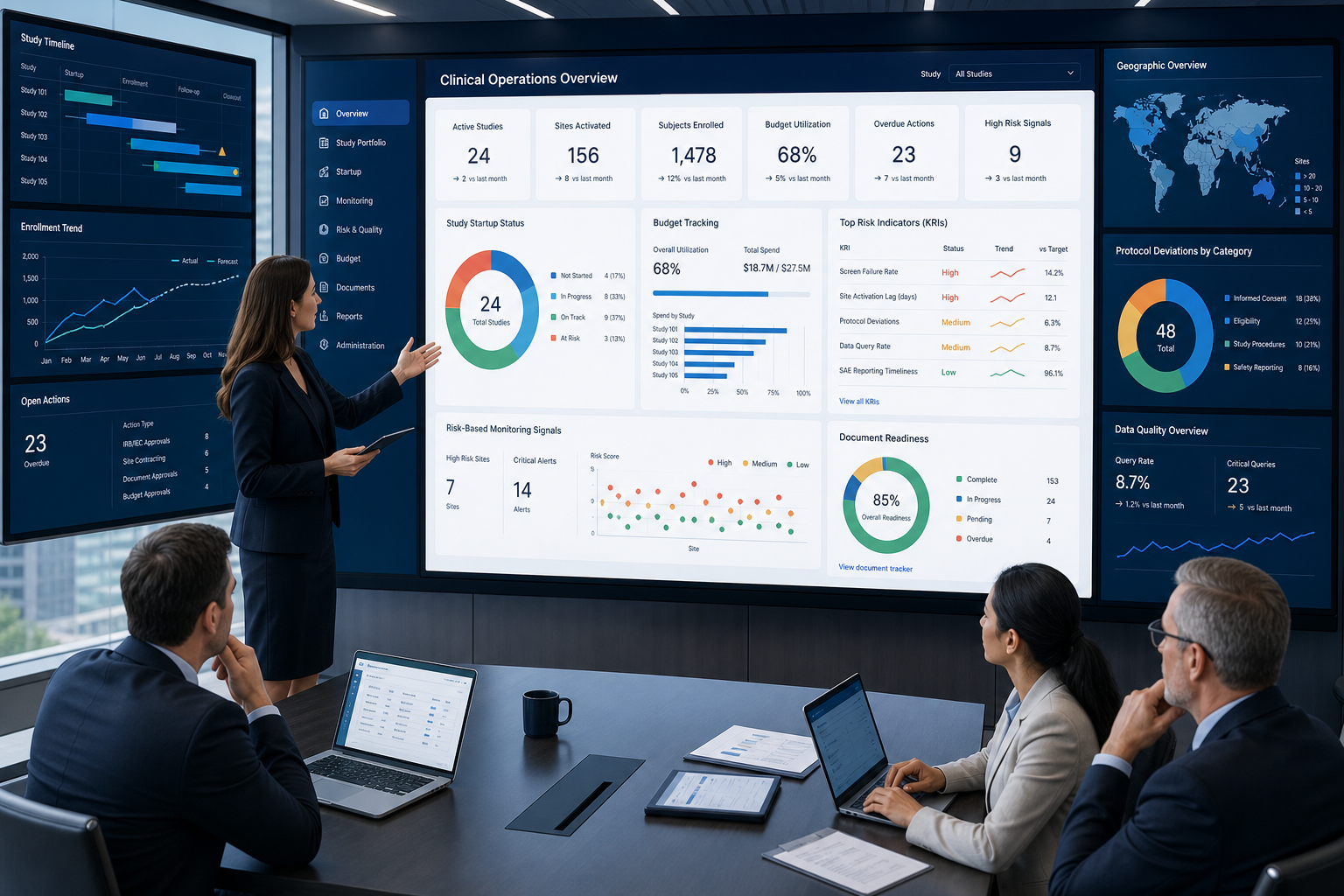
Fast dashboards still fail when startup, finance, and records sit apart. This post shows how unified CTMS makes KRIs actionable.
Why real-time dashboards still fail operational teams
A real-time KRI dashboard is only valuable if it helps a clinical operations team act sooner. Many dashboards still fail that test. They show that something has changed, but not enough surrounding context to explain why it changed or what the next decision should be. For Clinical Operations leaders, that gap is the difference between visibility and control.
In many clinical environments, the dashboard shows the symptom while the explanation lives somewhere else. CTMS may show a startup issue. Financial management may hold the payment dependency or accrual exposure that explains why the signal matters now. eTMF may contain the essential record status or metadata pattern that completes the picture. Each system holds a piece of the truth, but none holds enough context on its own to make the signal immediately actionable. The dashboard is technically real time, yet the decision still arrives late because people have to rebuild the full story manually.
This is the hidden limitation of many KRI programs. The issue is not that the indicators are wrong. The issue is that the architecture behind them is incomplete. Risks in clinical operations often emerge where functions overlap. A site may appear risky because startup is stalled. It may look risky because financial dependencies are delaying execution. It may trigger concern because document readiness is incomplete even though operational progress looks positive. In each case, the threshold breach may look similar while the correct intervention is completely different.
That is why teams can feel flooded with indicators and still slow to respond. A threshold breach without surrounding context simply creates another investigation cycle. Someone has to determine whether the issue is a true performance problem, a finance hold, a startup bottleneck, or a records gap. Clinical Operations leaders do not need more dashboards that escalate ambiguity faster. They need signals that arrive with enough operational meaning to support action. Without that, even a fast dashboard can still produce slow oversight.
How disconnected risk signals slow US and EU trial decisions
That gap matters even more under updated quality management expectations. ICH E6(R3) emphasizes quality by design, fit-for-purpose systems, risk-proportionate oversight, and the review of relevant data and metadata across the trial lifecycle. A dashboard that refreshes quickly but still sends teams into manual investigation loops does not fully meet the spirit of that shift. It improves visibility, but not necessarily intervention speed.
This is especially important across US and European operations, where startup pathways, payment dependencies, and document requirements often vary by site and country. A risk signal at one site can reflect operational issues, a financial blockage, or an essential record gap. The sponsor still needs to know which explanation is true quickly enough to act proportionately. If the KRI arrives without that context, the team spends valuable time reconstructing the issue before it can respond.
The European environment makes this particularly relevant because sponsors are already coordinating activity across jurisdictions using the Clinical Trials Information System. But external regulatory coordination does not solve the internal problem of fragmented oversight. Leaders still need one operational frame that joins startup status, financial exposure, and document readiness tightly enough to support faster decisions.
Clinical Operations leaders do not need more red indicators. They need indicators that shorten the distance between detection and response. That is the real standard for real-time KRI dashboards. If every signal still requires an extra reconciliation cycle across CTMS, financial management, and eTMF, then the dashboard is current but not yet useful enough. Modern risk-based monitoring needs more than speed. It needs context that travels with the signal.
Why unified CTMS improves actionability under ICH E6(R3)
Cloudbyz supports that kind of actionability by keeping CTMS, Clinical Trial Financial Management, and eTMF on one Salesforce-native platform. Because the operating record is unified, KRI dashboards can draw from startup, spend, and readiness context without forcing teams into separate systems to explain what they are seeing.
Within Cloudbyz CTMS, study teams manage planning, startup, site oversight, clinical monitoring, and reporting on the same platform used to run the trial. Native CTFM adds budget, payment, accrual, and transparency context to the same study and site view. Connected eTMF adds document status, metadata, and readiness signals inside that same operating model.
The result is that a KRI can do more than show a trend. It can help reveal whether the issue is likely operational, financial, or documentary. If startup risk rises, leaders can see whether the likely cause is contracting, budget alignment, or incomplete essential records. If a site-level quality signal worsens, teams can determine whether the issue reflects site behavior, payment friction, or readiness gaps. That is what makes risk-based monitoring more actionable and easier to defend.
For VPs, Directors, Heads of Clinical Operations, Clinical Project Managers, and Clinical Operations Managers, the payoff is straightforward. Faster decisions become possible because teams no longer need to rebuild the trial story across multiple systems before acting. Escalations become more precise because the signal is closer to the process that likely caused it. Oversight becomes more defensible because the path from alert to intervention is grounded in the same platform record. A disconnected dashboard can tell you that risk exists. A unified CTMS gives that risk enough context to support earlier, more proportionate action. That is how real-time KRIs become operationally useful instead of merely informative.
Subscribe to our Newsletter
