

Request a demo specialized to your need.
The clinical trial industry is under a kind of pressure most of us haven't seen in decades. Costs are climbing. Timelines are stretching. And the patients these trials exist to help are left waiting longer than they should be.
If you're a CRO, you already feel this. You're accountable to sponsors for delivery, quality, and cost — all at once. And a lot of that pressure doesn't land on the science. It lands on the paperwork.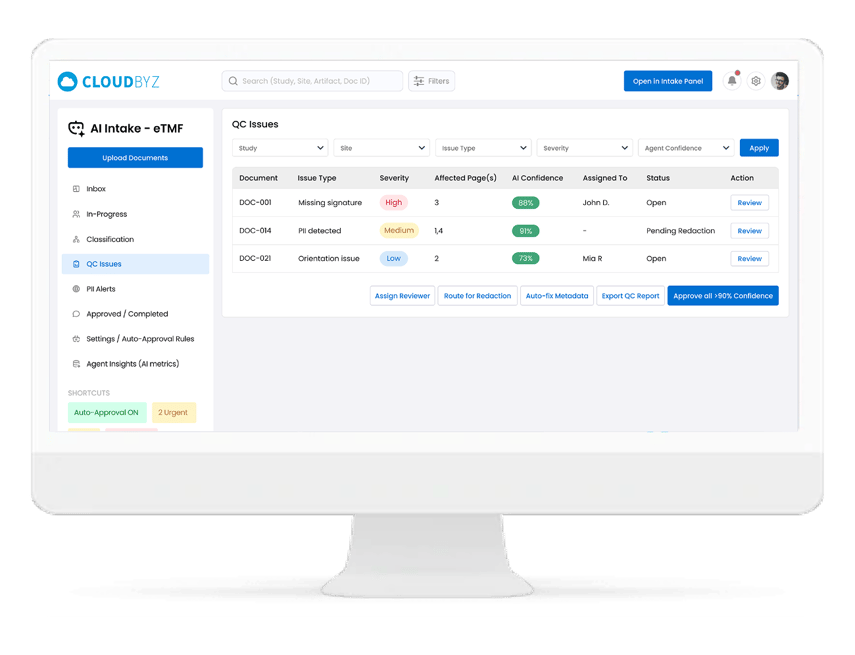
The Numbers Don't Lie
Over 80% of clinical trials experience delays — averaging one to six months. Just 10% finish on time. Every delay keeps site costs running, keeps teams chasing documents, and quietly eats into margins that were already tight.
Somewhere in that pile of incoming files from sites, vendors, and partners, someone on your team is manually classifying documents, fixing metadata errors, and re-doing work that shouldn't have needed doing in the first place.
Protocol amendments alone are believed to cost several hundred thousand dollars each. And TMF management — headcount-heavy, error-prone, largely invisible — sits squarely in that category. Until an inspection makes it very visible.
CROs Are Being Asked to Do More With Less
Sponsors aren't just watching costs anymore — they're more willing to switch partners than they've ever been. That puts CROs in a tough spot: prove efficiency and quality, not one at the expense of the other.
The traditional TMF model wasn't built for this. More trials means more documents. More documents means more people filing, classifying, checking. Costs grow with headcount. Quality gets inconsistent. And compliance risk builds quietly in the background.
We've talked to enough CRO teams to know this isn't a hypothetical. It's Tuesday.
CROs are being asked to do more with less
Budgets in clinical research have been tight for the last few years, with teams needing to do more with less, and every expense needing justification. Sponsors are not just watching costs, they are more willing to switch partners than they have traditionally been.
That's a direct pressure on CROs to demonstrate efficiency and quality simultaneously, not trade one for the other. CROs manage high document volumes, aggressive timelines, and complex multi-sponsor workflows, often with the same headcount stretched across all of it.
The traditional TMF model struggles here. More trials means more documents. More documents means more people filing, classifying, and checking. Costs grow linearly with headcount. Quality becomes inconsistent across studies and sites. And the compliance risk rises quietly in the background.
How Cloudbyz transforms TMF intake into an automated, AI-driven process?
We didn't build the Cloudbyz AI eTMF Agent to replace your clinical teams. We built it to take the volume work off their plates, so they can focus on what actually needs human judgment, and so you can scale TMF operations without scaling headcount at the same rate.
Here's what that looks like in practice:
- When a CRA uploads documents while traveling — multiple files uploaded at onego, automatically classified against the DIA TMF reference model (3.2.1 and 3.3.1 built in)
- Instead of going back and forth on metadata — metadata is extracted and pre-filled at intake. No manual entry or rework loops
- Before compliance becomes a downstream issue — PHI detection happens upfront. Patient identifiers are flagged before documents move anywhere in the workflow
- So teams don't have to review everything manually — AI confidence scoring guides review. Teams focus only on exceptions, not full document volumes. High-confidence documents move forward automatically, with a full audit trail and traceability
The downstream outcomes are where this really compounds:
- Faster cycle times — less time spent on document handling means studies move faster end to end
- Higher-quality sponsor deliverables — standardized, AI-checked filing means fewer errors reaching the sponsor's desk
- Stronger margins — when cost doesn't scale linearly with volume, profitability improves on every study
- Competitive differentiation in RFPs — AI-powered TMF operations, real-time dashboards, and inspection-ready audit trails carry real weight when sponsors are evaluating partners
The efficiency case is also the quality case
Here is some food for thought: automating routine TMF work doesn't introduce risk. It removes the human error that was already there.
That matters more now than it ever has and the regulators are already showing us the way. The FDA has deployed Elsa, an agency-wide generative AI tool that cut clinical protocol review from three days to minutes, and has since expanded into agentic AI across submissions, inspections, and post-market surveillance. A TMF that passed a cursory review in 2022 is now being assessed by an AI-assisted reviewer who surfaces gaps and missing documents faster than any manual process.
The question for CROs isn't whether to adopt AI in clinical operations. It's whether you do it proactively, or explain to your next sponsor why you didn't.
The TMF is a good place to start. And Cloudbyz is happy to show you exactly what that looks like for your operation.
Subscribe to our Newsletter
