
Request a demo specialized to your need.
Adverse events don't wait for a convenient time to happen. A patient in a Phase II oncology trial reports unexpected nausea at 11 p.m. on a Friday. A site coordinator in a different time zone logs a serious adverse event the following Monday. Somewhere in between, a safety team is trying to reconcile spreadsheets, email threads, and a case management tool that doesn't talk to the clinical trial management system. This is the reality for many sponsors and CROs still running drug safety operations on manual or fragmented processes — and it's exactly the problem pharmacovigilance software was built to solve.
This guide breaks down what pharmacovigilance software actually is, how it changes adverse event reporting and case processing, and why it has become a baseline requirement — not a nice-to-have — for clinical trial safety at scale.
What Is Pharmacovigilance Software?
Pharmacovigilance software is a purpose-built technology platform that captures, processes, evaluates, and reports adverse events and safety data throughout the lifecycle of a drug or biologic — from first-in-human studies through post-marketing surveillance. In the context of clinical trials specifically, it manages the intake of adverse event (AE) and serious adverse event (SAE) reports, supports case triage and medical review, automates regulatory submissions like E2B(R3) ICSRs, and maintains the audit trail required to demonstrate compliance with global safety regulations.
Unlike a generic database or a shared spreadsheet, pharmacovigilance platforms are designed around the specific mechanics of drug safety: MedDRA coding, causality assessment, expectedness determination against a reference safety information document, and time-bound regulatory reporting clocks that start the moment a site becomes aware of an event. The software exists because safety data has legal and patient-safety consequences, and the process of managing it needs to be defensible, traceable, and fast.
Why Manual and Disconnected Workflows Fall Short
Many organizations — particularly smaller biotechs and CROs managing early-phase trials — still rely on a patchwork of tools: AE data captured in the EDC, a separate spreadsheet tracking SAE reconciliation, case narratives drafted in Word, and regulatory submissions built by hand in an XML editor. This approach tends to break down in a few predictable ways.
Reconciliation gaps. When AE data lives in the EDC and case data lives in a separate safety database, someone has to manually reconcile the two on a recurring basis. Discrepancies — a case closed in one system but still open in another — are common and often caught late.
Missed reporting timelines. Expedited SAE reporting to regulators typically must happen within 7 or 15 calendar days of the sponsor becoming aware of the event, depending on severity and expectedness. Manual tracking of these clocks across multiple ongoing studies increases the risk of a missed or late submission, which carries direct regulatory exposure.
Inconsistent MedDRA coding. Without embedded coding tools and version control, the same adverse event can be coded differently by different reviewers or across different studies, undermining the integrity of aggregate safety signal detection.
Audit trail fragility. Inspectors and auditors expect a complete, timestamped record of who did what, when, to a case. Spreadsheets and email chains don't produce this natively, which turns every audit into a scramble.
No real-time visibility. Clinical operations leaders and safety leads often can't see current case status, backlog, or aging cases without requesting a manual report, which delays decision-making exactly when speed matters most.
How Pharmacovigilance Software Changes the Picture
Structured Adverse Event Reporting
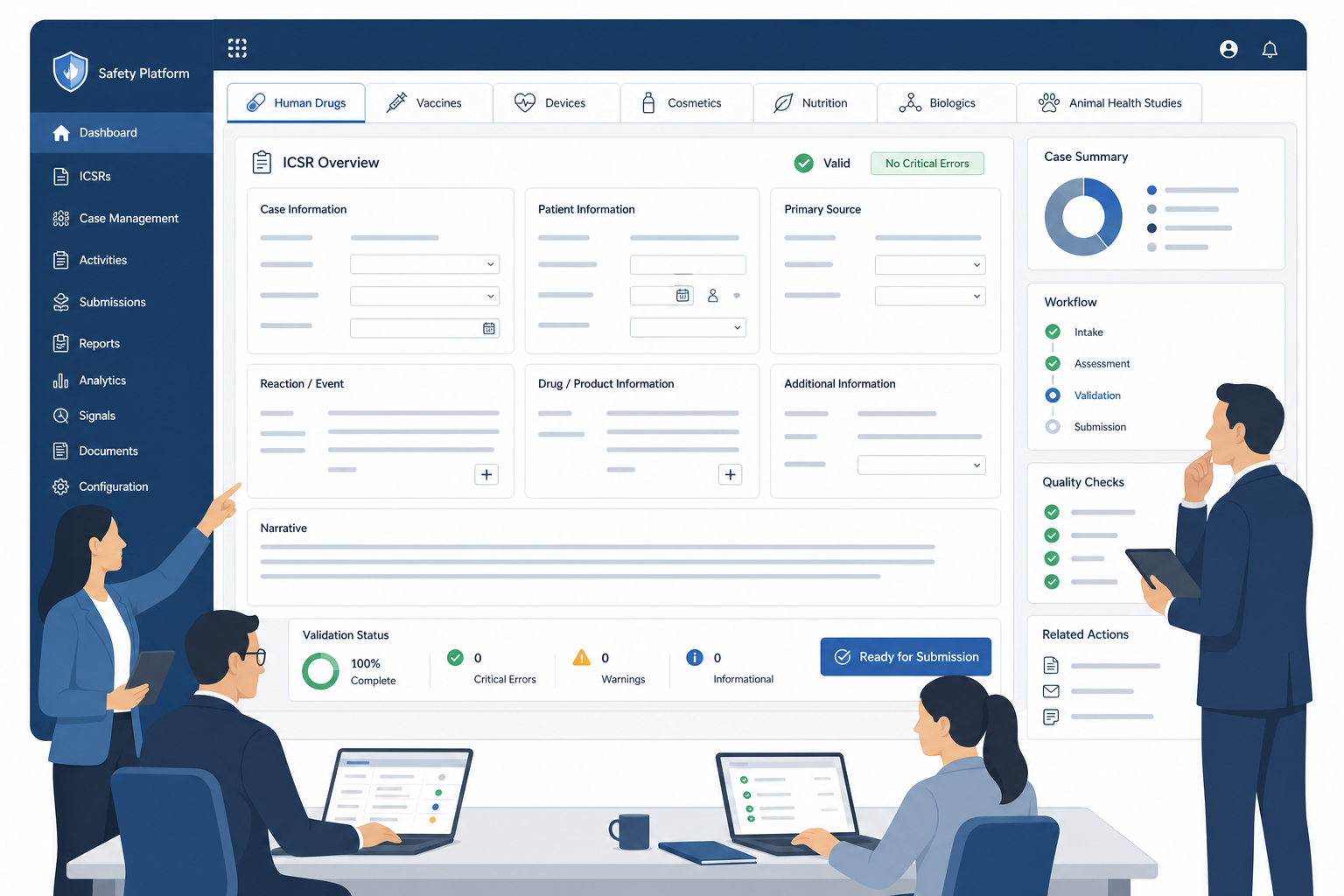
Pharmacovigilance platforms provide a single, structured intake point for adverse event reporting, whether the report originates from a clinical site, a patient-reported outcome, a call center, or literature surveillance. Built-in validation rules catch incomplete or inconsistent data at the point of entry rather than downstream, and duplicate-detection logic flags potential repeat reports before they become two open cases for the same event.
Automated Case Processing
Once a case is opened, the software manages it through a defined workflow: triage, data entry, medical review, causality and expectedness assessment, quality check, and closure. Each step carries an owner, a due date, and a status, which replaces the ad hoc "who has this case right now" conversations that plague manual processes. Many platforms also auto-populate case narratives and pre-fill regulatory forms using structured case data, cutting the manual drafting time that traditionally consumes a safety associate's day.
E2B(R3) and Regulatory Submission Automation
A core function of modern pharmacovigilance software is generating and transmitting E2B(R3)-compliant Individual Case Safety Reports (ICSRs) directly to regulatory gateways — FDA FAERS, EMA EudraVigilance, and other national agencies — without manual XML construction. This closes the gap between "case is medically reviewed and ready" and "case is actually submitted," and it timestamps the submission automatically, which matters enormously when demonstrating compliance with expedited reporting deadlines.
Signal Detection and Aggregate Reporting
Beyond individual case management, pharmacovigilance platforms aggregate safety data across a study or a full development program to support signal detection, DSUR (Development Safety Update Report) and PSUR/PBRER preparation, and ongoing benefit-risk assessment. This is difficult to do reliably when case data is scattered across disconnected systems, because the underlying dataset is never fully complete or fully current.
Compliance and Audit Readiness
Every action inside a validated pharmacovigilance platform — case creation, edits, reviewer sign-offs, submission timestamps — is captured automatically as part of the audit trail, supporting 21 CFR Part 11 electronic records requirements and ALCOA+ data integrity principles. When an inspector asks to see the history of a specific case, the answer is a report, not a research project.
Key Capabilities to Look For
Organizations evaluating pharmacovigilance platforms typically assess the following:
- MedDRA and WHODrug coding tools with version management and coding consistency checks
- Configurable workflow engines that route cases based on seriousness, study, or region
- E2B(R3) gateway connectivity for direct regulatory transmission
- Regulatory reporting clock automation with built-in alerts for approaching deadlines
- Integration with EDC, CTMS, and eTMF systems so safety data isn't isolated from the rest of the trial record
- Dashboards and analytics for real-time visibility into case aging, backlog, and reporting compliance
- Validation documentation (IQ/OQ/PQ) appropriate for a GxP-regulated environment
- Scalability across studies and programs, since safety operations rarely stay confined to a single trial
The Business Case: Beyond Compliance
While regulatory compliance is the non-negotiable baseline, the operational case for pharmacovigilance software extends further. Case cycle times shrink when data doesn't have to be re-entered across systems. Safety teams spend less time on manual reconciliation and more time on medical assessment, which is where their expertise actually adds value. Sponsors and CROs gain defensible, audit-ready documentation without building it retroactively before an inspection. And as trials scale across more sites, more countries, and more concurrent studies, a platform built for that scale prevents the safety function from becoming the operational bottleneck.
Where Pharmacovigilance Software Fits in a Connected Clinical Trial Ecosystem
Adverse event reporting doesn't happen in isolation from the rest of clinical trial safety management — it depends on site-reported data, protocol details, and patient records that often originate elsewhere in the trial infrastructure. Pharmacovigilance platforms deliver the most value when they connect natively with EDC, CTMS, and eTMF systems rather than operating as a silo that requires manual data transfer. Organizations built on a unified, Salesforce-native architecture — like Cloudbyz — are positioned to close that gap directly, since clinical operations, regulatory, and drug safety management can share a common data layer instead of reconciling exports between disconnected point solutions.
Final Thoughts
Pharmacovigilance software isn't just a compliance requirement — it's the infrastructure that makes fast, accurate, well-documented drug safety management possible at the pace modern clinical trials demand. As trials grow more complex and regulatory scrutiny increases, the gap between organizations running structured pharmacovigilance platforms and those still relying on manual, disconnected workflows will only widen. For clinical operations and pharmacovigilance leaders evaluating their next investment in trial infrastructure, the question isn't whether to adopt pharmacovigilance software, but how well it integrates with everything else the organization already runs on.
Subscribe to our Newsletter
