
Request a demo specialized to your need.
Summary
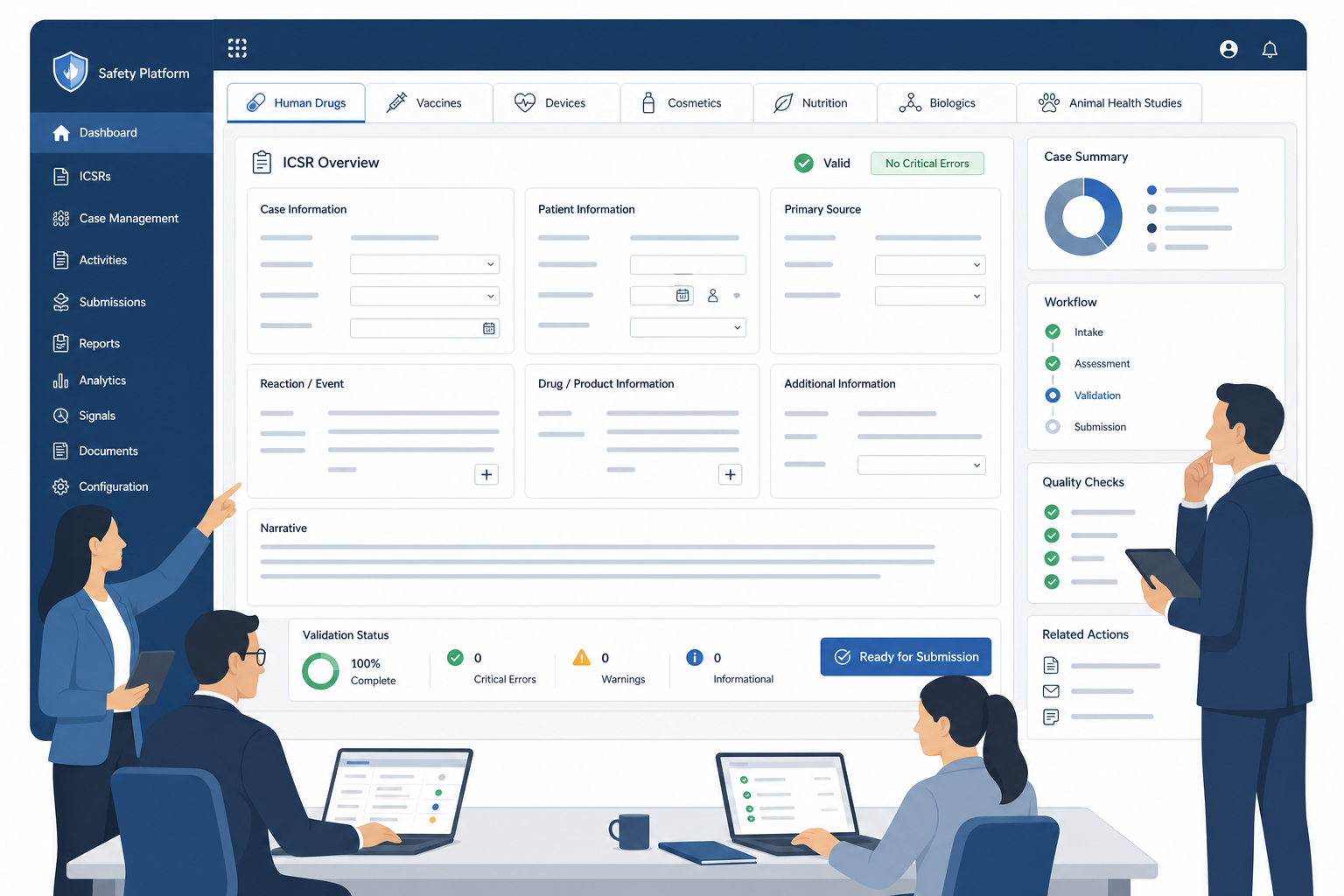
Pharmacovigilance software gives sponsors and CROs a single, connected system for capturing adverse events, processing cases, and meeting global regulatory reporting deadlines. This article explains what the software does, how it changes the mechanics of safety operations, and why organizations that still rely on manual or disconnected workflows carry avoidable compliance and quality risk.
The Safety Burden Clinical Trials Cannot Outsource to Spreadsheets
Every investigational product generates a stream of safety data from the moment the first patient is dosed. Adverse events, serious adverse events, and suspected unexpected serious adverse reactions all have to be captured, medically reviewed, coded, assessed for causality, and in many cases reported to regulators within hours or days. The obligation does not scale down for small trials or early phases. A single missed expedited report can trigger a regulatory finding, delay a submission, or in the worst case put patients at risk.
Despite this, a large share of sponsors, particularly mid-sized biotech and specialty pharma companies, still run safety operations on a mix of email, shared spreadsheets, PDF forms, and a case management tool that does not talk to the rest of the clinical technology stack. Pharmacovigilance software exists to close that gap by giving safety, clinical operations, and regulatory affairs teams one connected system of record for the full adverse event lifecycle.
What Pharmacovigilance Software Actually Does
At its core, pharmacovigilance software manages four linked functions that together make up drug safety operations.
Adverse event intake and case creation. The system captures reports from investigators, patients, call centers, and literature sources through structured forms rather than free text emails. Each report is automatically converted into a case with a unique identifier, removing the manual step of transcribing information from an inbox into a tracking sheet.
Case processing and medical review. Once a case exists, the software supports triage, MedDRA coding, causality and expectedness assessment, and narrative writing inside a single workflow. Reviewers see the full case history, prior related events, and product labeling reference material in one place instead of switching between systems.
Regulatory reporting and submission. The software calculates reporting clocks based on seriousness, expectedness, and jurisdiction, then generates the required outputs, including E2B(R3) files, CIOMS forms, and MedWatch 3500A reports, and routes them through validated gateways to FDA, EMA, PMDA, and other health authorities.
Signal detection and aggregate reporting. Beyond individual case processing, the software aggregates safety data across the study or product to support signal detection, DSUR and PBRER authoring, and periodic safety review, giving the safety team a continuously current view rather than a picture reconstructed at the end of a reporting period.
Why Manual and Disconnected Workflows Fall Short
The problems with spreadsheet-based and disconnected pharmacovigilance are structural, not simply a matter of discipline or effort. Three failure modes show up repeatedly across sponsor and CRO organizations.
Data Re-Entry Introduces Errors and Delay
When adverse event data moves from an email, to a spreadsheet, to a separate safety database, and finally into an E2B file, it is transcribed multiple times by different people. Each transcription is an opportunity for a coding error, a missed field, or a version conflict. These errors are rarely caught until a health authority query or an audit surfaces them, at which point the cost of correction is far higher than the cost of preventing them.
Reporting Clocks Are Tracked Outside the System That Manages the Case
Regulatory clocks for serious and unexpected events typically run in single or double digit days from the point of awareness. When the clock lives in a separate spreadsheet from the case itself, someone has to remember to check it, update it, and escalate it. Pharmacovigilance software starts the clock automatically at the moment the case is classified, and it keeps escalating visibility to the responsible reviewer until the report is submitted, which removes the dependency on manual follow-up.
Audit Trails Are Reconstructed Rather Than Native
Inspectors and auditors expect to see who did what and when, for every case. In a disconnected workflow, that history is scattered across email threads, document versions, and verbal handoffs, and reconstructing it under time pressure is a significant burden. Pharmacovigilance software captures every action, timestamp, and electronic signature as a byproduct of normal use, so the audit trail already exists when it is requested.
Manual Workflows vs. Pharmacovigilance Software
|
Capability |
Manual / Disconnected Workflow |
Pharmacovigilance Software |
|
Adverse event intake |
Email, fax, and spreadsheet capture with manual triage |
Structured intake forms with automated case creation and triage rules |
|
Case processing |
Re-keying data across systems; siloed narrative writing |
Single case record with workflow-driven MedDRA coding, causality assessment, and narrative generation |
|
Regulatory reporting |
Manual tracking of due dates in spreadsheets; high risk of missed submissions |
Automated clock-start detection and configurable timelines for FDA, EMA, PMDA, and other authorities |
|
E2B(R3) submissions |
Third-party gateway or manual XML preparation |
Native E2B(R3) generation and validation with direct gateway connectivity |
|
Signal detection |
Periodic manual review of aggregate data |
Continuous statistical monitoring with configurable thresholds and alerts |
|
Audit readiness |
Reconstructing timelines from emails and shared drives |
Full audit trail with timestamped actions and electronic signatures |
Where Pharmacovigilance Software Fits in the Clinical Trial Stack
Pharmacovigilance does not operate in isolation from the rest of clinical trial data. Safety signals often first appear in EDC as reported adverse events, get referenced during monitoring visits tracked in CTMS, and eventually need to be reflected in the trial master file for inspection readiness. Pharmacovigilance software delivers the most value when it is connected to these systems rather than standing alone.
A unified eClinical platform approach, where CTMS, EDC, eTMF, and safety share the same underlying data model, removes the need for point-to-point integrations between separate vendor systems. Case data captured in safety can be cross-referenced against protocol deviations in CTMS or subject visit data in EDC without a custom interface, and documentation supporting a serious adverse event report can be filed directly into the eTMF as part of the same workflow rather than as a separate manual step.
What Good Pharmacovigilance Software Looks Like in Practice
- Configurable intake forms that match the data collection needs of the specific study or product, without requiring custom development for every protocol
- Automated MedDRA and WHO Drug Dictionary coding assistance that speeds medical review without removing clinical judgment
- Jurisdiction-aware reporting rules that account for the differences between FDA, EMA, PMDA, and other regional requirements
- Native E2B(R3) generation with built-in validation prior to gateway submission
- Role-based dashboards that give safety leads, medical reviewers, and regulatory affairs visibility into case status without status meetings
- A complete, exportable audit trail that supports inspection readiness at any point in the trial, not only at closeout
The Bottom Line
Adverse event reporting obligations in clinical trials are not going to become simpler, and regulators are not going to extend reporting windows to accommodate manual processes. Pharmacovigilance software addresses this by replacing fragmented, re-entered, and manually tracked safety data with a connected system that captures a case once, processes it consistently, and reports it on time. For sponsors and CROs evaluating their safety operations, the relevant question is no longer whether to move away from spreadsheets and disconnected tools, but how quickly the transition can be made without disrupting active studies.
Cloudbyz delivers a Salesforce-native Safety and Pharmacovigilance solution as part of a unified eClinical platform spanning CTMS, eTMF, EDC, and CTFM, purpose-built for pharma, biotech, CRO, SMO, medical device, and diagnostics organizations.
Subscribe to our Newsletter
