

Request a demo specialized to your need.
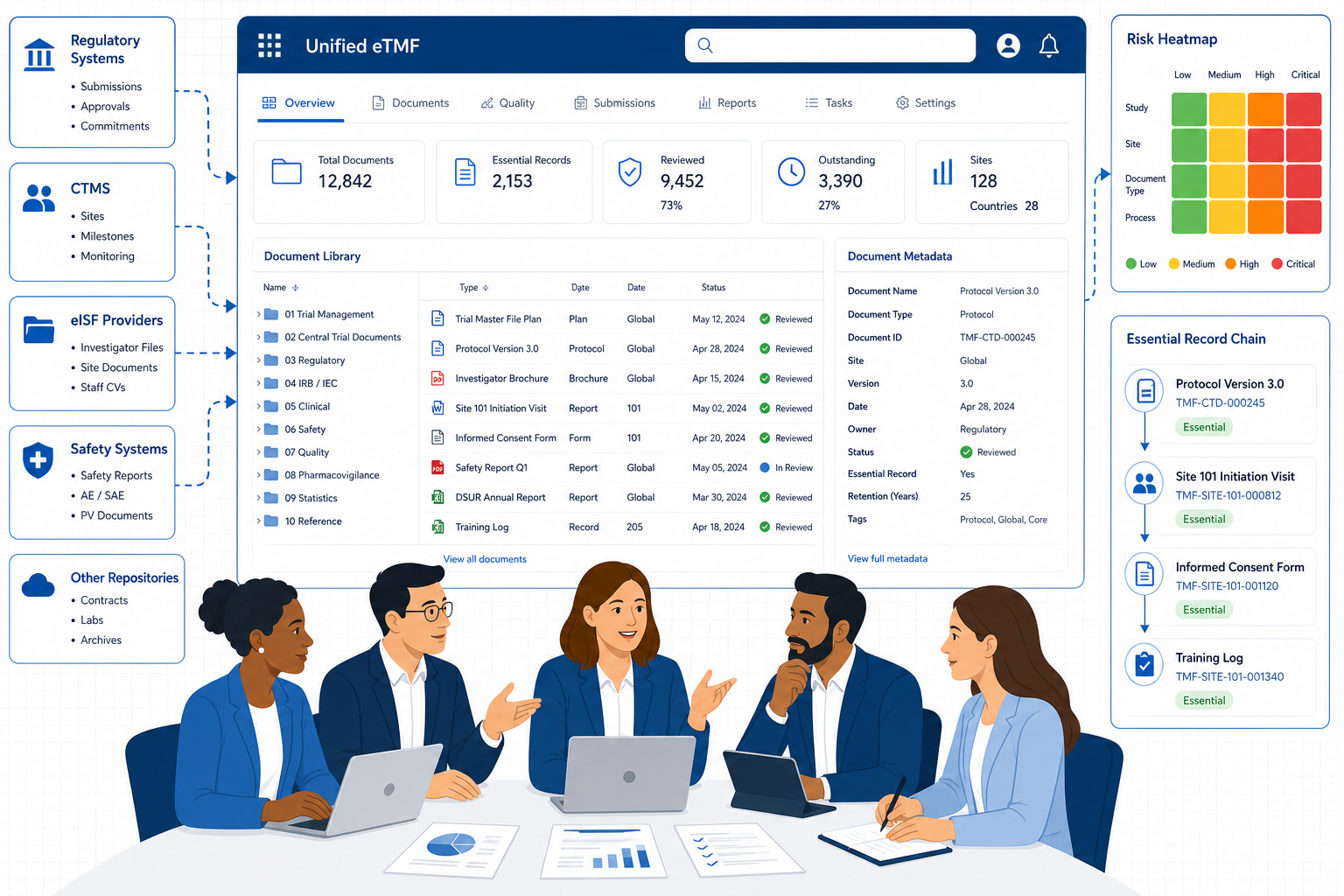
Clinical trials generate an enormous volume of documentation — protocols, informed consent forms, monitoring visit reports, IRB/IEC correspondence, investigator credentials, safety reports, and thousands of other artifacts that prove a trial was conducted according to protocol, GCP, and applicable regulations. When that documentation lives across shared drives, email threads, and disconnected point solutions, sponsors and CROs don't just lose efficiency — they lose inspection readiness. An electronic trial master file (eTMF) system exists to solve exactly that problem.
This guide breaks down what an eTMF system actually is, why it has become foundational infrastructure for clinical operations and regulatory teams, and what to look for when evaluating one.
What Is an eTMF System?
An eTMF system is a purpose-built software platform for creating, collecting, organizing, and managing the Trial Master File (TMF) — the complete set of documents that demonstrate compliance with ICH E6(R2)/(R3) Good Clinical Practice, along with the conduct of the trial itself. The TMF is not optional documentation; it's the evidentiary backbone that regulators, auditors, and inspectors rely on to reconstruct exactly how a trial was run.
Historically, TMFs were paper-based binders stored in filing rooms, organized by site and document type. That model made retrieval slow, version control nearly impossible, and inspection prep a weeks-long fire drill. An eTMF system digitizes this entire structure, typically aligned to the DIA TMF Reference Model, and layers in the workflow, metadata, and access controls needed to keep the file complete and current throughout the trial lifecycle — not just at the end.
At its core, an eTMF system does four things:
- Centralizes every trial document into a single, structured repository
- Standardizes filing using a common taxonomy (zones, sections, artifacts) so documents are predictable and findable
- Tracks completeness and timeliness through real-time quality metrics and expected document lists
- Enforces compliance controls — audit trails, e-signatures, role-based access, retention rules — required under 21 CFR Part 11 and GxP frameworks
Why Clinical Documentation Becomes Chaotic Without One
Documentation chaos rarely happens all at once. It accumulates gradually, and by the time a sponsor is preparing for an FDA or EMA inspection, the cracks are already load-bearing. A few common failure patterns:
Fragmented ownership across sites and vendors. In a typical multi-site, multi-CRO trial, documents originate from dozens of sources — sites, CROs, central labs, IRBs, safety vendors. Without a shared system of record, each party maintains its own version of "the truth," and reconciling them becomes a manual, error-prone exercise.
No visibility into what's missing. Teams often don't discover a document is missing, outdated, or misfiled until an audit or inspection surfaces it — at which point the fix is reactive and stressful rather than proactive.
Version control failures. Shared drives and email don't track document lineage. When multiple stakeholders touch the same document, determining which version is final, approved, and inspection-ready becomes guesswork.
Delayed filing. Documents get created during trial conduct but filed into the TMF weeks or months later, if at all. This creates a persistent gap between what actually happened in the trial and what the TMF reflects — which is precisely what inspectors probe for.
Inconsistent metadata and taxonomy. Without a standardized structure, similar documents get filed differently by different people, making retrieval slow and completeness assessment nearly impossible to automate.
An eTMF system directly addresses each of these failure modes by giving the organization one authoritative, real-time view of trial documentation instead of a patchwork of local truths.
How an eTMF System Improves Inspection Readiness
Inspection readiness is really a question of one thing: can you produce a complete, accurate, contemporaneous TMF on demand? A well-implemented eTMF system builds that readiness in continuously, rather than as a scramble before an inspection.
Real-time completeness and quality dashboards. Modern eTMF platforms compare the current file against expected document lists (based on trial design, milestones, and country/site requirements) and surface gaps immediately — not at trial closeout. This turns TMF health into an ongoing operational metric rather than a year-end surprise.
Timeliness tracking. Beyond completeness, inspectors care about whether documents were filed close to the events they document. eTMF systems track filing lag and flag documents that are overdue, giving clinical operations leaders an early warning system rather than a retrospective finding.
Audit trail integrity. Every action — upload, edit, approval, access — is logged with a timestamp and user ID. This satisfies 21 CFR Part 11 requirements and gives inspectors confidence that the file hasn't been altered outside of controlled processes.
Structured, predictable retrieval. Because documents are filed against a standard taxonomy like the TMF Reference Model, inspectors and internal QA teams can navigate the file efficiently, without depending on institutional knowledge of where things "usually" get saved.
Certified copies and QC workflows. eTMF systems support the certified copy processes and quality control checks needed to demonstrate that scanned or transferred documents faithfully represent their originals — a frequent point of inspector scrutiny.
The net effect: inspection prep shifts from a reactive, all-hands document hunt to a routine export of a file that has been maintained in an inspection-ready state throughout the trial.
eTMF vs. CTMS: Where the Line Sits
It's common for clinical operations leaders evaluating platforms to ask how an eTMF system relates to CTMS software, since both sit at the center of trial execution. The distinction matters for architecture decisions:
- CTMS (Clinical Trial Management System) is operational — it manages trial planning, site and study activities, milestones, enrollment tracking, and monitoring visit scheduling. It answers "what is happening and when."
- eTMF is evidentiary — it manages the documentation that proves those activities happened in compliance with GCP and the protocol. It answers "can we prove what happened, and where's the record."
In practice, the two are tightly linked. A monitoring visit scheduled and tracked in CTMS should generate a corresponding monitoring visit report that gets filed in the eTMF. When CTMS and eTMF are disconnected systems, this link has to be maintained manually, which is where filing delays and completeness gaps creep in. This is why many sponsors and CROs increasingly favor eTMF and CTMS built on a unified platform architecture — so operational events and their supporting documentation stay connected automatically, rather than depending on someone remembering to file the report after the visit closes.
Core Capabilities to Look for in an eTMF System
When evaluating electronic trial master file systems, clinical operations and regulatory teams should look past basic document storage and assess these capabilities:
TMF Reference Model alignment. The system should support the DIA TMF Reference Model out of the box, with the flexibility to configure zones, sections, and artifacts to match study-specific and sponsor-specific requirements.
Expected document list automation. The platform should auto-generate expected document lists based on study configuration (design, phase, country, site status) so completeness can be measured against what should exist, not just what's been uploaded.
Workflow-driven quality control. Upload, QC review, and approval should follow configurable workflows with clear accountability, rather than relying on informal review outside the system.
Real-time metrics and dashboards. Completeness, quality, and timeliness metrics should be visible at the study, site, and country level, ideally rolling up into portfolio-level views for clinical operations leadership.
Role-based access and permissions. Sponsors, CROs, sites, and vendors often need different levels of access to the same TMF. Granular, configurable permissions are essential for multi-party trials.
21 CFR Part 11 and GxP compliance. Full audit trails, e-signatures, validated system status, and data integrity controls (ALCOA+) are non-negotiable for a system that will be inspected.
Integration with CTMS and other eClinical systems. APIs or native platform integration with CTMS, EDC, and safety systems reduce duplicate data entry and keep the TMF synchronized with actual trial conduct.
Migration and archival support. For sponsors and CROs consolidating legacy TMFs or transitioning vendors, the platform needs robust, auditable migration tooling and long-term retention/archival capabilities that meet regulatory retention periods.
eTMF Best Practices for Sponsors and CROs
Technology alone doesn't guarantee an inspection-ready TMF. The organizations that get the most value from an eTMF system pair the platform with disciplined process:
- File as you go, not at closeout. Build filing expectations and timeliness targets into study startup, and hold sites and CROs accountable to them throughout conduct — not retrospectively.
- Assign clear TMF ownership. Ambiguity about who is responsible for filing a given document type is one of the most common root causes of gaps. Define ownership by zone and artifact at study startup.
- Review completeness and quality monthly, not annually. Treat TMF health as an ongoing operational KPI reviewed alongside enrollment and site performance metrics.
- Standardize taxonomy across the portfolio. Consistent use of the TMF Reference Model across studies, rather than study-by-study customization, makes cross-study reporting and staff onboarding significantly easier.
- Build QC into the upload workflow, not after the fact. Catching metadata errors, misfiled documents, or missing signatures at the point of upload is far cheaper than catching them during inspection prep.
- Treat vendor and CRO TMF contributions as part of your process, not theirs. Sponsors remain ultimately accountable for TMF completeness even when CROs manage day-to-day filing, so oversight mechanisms need to be built into vendor management, not assumed.
The Bottom Line
An eTMF system is what turns clinical trial documentation from a scattered, reactive liability into a centralized, continuously inspection-ready asset. For clinical operations and regulatory teams managing multi-site, multi-vendor trials, the difference between a disconnected set of point solutions and a unified eTMF — ideally integrated with CTMS and the broader eClinical ecosystem — is the difference between finding out about a documentation gap during an FDA inspection versus catching it in a routine dashboard review three months earlier.
As trials grow more complex and inspection scrutiny increases, the organizations best positioned aren't the ones with the most documentation — they're the ones who can prove, at any moment, that their documentation is complete, current, and compliant.
Subscribe to our Newsletter
