
Request a demo specialized to your need.
The objection to AI in TMF management is rarely "will it be faster." It's "what happens when it's wrong, and nobody notices." A document gets misclassified, filed under the wrong type, or a signature page gets missed, and if the system that made that call doesn't flag its own uncertainty, the error sits in the TMF looking exactly as confident as every correctly filed document around it until an inspector finds it, or a QC review does, months later.
That objection is legitimate, and it's the right question to ask before trusting any automated system with document filing. The answer isn't "the AI doesn't make mistakes." It's whether the system is built to know, and show you, when it isn't sure.
What Confidence Scored Auto Approval Actually Means
A well-built AI document agent doesn't treat every classification decision the same way. Each time it reads and classifies a document, it produces a confidence score a measure of how certain the system is that its classification is correct. Above a defined threshold, the classification is trusted enough to auto-approve and file without a human reviewing it first. Below that threshold, the document is routed to a person instead, specifically because the system itself flagged that it isn't confident enough to decide alone.
This is the difference between automation and a black box. A black box system files everything the same way and gives you no signal about which decisions it was actually sure of. A confidence scored system tells you, document by document, where it's confident and where a human needs to look which means the review burden goes exactly where the risk is, instead of being spread evenly across documents that didn't need a second look.
Manual Review vs. Automation vs. Confidence-Scored Review
| Fully Manual Review | Black-Box Automation | Confidence-Scored AI Review | |
|---|---|---|---|
| Signals its own uncertainty | N/A a person decides every time | No every document is treated the same | Yes low-confidence documents are routed to a human automatically |
| Where review effort goes | Spread evenly across every document | None nothing gets reviewed after filing | Concentrated on the documents the system flagged as uncertain |
| Risk of an unnoticed misclassification | Depends entirely on reviewer attention and fatigue | High nothing catches its own errors | Lower uncertain cases are surfaced before filing, not after |
| Evidence of accuracy over time | Anecdotal, rarely tracked systematically | Rarely available | Tracked and trended classification accuracy is a visible, ongoing metric |
| Scales with document volume | No review time grows linearly with volume | Yes, but risk grows with it too | Yes review effort grows only with uncertainty, not raw volume |
6 Questions to Ask Before Trusting Any AI Document Tool in Your TMF
- Does the system tell you how confident it was in a specific classification, or just give you the result?
- What happens to a document the system isn't sure about filed anyway, or routed to a person?
- Can you see classification accuracy trending over time, or only find out about errors when someone stumbles on one?
- Are PII or signature-related issues flagged with their own severity level, or buried in with everything else?
- If ten auto-approved documents were pulled at random, would you trust all ten equally?
- Who reviews the documents the system flagged as low-confidence, and how quickly?
If you can't answer most of these about a tool already in use, the risk isn't that the AI is wrong sometimes every system is. The risk is not knowing when.
How the Cloudbyz AI eTMF Agent Handles This
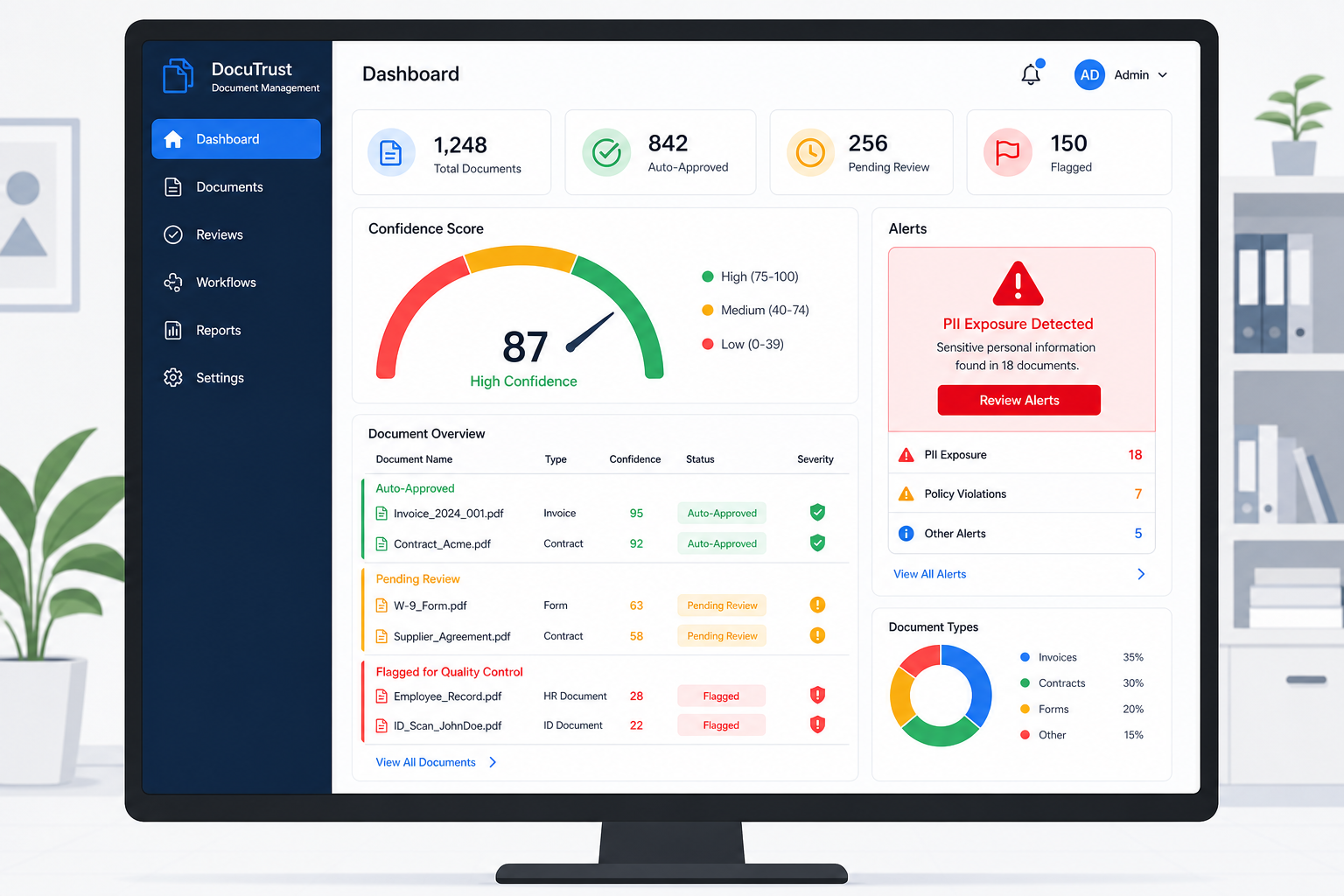
The Cloudbyz AI eTMF Agent's intake dashboard is built around exactly this distinction. Every incoming document is classified with a confidence score, and documents above the platform's approval threshold move to auto-approved status automatically the dashboard tracks how many were auto-approved in a given week alongside an accuracy confirmation rate, so that number isn't just a count, it's a number with a trust level attached to it. Documents that fall below the threshold, along with anything flagged as a QC issue, are routed into a review queue and shown by severity high, medium, or low with the system's own confidence level attached to each one, so a reviewer knows exactly which flagged documents need attention first.
PII exposure gets its own dedicated alert category, separate from general QC issues, because a redaction miss carries different urgency than a misfiled document type. And overall classification accuracy is tracked as a trending metric on the dashboard itself not a one-time claim, but a number the team can watch move over time, which is what actually lets a QA or eTMF Director stand behind the system's output rather than simply hoping it's right.
See the Confidence Scoring in Action
If the honest concern holding your team back from AI-assisted document intake is "how would we know when it's wrong," that's worth seeing answered directly. Book a demo with Cloudbyz team.
Subscribe to our Newsletter
