
Request a demo specialized to your need.
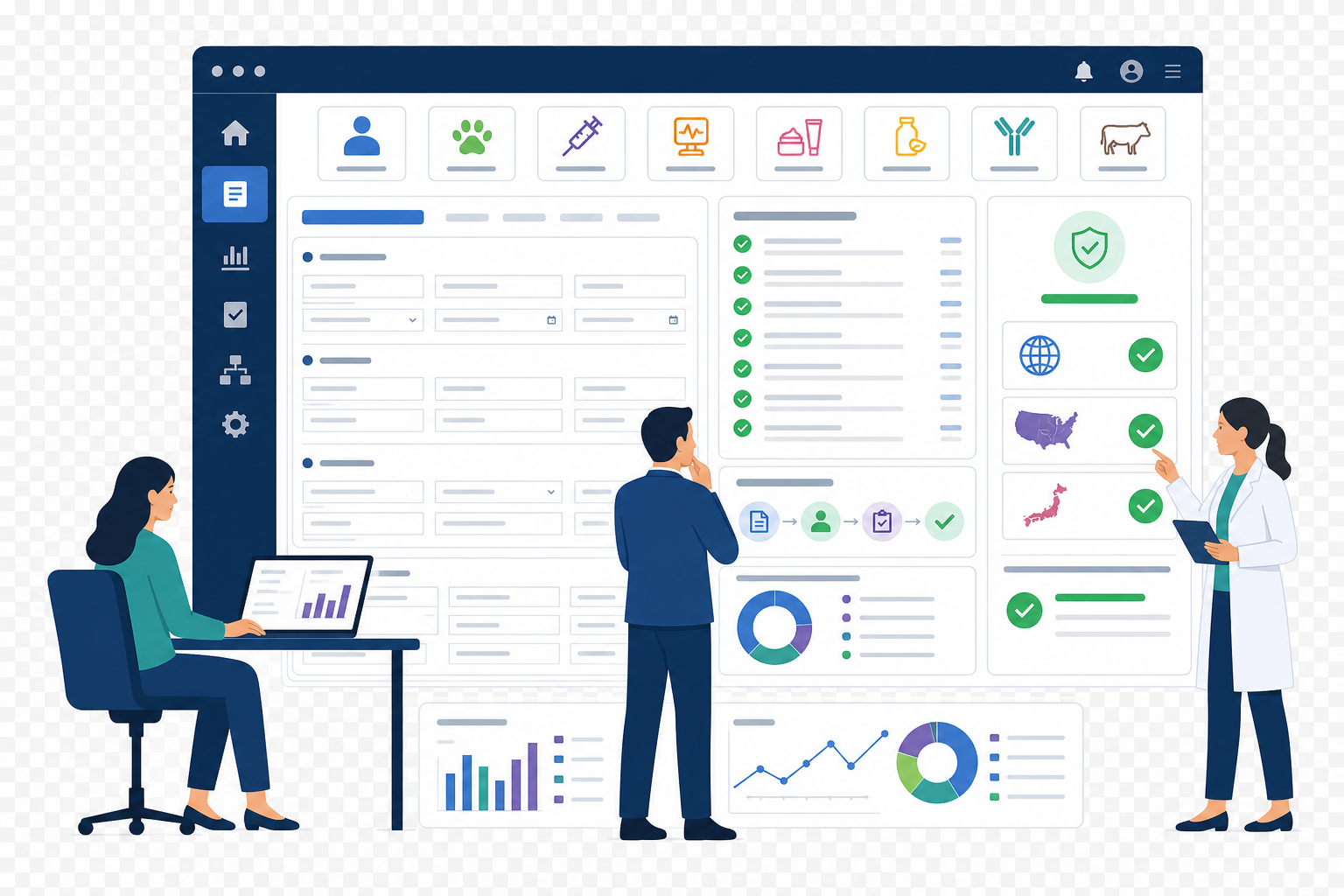
Pharmacovigilance (PV) exists to answer one question, continuously and defensibly: is this product still safe for the patients using it? That question sounds simple. Operationally, it is anything but. Every adverse event report, every literature hit, every aggregate report deadline, and every regulatory inquiry tests whether an organization can capture, assess, and report safety data accurately and on time — across every market where the product is sold.
Many small and mid-sized life sciences companies still run this function on a patchwork of spreadsheets, shared mailboxes, Word templates, and manual tracking logs. It works, in the sense that reports eventually get filed. But "eventually" is not a defense regulators accept, and "it worked last time" is not a substitute for a system that scales. Below is a detailed look at where PV programs break down when they lack dedicated safety software — and why the cracks tend to widen exactly when case volume, product complexity, or regulatory scrutiny increases.
1. Case Intake Is Inconsistent and Easy to Lose
Adverse event reports arrive from everywhere: consumer calls, sales reps, medical information queries, clinical trial sites, social media, literature searches, and regulatory authorities themselves. Without a centralized intake mechanism, each channel tends to develop its own informal process — an inbox here, a spreadsheet there, a folder of scanned faxes somewhere else.
The result is that cases get duplicated, delayed, or simply missed. A report that arrives through a non-standard channel (a customer service email, a comment on a patient support program) may never make it into the safety database at all, because there is no software forcing every intake point to funnel into one queue with a timestamp and an owner.
2. Manual Case Triage and Seriousness Assessment
Once a case is captured, someone has to determine whether it is valid (has an identifiable reporter, patient, suspect product, and event), whether it is serious per ICH E2A criteria, and whether it is expected or unexpected against the reference safety information. Dedicated safety databases encode these decision rules and prompt reviewers with structured fields. Without that structure, triage depends entirely on the individual reviewer's memory of the criteria, applied consistently only as well as their attention allows on a given day.
This matters because seriousness and expectedness determine the reporting clock. Get the classification wrong, and a 15-day expedited report can silently become a 90-day periodic report — a compliance gap that may not surface until an inspection.
3. Regulatory Timelines Tracked by Memory and Spreadsheets
Expedited reporting obligations are unforgiving: 7 calendar days for fatal or life-threatening unexpected serious adverse reactions in many jurisdictions, 15 days for other serious unexpected events, plus a web of country-specific variations for the EU, FDA, PMDA, Health Canada, and other authorities. Each clock starts the moment anyone in the organization becomes aware of the case — not when the safety team gets around to logging it.
Dedicated PV software calculates due dates automatically the instant a case is entered and escalates as deadlines approach. Without it, due-date tracking usually lives in a spreadsheet that someone has to update manually, cross-referenced against a separate list of country-specific rules. It is easy for a single missed row, a broken formula, or a case entered under the wrong "date of awareness" to result in a late submission — which is one of the most common findings in PV inspections.
4. Duplicate Detection Becomes a Manual, Error-Prone Exercise
The same adverse event is often reported multiple times — by the patient, the prescriber, and a sales rep, for instance — and the same case may also appear in literature searches or come back from a regulatory authority. Detecting duplicates without software means relying on manual cross-checks of patient initials, age, event terms, and dates, which is slow and unreliable at any meaningful volume. Duplicate cases inflate signal detection noise and can distort safety profiles; missed duplicates that get reported twice to a health authority create their own compliance headaches.
5. Inconsistent MedDRA Coding
Accurate coding of adverse events to MedDRA preferred terms is foundational to everything downstream — aggregate reporting, signal detection, and cross-product comparability all depend on consistent terminology. Without software that enforces coding standards, version control, and coder-level validation, terms get coded inconsistently across reviewers and over time as MedDRA versions update. A verbatim term like "felt dizzy and passed out" might be coded as one PT by one reviewer and split into two different PTs by another, quietly fragmenting the data used for trend analysis.
6. Signal Detection Is Reactive Instead of Systematic
Modern PV expects proactive signal detection — statistical disproportionality analysis, trend monitoring across the case database, and systematic literature and social media surveillance. This requires a database that can be queried, filtered, and analyzed in aggregate. When case data lives across disconnected spreadsheets and email archives, there is no practical way to run disproportionality analyses or spot an emerging pattern across hundreds or thousands of cases. Signal detection becomes a manual, retrospective exercise — someone noticing a pattern by memory or during a periodic report write-up, well after the signal may have first been detectable.
7. Aggregate Reports Become a Fire Drill
PSURs, PBRERs, and DSURs require pulling every case within a defined reporting interval, reconciling it against the safety database, summarizing cumulative exposure data, and producing a scientifically defensible benefit-risk narrative. Without dedicated software, this becomes a manual reconciliation exercise: exporting scattered case logs, cross-checking against email threads, and rebuilding line listings by hand in the weeks before the deadline. This is labor-intensive, highly susceptible to transcription errors, and creates enormous schedule risk when a single missing case is discovered late in the process.
8. Weak Audit Trails and Data Integrity Gaps
Regulators expect ALCOA+ principles — data that is attributable, legible, contemporaneous, original, and accurate — along with a full audit trail of who changed what, when, and why. Spreadsheets and shared documents typically don't capture this natively; edits overwrite prior values, version history is incomplete, and there is no reliable record of who reviewed or approved a given assessment. In an inspection, the inability to reconstruct a case's history is a direct finding, regardless of whether the underlying safety decision was correct.
9. 21 CFR Part 11 and Electronic Signature Gaps
For companies subject to FDA regulation, electronic records and signatures used in place of paper must meet Part 11 requirements: secure, attributable e-signatures, system validation, and access controls. Generic office tools were not built for this, and organizations relying on them often end up with hybrid paper-and-electronic workarounds — printing forms for wet signatures, then scanning them back in — which adds friction without actually closing the compliance gap.
10. Poor Visibility for Management and QPPVs
Qualified Persons for Pharmacovigilance (QPPVs) and PV leadership need real-time visibility into open cases, upcoming due dates, overdue items, and quality metrics to oversee the system effectively, as required by GVP Module I. Without dashboards or reporting tools, this oversight depends on someone manually compiling status updates — which are stale the moment they're produced and make it very difficult to catch a bottleneck before it becomes a missed deadline.
11. Literature Monitoring Is Labor-Intensive and Incomplete
Ongoing literature surveillance is a regulatory requirement in most major markets, and it needs to be systematic and documented — not an occasional search when someone has time. Manually searching databases like Embase or PubMed, screening abstracts, and tracking which searches were run and when (with no automated recurring search or audit log) is time-consuming and hard to prove was done comprehensively during an inspection.
12. Difficulty Scaling With Product and Market Growth
A spreadsheet-based process might hold up for a single product in a single market with low case volume. It does not hold up as a company adds products, enters new markets with different reporting rules, or scales clinical trial activity. Each new product or geography multiplies the manual reconciliation burden, and the process that "worked" at low volume becomes the primary bottleneck — and risk — at scale. This is often the point at which companies discover, the hard way, that their PV process was never really a system, just a set of habits that depended on a few people remembering everything correctly.
13. Higher Staffing Burden and Burnout Risk
Every manual step — data entry, duplicate checking, deadline tracking, report compilation — consumes analyst time that could otherwise go toward case assessment and signal evaluation, the parts of PV that actually require clinical judgment. Teams without dedicated software often end up hiring for administrative throughput rather than safety expertise, and experienced safety scientists spend a disproportionate share of their time on manual reconciliation rather than analysis. This also raises the risk of fatigue-driven errors precisely in the process — deadline tracking — where an error is most costly.
14. Inspection Readiness Is Always Uncertain
Perhaps the cumulative effect of all the above: when an inspector asks to see the full history of a specific case, the completeness of the case reconciliation process, or evidence that literature monitoring has been continuous, an organization without dedicated safety software often cannot answer quickly or confidently. Reconstructing that evidence from scattered sources under inspection pressure is itself a risk, independent of whether the underlying safety work was actually sound.
The Common Thread
None of these challenges are really about a single missed report or one coding inconsistency. They're about the absence of a system that enforces consistency, calculates deadlines automatically, preserves an auditable history, and makes the full case portfolio queryable and analyzable — rather than relying on individual diligence to hold everything together. As case volume, product count, and market footprint grow, manual processes don't just get harder; they get exponentially riskier, because the probability that something falls through a gap compounds with every additional case, product, and jurisdiction.
Dedicated pharmacovigilance software doesn't eliminate the need for clinical judgment — assessing causality, seriousness, and benefit-risk will always require trained safety scientists. What it does is remove the operational risk that surrounds that judgment: the missed deadline, the duplicate case, the inconsistent coding, the audit trail that can't be reconstructed. That distinction — judgment versus operational risk — is usually where the real cost of "we'll manage it with spreadsheets for now" becomes clear.
Subscribe to our Newsletter
