

Request a demo specialized to your need.
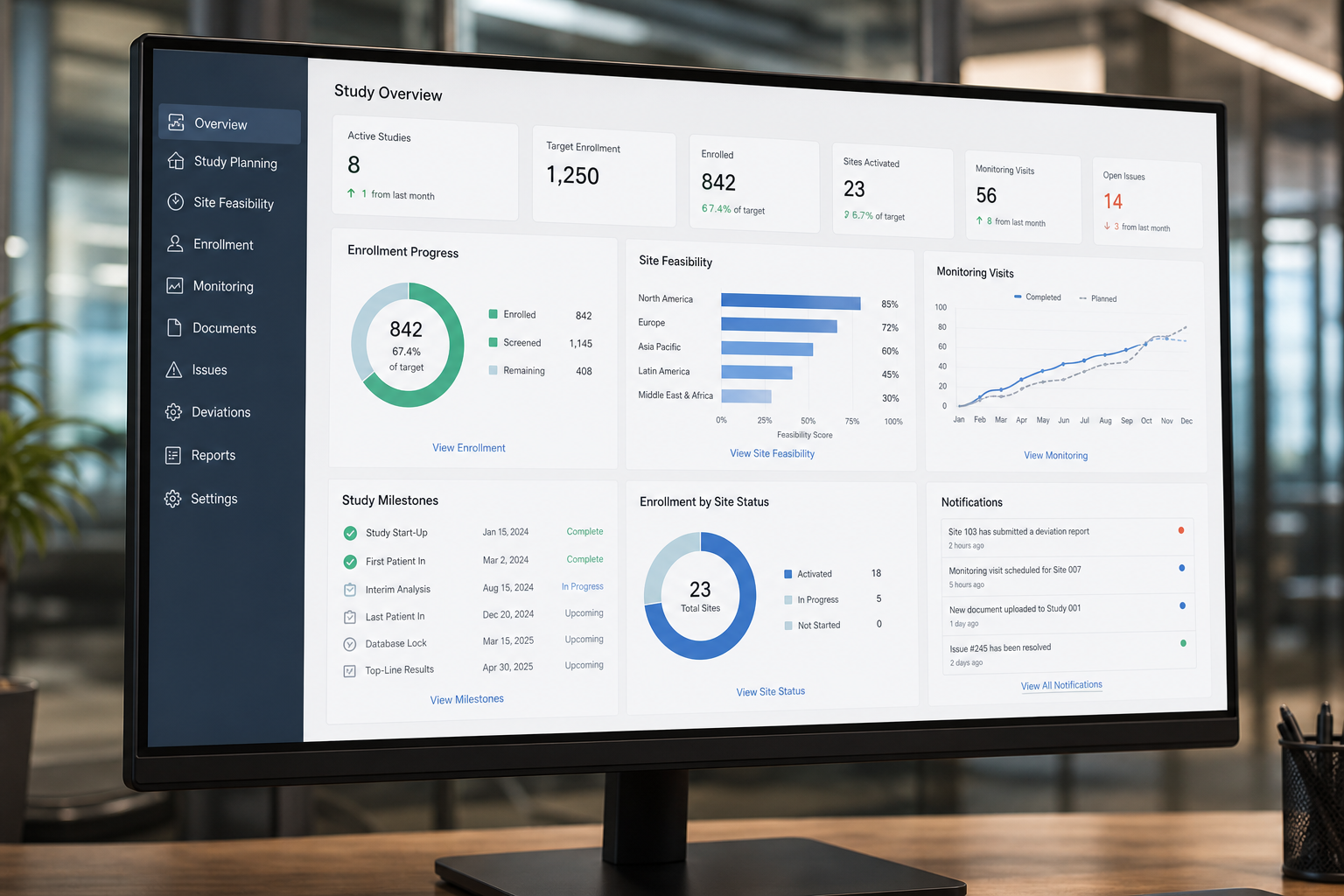
A clinical trial management system (CTMS) is the operational record of a study: which sites are taking part, where each one is in start-up, how enrolment is going, what monitors found at each visit, and what still needs to be done. In a Tufts CSDD study of 257 sponsors and CROs, companies used an average of six applications to support each study (Tufts CSDD via GlobeNewswire). The CTMS is usually the one that ties the operational picture together.
ICH E6(R3) asks sponsors to oversee trials in a way that is proportionate to risk, including activities carried out by service providers (ICH E6(R3), EMA Step 5). Much of the evidence for that oversight lives in the CTMS. Here are the seven functions most CTMS platforms cover.
The seven functions at a glance
|
Function |
What it tracks |
Main users |
|---|---|---|
|
1. Study planning and set-up |
Milestones, visit plans, countries |
Study managers |
|
2. Site feasibility and start-up |
Surveys, selection, contracts, approvals |
Start-up teams, CTMs |
|
3. Enrolment and subject tracking |
Screened, enrolled, completed, withdrawn |
CTMs, CRAs |
|
4. Monitoring |
Visits, reports, follow-up letters |
CRAs, CTMs |
|
5. Issues and deviations |
Findings, actions, protocol deviations |
CRAs, QA |
|
6. Documents and contacts |
Site contacts, essential documents |
CTAs, start-up teams |
|
7. Reporting and oversight |
Dashboards across studies and sites |
ClinOps leaders |
1. Study planning and set-up
The study's countries, planned sites, milestones and visit schedule are set up in the CTMS, giving every later activity a plan to measure against.
2. Site feasibility and start-up
Feasibility surveys, site selection, confidentiality agreements, contracts, ethics approvals and site initiation are tracked site by site, so the team can see which sites are close to activation and what is holding others back.
3. Enrolment and subject tracking
The CTMS shows how many participants each site has screened, enrolled, completed or withdrawn, compared with targets. This is where slow sites show up first.
4. Monitoring
Monitoring visits are scheduled, reported and followed up in the CTMS, including visit reports, follow-up letters and their timelines.
5. Issues and deviations
Findings from monitoring and other sources are logged as issues or protocol deviations, with owners, due dates and resolution, so nothing raised at a visit is lost.
6. Documents and contacts
Site contacts, investigator details and key documents are held against each site, often linked to the eTMF.
7. Reporting and oversight
Dashboards across studies, countries and sites give leaders a view of start-up, enrolment, monitoring and issues. That view is part of the evidence of sponsor oversight.
What a CTMS is not
- Not an EDC. EDC holds participant data from case report forms; the CTMS holds operational data about the study.
- Not an eTMF. The eTMF is the official record of essential documents; the CTMS tracks activities and may link to them.
- Not a finance system on its own. Budgets and payments sit in a financial management tool, which works best when connected to the CTMS.
What this means by role
- New clinical operations staff: the CTMS is where most of your daily tracking will happen.
- CRAs: monitoring visits, reports, letters and action items all live here.
- ClinOps leaders: dashboards across studies are your oversight view.
How Cloudbyz helps
Cloudbyz CTMS, built natively on Salesforce, covers study planning, feasibility and start-up, site and subject management, monitoring, issues and deviations, and dashboards, on the same platform as Cloudbyz eTMF, EDC and CTFM. See how Cloudbyz CTMS works or visit cloudbyz.com.
Subscribe to our Newsletter
