

Request a demo specialized to your need.
The question is no longer whether AI belongs in regulatory submissions. The question is whether the AI your organization is considering can be trusted in a regulated environment.
That is a harder question to answer than it sounds, because the word "trust" in a GxP context means something specific. It means the system has been validated. It means the outputs are traceable. It means the humans using the system remain accountable for the decisions it supports. And it means that when an FDA inspector asks how a specific finding was generated, there is a documented, auditable answer.
This post addresses what sponsors, CROs, and regulatory affairs professionals need to evaluate before deploying AI into the submission process.
The Regulatory Framework for AI in Submissions
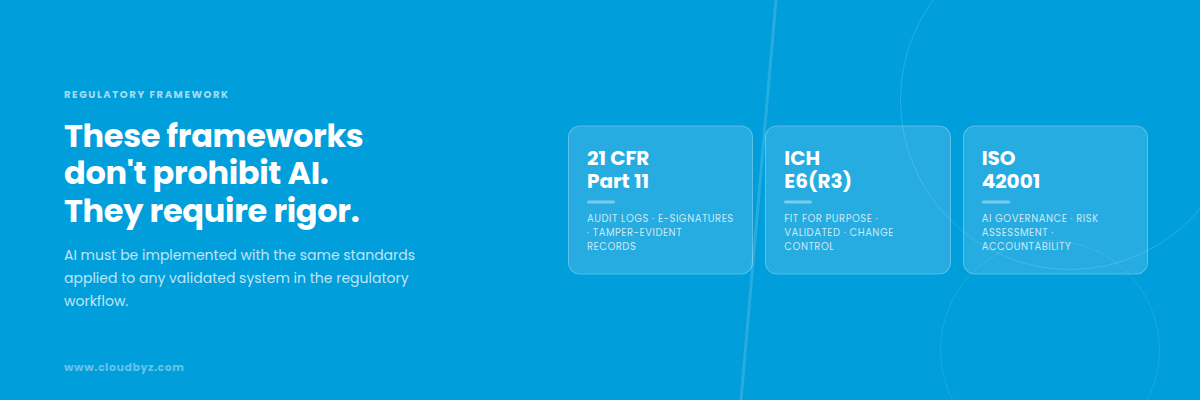
The FDA has been actively developing guidance on AI in regulated contexts, and two frameworks are particularly relevant for submission validation tools.
21 CFR Part 11 governs electronic records and electronic signatures. Any AI system used in the submission process must maintain persistent, tamper-evident audit logs of system actions and reviewer decisions. This is not optional. It is the baseline requirement for any tool that touches a regulatory submission record.
ICH E6(R3) and related GCP guidance establish that technology used in clinical and regulatory workflows must be fit for purpose, validated, and operated in accordance with documented procedures. For AI specifically, this translates to requirements for model documentation, change control procedures, and evidence that the system performs as intended under defined conditions.
ISO 42001, the AI management system standard, is increasingly being referenced as a framework for responsible AI governance in life sciences contexts. It addresses AI risk assessment, monitoring, and accountability structures.
The critical point is that these frameworks do not prohibit AI. They require that AI be implemented with the same rigor applied to any other validated system in the regulatory workflow.
The Four Questions to Ask Any AI Regulatory Tool
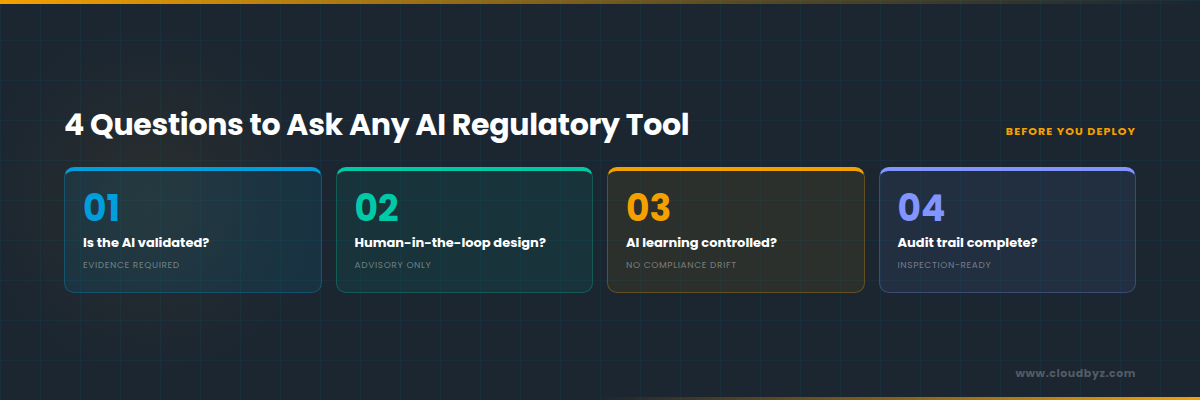
1. Is the AI itself validated, and what is the evidence?
Validation of an AI system in a regulatory context requires more than functional testing. It requires documented evidence that the system produces consistent, accurate outputs within defined operating conditions, that the model's behavior under edge cases has been tested, and that a plan exists for ongoing monitoring and revalidation as the model is updated.
For the Cloudbyz AI RegCheck Agent, validation is currently at approximately 80-90% completion, with work ongoing in areas related to complex document edge cases. A credibility report is available, and the validation team is actively engaged with the in-progress FDA guidance on AI credibility assessment. This is a more transparent answer than many vendors will provide. Any vendor that claims full validation without being able to point to specific evidence of what was tested and under what conditions should be pressed for detail.
2. What is the human-in-the-loop design?
"Human in the loop" is frequently used as a reassurance phrase without much operational specificity. For a submission validation tool, the meaningful question is: at what points in the workflow does a human have to make a decision, and what happens when they do?
For the AI RegCheck Agent, the human is always the final decision-maker. The system generates checklists, maps documents, flags compliance issues, and makes recommendations. It does not submit anything, approve anything, or override a reviewer's judgment without explicit human instruction. When a reviewer overrides a finding or marks something as a false positive, that action is logged, attributed to that specific user, and subject to the access controls defined by the organization.
This design is meaningful because it means the AI is in an advisory role throughout. The regulatory team retains full accountability for the submission.
3. How is AI learning controlled to prevent compliance drift?
Machine learning systems that improve based on user feedback introduce a specific risk: the feedback loop can introduce organizational bias or errors into the model's future behavior. In a regulated context, this needs to be controlled.
The AI RegCheck Agent addresses this through two mechanisms. First, when a user provides feedback, the system determines whether that feedback reflects an organizational workflow preference (stored at the org level, applied to future submissions) or a project-specific decision (stored at the project level, reset for new projects). This prevents local decisions from inadvertently shaping the system's global behavior.
Second, role-based access controls determine who can provide feedback that influences the model. Not every team member can mark a compliance flag as a false positive. Those permissions are configured at the organizational level and are part of the system's accountability structure.
4. What audit trail does the system maintain?
For inspection purposes, the audit trail is the evidence. A system that generates useful outputs but does not document how it generated them is not suitable for regulated use.
The AI RegCheck Agent maintains two parallel audit trails: one for human actions (who uploaded what, who reviewed what, who approved or overrode what, and when) and one for AI outputs (what the model flagged, what it recommended, and what version of the model generated each output). Prompt versioning ensures that the exact state of the model at the time of any given decision can be reconstructed if needed.
PHI checks are built into the document processing layer, relevant for any submission involving patient-level data.
The Pilot Program Approach: Why It Matters
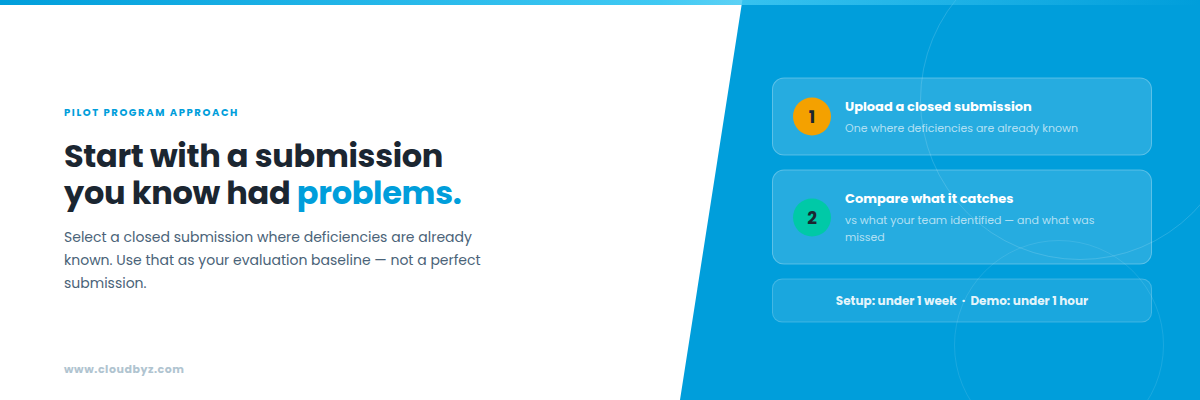
The most practical advice for organizations evaluating AI submission tools is to begin with a historical submission, not a live one.
Select a submission that your team knows had issues. One where you received an FDA deficiency letter, a CRL, or significant internal QC findings. Upload the package into the system. Run the validation. Then evaluate whether the system would have caught the same issues your team eventually identified, and what additional gaps it flags that were not caught.
This approach has several advantages. It is low-risk because the submission is already closed. It gives your team a realistic baseline for evaluating the system's accuracy. And it identifies any configuration or customization work that would be needed before the system is used on active submissions.
The Cloudbyz AI RegCheck Agent can be set up within a week for an out-of-the-box deployment. Organizations with specific configuration requirements typically need two to two and a half weeks from agreement to working system.
What Responsible AI Deployment Looks Like
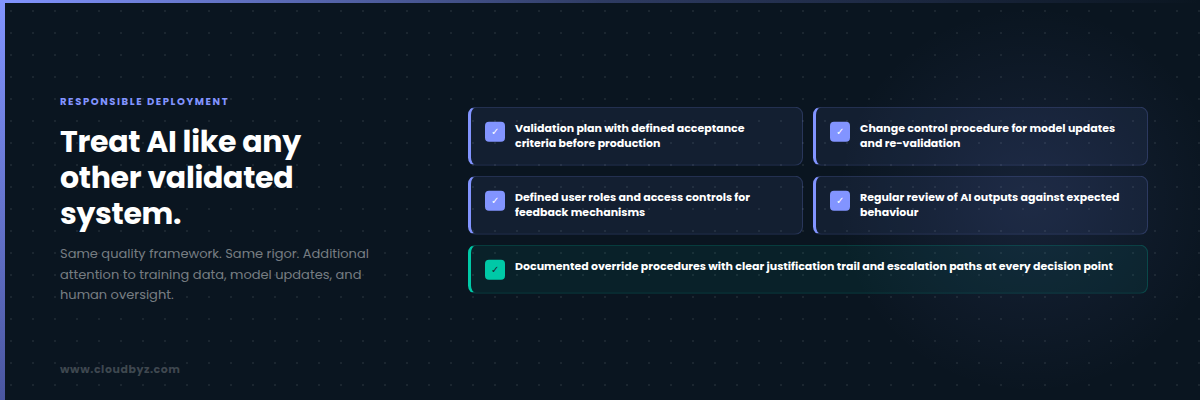
Deploying AI into regulatory workflows responsibly means treating the AI system the way you would treat any other validated system in your quality management framework. That means:
A documented validation plan with defined acceptance criteria before the system is used in production.
A change control procedure for model updates, including testing requirements and re-validation thresholds.
Defined user roles and access controls that determine who can interact with the system's learning mechanisms.
A regular review of AI outputs against expected behavior, with a process for reporting and addressing anomalies.
A plan for what happens when the system flags something unexpected, and clear procedures for overrides, justifications, and escalations.
None of this is unique to AI. It is the same framework applied to any validated system in a regulated environment. What AI adds is the need for additional attention to the training data, the model update cycle, and the human-in-the-loop design.
The Bottom Line
AI can be trusted in regulatory submissions when it is implemented with the rigor that regulated environments require. That rigor includes validation evidence, human oversight at every decision point, controlled learning mechanisms, and auditable records.
The organizations that will benefit most from AI submission tools are the ones that treat AI adoption as a quality management initiative, not just a technology procurement.
To learn more about the Cloudbyz AI RegCheck Agent, the validation approach, and the pilot program process, contact info@cloudbyz.com or visit www.cloudbyz.com. Cloudbyz is ISO 9001 and ISO 27001 certified and fully compliant with FDA 21 CFR Part 11, GCP, and HIPAA.
Subscribe to our Newsletter
