

Request a demo specialized to your need.
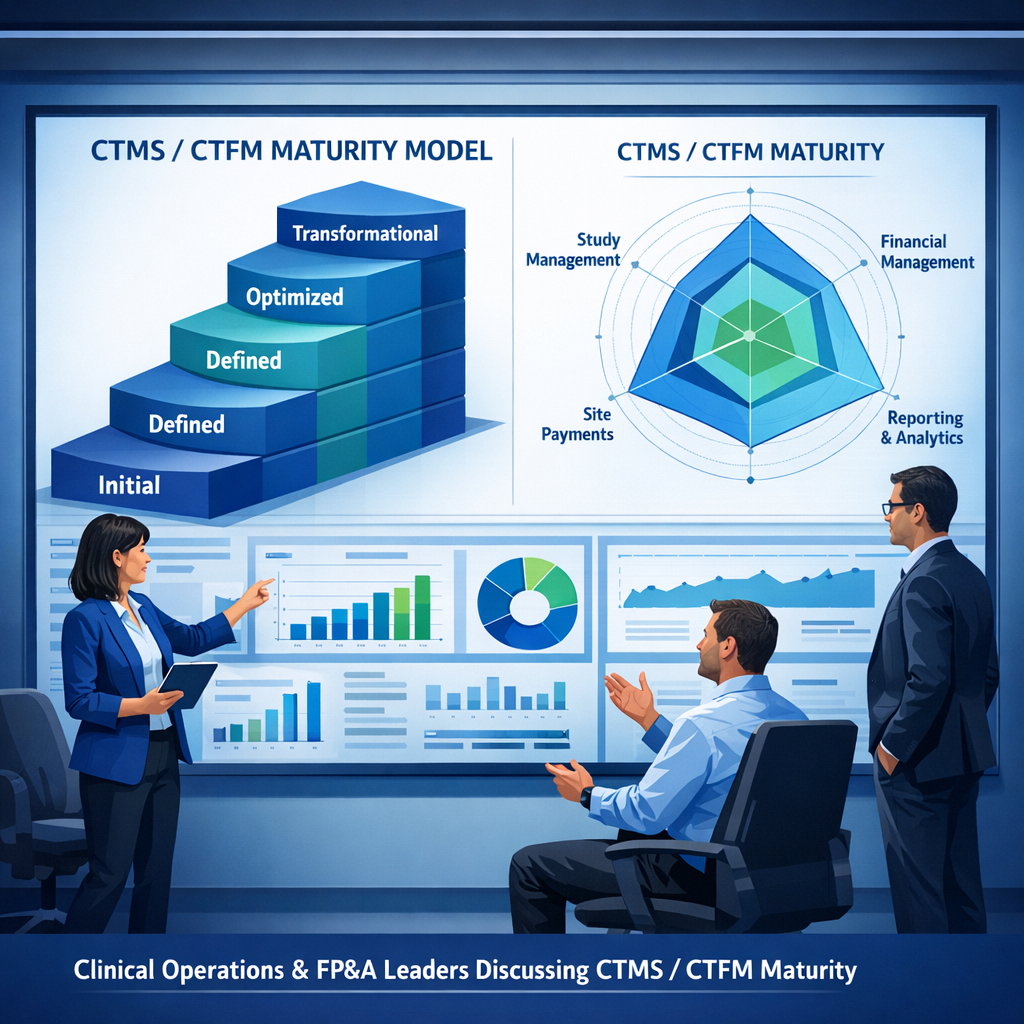
How to apply a CTMS maturity model to strengthen clinical trial financial management on Cloudbyz.
Using Maturity Models to Strengthen CTMS and Clinical Trial Financial Management
The Problem With "Fixing CTMS"
Many sponsors and CROs know their clinical trial financial management is falling short, but struggle to describe the gap in a way that leads to focused action. Teams feel the symptoms: unreliable accruals, opaque site payments, spreadsheet-driven variance explanations. Yet initiatives to "fix CTMS" or "improve reporting" routinely stall because they are too broad and not clearly tied to business value.
A structured maturity model offers a better path forward.
Rather than treating CTMS and Clinical Trial Financial Management (CTFM) capabilities as binary, either you have them or you don't, a maturity model describes how they evolve from ad hoc, manually patched systems into integrated, analytics-ready backbones. Recent work on a Clinical Trials Management Ecosystem (CTME) maturity model, published in the Journal of Clinical and Translational Science, outlines five levels across axes including financial management, reporting analytics and dashboarding, system integration, and organizational culture.
For organizations using Cloudbyz, that framework can be adapted to focus specifically on trial financials:
- Level 1 (Ad Hoc): CTMS and finance tools are fragmented. Visits and milestones are inconsistently coded, site payments and vendor invoices are tracked offline, and there is no reliable bridge from CTMS data to accruals or forecasts.
- Levels 2-3 (Standardized/Integrated): Core processes are standardized and integrated for some portfolios or geographies, but not all. Dashboards exist but rely on manual data preparation. Eligibility rules are documented but not consistently enforced in systems.
- Levels 4-5 (Optimized): Cloudbyz CTMS and CTFM function as a unified, Salesforce-native backbone. Operational events flow cleanly into rate cards and eligibility logic. Financial entries are traceable back to CTMS evidence, and executives rely on a small, trusted set of CTMS-driven financial KPIs.
The power of a maturity lens is that it turns vague dissatisfaction into concrete capability goals. Instead of "we need better reports," teams can say: "We want to move our financial management axis from level 2 to level 3 over the next year by standardizing visit and milestone dictionaries, integrating CTMS and CTFM for pivotal studies, and automating site-payment eligibility." That kind of statement is far easier to fund, sequence, and measure than a generic system upgrade.
Assessing Your Current Maturity
Once leaders understand what maturity looks like, the next challenge is scoring honestly, especially on financial axes where ownership is often scattered across teams. The recommended approach is to assemble a cross-functional group, walk through maturity statements for each axis, and collectively agree on the level that most closely describes the organization, even if reality is uneven.
For financial management and reporting analytics, that exercise can be grounded in five key questions:
1. Data Standardization Are visits, milestones, and vendor services represented consistently in CTMS, or do codes and templates vary by program and region? How often do finance teams need to ask study teams to reconcile what a service description actually means?
2. System Integration Are CTMS events reliably feeding CTFM, and from there the ERP and data warehouse, or are there still manual handoffs and shadow calculations living in spreadsheets?
3. Eligibility Logic Is there a single, documented set of rules in CTFM governing when a visit or milestone becomes payable and accrue-able, or do local teams improvise their own interpretations?
4. Control Evidence When auditors or boards question a number, can teams trace it from the general ledger back through CTFM entries to specific CTMS events and supporting documents, or does the audit trail disappear into email chains?
5. Analytics Do executives and portfolio leaders have access to live dashboards for budget burn, accrual coverage, and site-payment health clearly tied to CTMS data, or do they rely on static decks assembled at quarter-end?
Scoring each dimension honestly often reveals that maturity is uneven. Some programs may run on fully integrated CTMS-CTFM workflows; others still depend on manual trackers. Some geographies may have excellent site-payment transparency; others may obscure problems inside aggregate vendor invoices.
That variability is not a failure. It is a map. The goal is to identify which combinations of trial type, geography, and vendor model already operate at level 3 or 4, and which remain stuck at level 1 or 2. From there, organizations can design targeted improvement waves rather than attempting to "fix CTMS" all at once. For example, a practical 12-month commitment might be: every new pivotal study launches with a standardized CTMS visit and milestone dictionary, a configured CTFM rate card, and a basic suite of CTMS-driven financial dashboards, with legacy studies following in a second wave as templates stabilize.
Turning Maturity Insights Into Investment Decisions
The real payoff from a maturity-based approach comes when it changes how budgets, roadmaps, and governance decisions are made. Instead of debating individual tools or isolated pain points, executives can ask two straightforward questions:
- Which maturity gaps most threaten our ability to run trials safely, efficiently, and credibly?
- Which investments will move those axes fastest at acceptable cost and risk?
Because CTMS and CTFM sit at the center of the trial ecosystem, improvements there tend to cascade. Cleaner data models improve analytics. Tighter integrations reduce manual work and errors. Clearer eligibility logic cuts down on payment exceptions and accrual adjustments. When mapped onto CTME axes, these effects become visible. A single integration project might simultaneously raise maturity on financial management, reporting analytics, and system integration.
Governance routines should reinforce this perspective. A quarterly CTMS-CTFM steering group, staffed by clinical operations, FP&A, data management, quality, and IT, can review maturity scores alongside standard KPI dashboards. For each axis, the group should ask: What changed since last quarter? What evidence supports the new score? What did it cost in time and money? Any proposed project that does not clearly move one or more axes toward level 3 or 4 should be challenged before resources are committed.
Externally, maturity narratives also strengthen relationships with regulators, auditors, and partners. Sponsors who can point to a structured, CTME-based roadmap and demonstrate before-and-after improvements in controls and outcomes are better positioned to defend their operating model under ICH E6(R3) and related expectations. Sites and CROs, meanwhile, can use maturity language to clearly articulate what "good" looks like when negotiating responsibilities and service levels.
Conclusion: Direction and Discipline Over Perfection
Maturity is not about perfection. It is about direction and discipline. No organization will operate every axis at level 5, and attempting to do so would be wasteful. But by using a CTMS maturity model to focus investments where they matter most, financial evidence, analytics, and integration, sponsors and CROs can make steady, explainable progress toward a state where clinical trial financial management is both strategically useful and inspection-ready by design.
The journey from ad hoc to optimized does not happen overnight. But with a shared language for capability levels, honest self-assessment, and governance that rewards measurable progress, it is a journey that can be planned, funded, and actually completed.
Subscribe to our Newsletter
