

Sites aren't drowning in data. They're drowning in interfaces. A headless approach to clinical systems architecture may finally let us redesign the experience without renegotiating the entire technology stack.
Ask a site coordinator what slows them down, and they won't say the protocol. They'll tell you about the passwords. The separate logins. The training module they've completed four times for four different sponsors, covering four subtly different ways to do the same thing. The Monday morning where three systems were offline simultaneously, and no single person knew who to call.
Clinical research has digitised aggressively over the past decade. eCRF replaced paper case report forms. eConsent replaced clipboards. RTSM replaced phone-based randomisation. ePRO replaced printed diaries. Every replacement was, individually, an improvement. Yet collectively, the site experience has become harder, not easier. The problem isn't that any given system is bad. The problem is that there are too many of them, and they were never designed to coexist.
"Our biggest challenge isn't running the study. It's onboarding new staff."
Clinical Research Associate, multi-site CRO
This is the paradox of clinical technology today: maximum investment, minimum coherence. And it is costing the industry in ways that are difficult to measure but impossible to ignore — slower study start-up, higher coordinator turnover, delayed patient visits, and an invisible tax on site bandwidth that compounds across every concurrent study on their portfolio.
The answer, increasingly, lies not in building better point solutions, but in rethinking the architecture that connects them. Specifically, it lies in an approach borrowed from modern software engineering: headless architecture.
What Headless Architecture Actually Means
In conventional software, the front end (what users see and interact with) is tightly coupled to the back end (where data is stored, processed, and transmitted). If you want to change the user interface, you often have to change the underlying system. If you want to connect to a new data source, you may need to rebuild the interface. The two layers are entangled by design.
Headless architecture severs that coupling. The back end becomes a pure engine: it stores data, enforces rules, executes logic, and exposes everything through an API. The front end — the "head" — becomes independent. It consumes the API and presents data however it needs to. You can have many different front ends pointing at the same back end, each tailored to a different context, device, role, or workflow
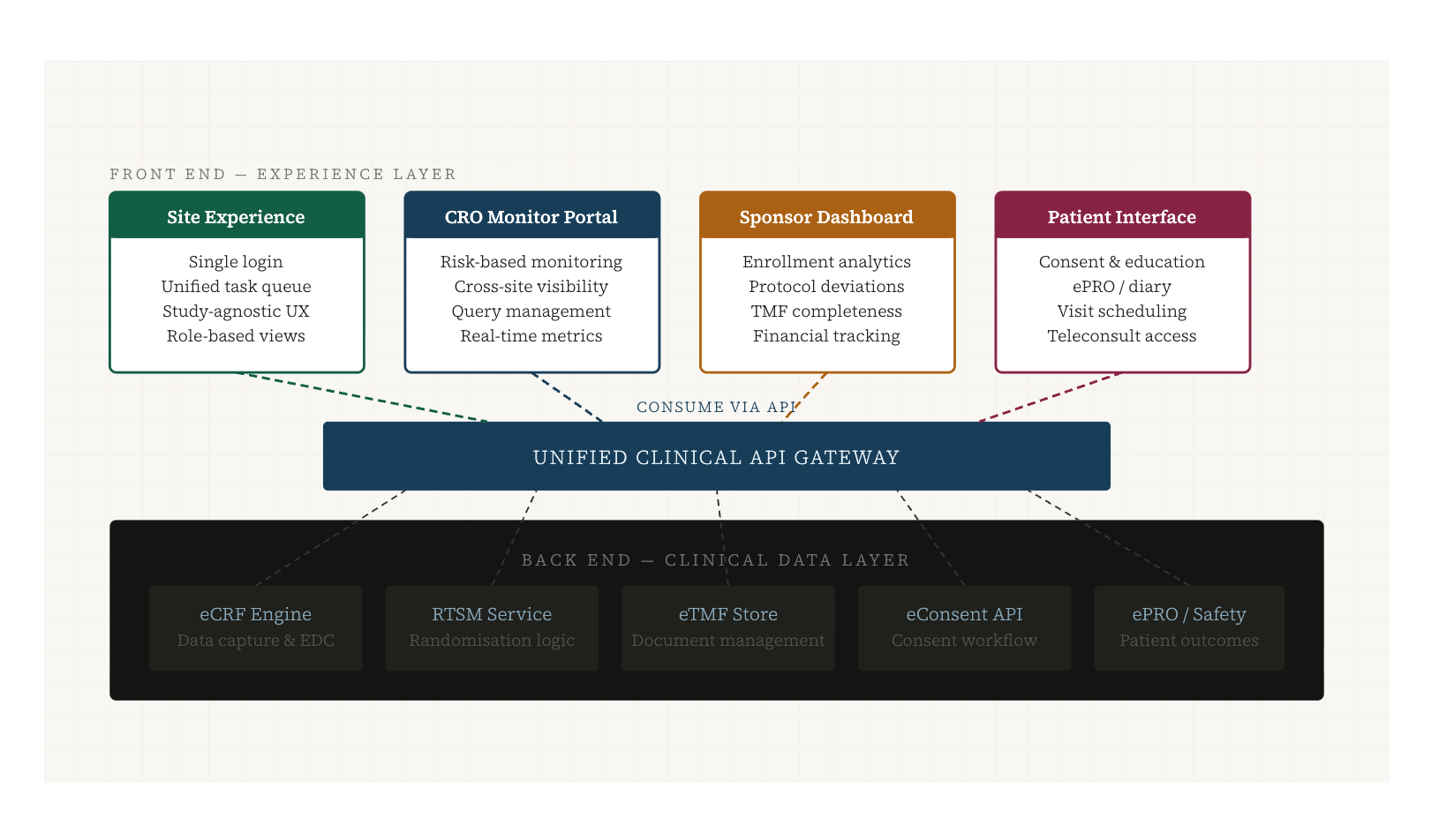
In mainstream technology, headless architecture is now so common as to be unremarkable. E-commerce platforms, content management systems, and financial services all operate this way. A shopper sees a mobile app; an employee sees a warehouse management console; a partner sees an API feed — all reading from and writing to the same product catalogue and inventory system. The data layer is stable, governed, and shared. The experience layer is purpose-built for each user.
Clinical research has not yet made this transition. Most eClinical systems still bundle their presentation layer with their data layer, which means every change to the user experience requires negotiating with the underlying system's vendor, timeline, and roadmap. Sites are left experiencing whatever the vendor designed — even when that experience was designed for a different kind of user, a different workflow, or a different era.
The Site Burden Problem, Restated in Architecture Terms
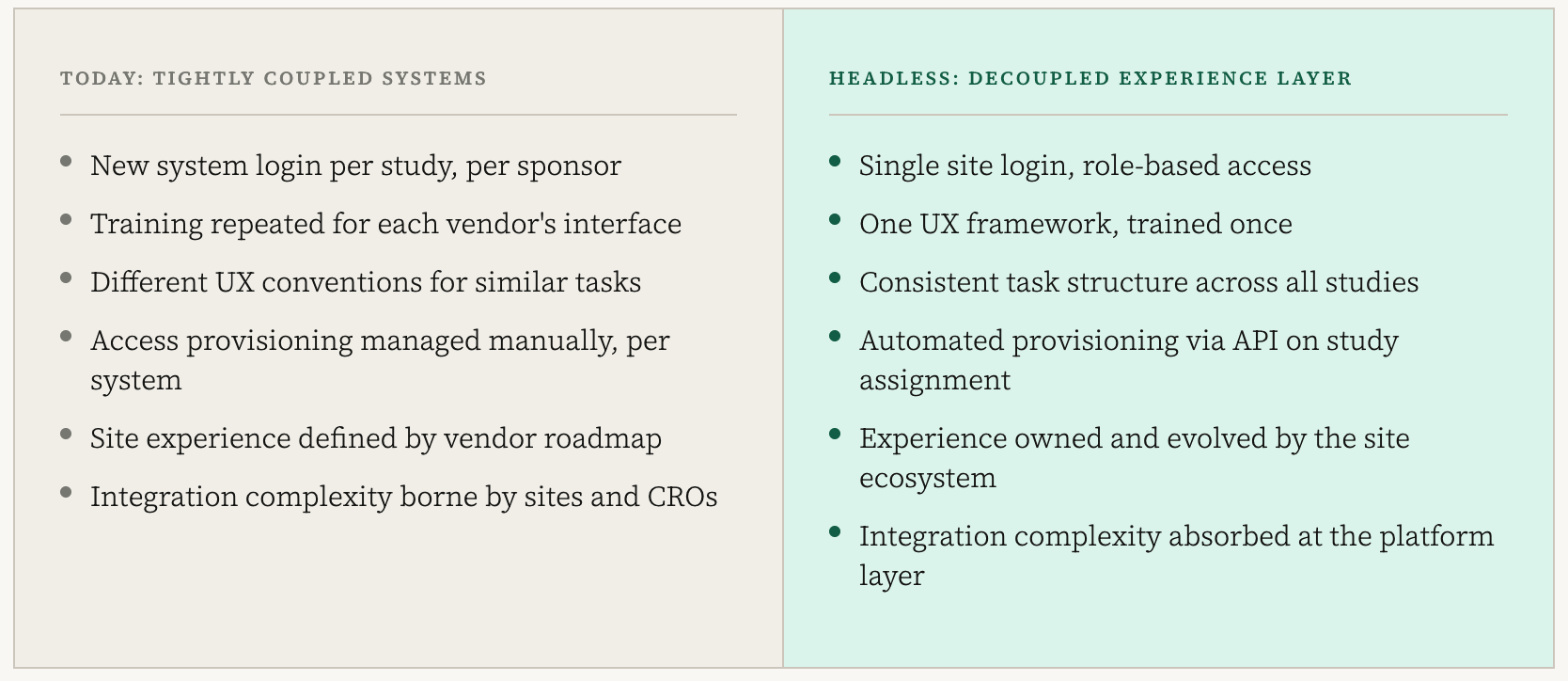
When a site runs multiple concurrent studies, each with its own eCRF, RTSM, and eConsent system, they are not simply juggling multiple tools. They are navigating multiple front-end design philosophies, each tightly coupled to its own back end, each requiring separate authentication, separate training, and separate mental models for what are often near-identical tasks.
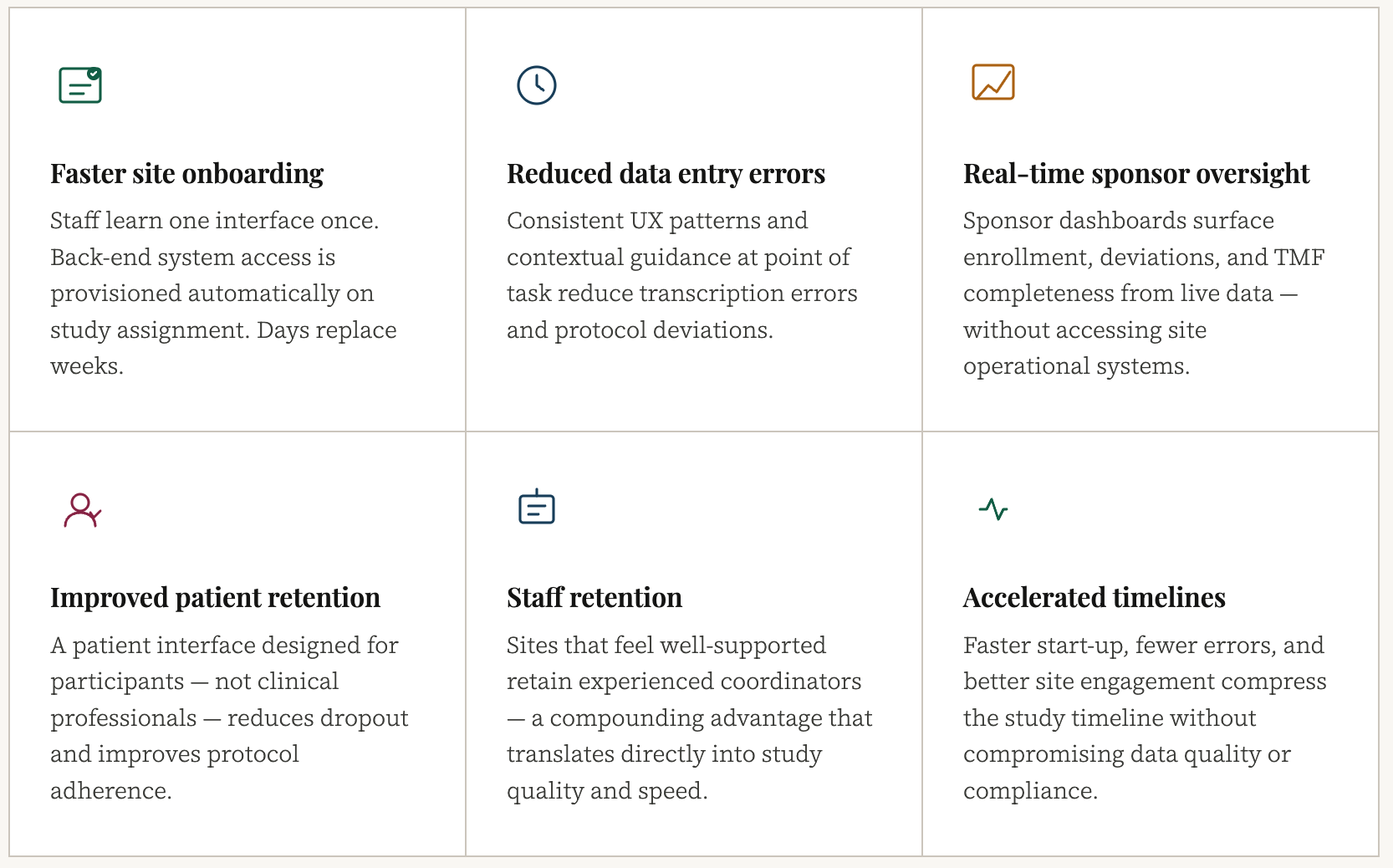
The eCRF from Sponsor A and the eCRF from Sponsor B both capture the same kind of structured patient data. The difference is entirely presentational: different field names, different screen layouts, different submission workflows, different error messaging styles. The coordinator must mentally switch between these interfaces dozens of times per day. Across a full study portfolio, this adds up to an enormous, invisible cognitive load that no study management software has ever tried to address — because each vendor only sees their own system.
Sites don't need thirty systems to do thirty things. They need one coherent experience that can orchestrate thirty things. Headless architecture is how you build the latter while preserving the former.
Headless architecture reframes this problem. If the data layer for each system exposes a well-defined API, a site-facing front end can be built independently — one that works the same way regardless of which sponsor's eCRF system is powering it underneath. The coordinator logs in once, sees one task list, interacts with one design language, and submits data to whichever back-end system is appropriate for that study — without ever seeing that system directly.
How Decoupling Transforms Site Operations
Universal onboarding, once
One of the most underestimated costs in clinical research is onboarding. When every study brings a new set of systems, every new coordinator requires a fresh round of access requests, approval cycles, and training completions before they can contribute meaningfully. In a headless model, onboarding is to the unified front end — once. Back-end system access can be provisioned automatically when a coordinator is assigned to a study, without the coordinator needing to understand or interact with the underlying system at all. Onboarding time compresses from weeks to days.
Consistent task structure, variable data
The paradox of clinical data is that it is endlessly variable at the protocol level but highly consistent at the task level. Entering a vital sign is conceptually the same task in an oncology study and a rare disease study, even if the fields differ. Completing a consent conversation follows the same ethical and procedural logic regardless of which eConsent platform is licensed for that study. A headless site layer can standardise task structure — how a coordinator navigates to a task, how progress is tracked, how errors are surfaced — while passing the protocol-specific data requirements through from whichever back-end system is authoritative for that study.
Role-aware, study-aware interfaces without reconfiguration
Coordinators, investigators, regulatory staff, and pharmacists at the same site have meaningfully different information needs. In a tightly coupled model, these users often share the same interface with visibility toggled on and off — a clumsy compromise that serves no one well. A headless architecture allows genuinely distinct interfaces to be designed for each role, all reading from the same underlying data layer. An investigator sees the clinical decision-relevant information front and centre. A coordinator sees the workflow task queue. A regulatory affairs manager sees the document completion status across studies. Each is a different front end; all are powered by the same APIs.
Reframing the Sponsor-CRO-Site Relationship
Clinical research operates through a tripartite relationship: sponsors fund and design studies, CROs execute them, and sites deliver them. Each party has different information needs, different governance obligations, and different risk tolerances. Yet the technology stack has historically been designed primarily from the sponsor's perspective, with site and CRO interfaces treated as downstream consumers of systems chosen for regulatory, compliance, or enterprise procurement reasons.
Headless architecture inverts this, not by removing sponsor control over data, but by allowing each party to interact with that data through an interface designed for their context.
Sponsor layer: governance and oversight without micromanagement
A sponsor's legitimate interest in their clinical data is essentially supervisory: they need to know that data is complete, accurate, and audit-ready; that the protocol is being followed; that risks are identified and managed; and that the study is on track to meet its timeline and budget objectives. They do not need to dictate the pixel-level experience through which a coordinator enters a blood pressure reading.
In a headless model, sponsors access a dashboard built for oversight — enrollment trends, protocol deviation tracking, TMF completeness scores, financial burn against milestone payments. This view is powered by the same underlying data that coordinators are entering, but presented in the language of program governance rather than operational task management. Sponsors gain genuine insight without imposing their UX preferences on sites.
CRO layer: monitoring as a service, not a system
CROs occupy a unique position in this architecture because their work spans both the site and the sponsor. Risk-based monitoring requires CRAs to understand what is happening at sites in real time, identify data anomalies early, and communicate efficiently with coordinators on queries. In a tightly coupled system, CRAs often must access the same interface as site staff — an imperfect fit, because their workflow is fundamentally different. They are reviewing, querying, and summarising across many sites, not entering data at a single one.
A headless CRO layer provides a cross-site monitoring view: query status, data completeness heat maps, risk signal triggers, and site performance analytics. Crucially, it enables CRAs to raise queries and communicate with sites through the unified site interface, rather than through separate email threads or the comment fields buried inside individual eCRF systems. The entire monitoring workflow becomes coherent and traceable.
Site layer: the experience that earns site loyalty
Sites are the most under-served constituency in clinical research technology — and the most consequential. A site that feels overwhelmed by technology burden will deprioritise studies, restrict enrollment, and eventually decline to participate. A site that feels well-supported will invest in building research capabilities, train staff to higher competency levels, and actively seek study opportunities.
The site layer in a headless architecture is where the industry can most dramatically improve the research experience. It should present a unified task queue that aggregates obligations across all active studies. It should provide contextual guidance — not as a separate training module, but inline at the point of task execution. It should surface the right information at the right time: upcoming patient visits, outstanding queries, documents awaiting signature, expiring staff certifications. And it should do all of this without requiring the site to understand or manage the back-end systems that are fulfilling each request.
Designing for the Patient in a Headless Model
The patient experience in clinical research has historically been an afterthought, bolted onto the edge of systems designed primarily for clinical and regulatory professionals. eConsent platforms often look and read like legal documents reformatted for screens. ePRO applications require patients to download and learn yet another app. Visit scheduling is managed through phone calls or email, outside the clinical systems entirely.
A headless architecture creates the structural conditions for this to change. When patient-facing interactions are delivered through an independent front end — one that consumes the same back-end clinical APIs as the site, CRO, and sponsor layers — they can be designed from first principles around the patient experience without any compromise imposed by clinical data management requirements.
Consent as a journey, not a form
When the eConsent back-end exposes its requirements through an API, the patient-facing front end can present them as an interactive educational journey — multimedia content, comprehension checks, the ability to ask questions asynchronously — rather than as a scrollable legal document with a signature field at the bottom.
ePRO integrated into daily life
When ePRO data collection is decoupled from a specific vendor's app, it can be delivered through channels that patients already use: a web-based interface optimised for mobile, a wearable integration, or a messaging-based diary. The back end receives structured data regardless of which front end the patient used to provide it.
Visit management as a participant service
A patient-facing layer can surface upcoming visits, travel logistics, reimbursement status, and study communications in one place — the information that currently arrives through a patchwork of phone calls, letters, and disconnected apps. Patients see themselves as participants in a managed process, not as passive subjects of a system they can't see.
Decentralised without fragmentation
Decentralised and hybrid trials require patients to interact with clinical research outside a traditional site visit. In a headless model, this is an architectural feature rather than a special-case integration: the same back-end APIs that power in-clinic data collection can power remote data collection through a patient app, a telemedicine interface, or an at-home monitoring device, all captured within the same data structure.
The Architecture in Practice: Five Design Principles
For clinical technology builders and platforms thinking about a headless transition, the principles below provide a practical foundation.
| Layer | Design Principle | What It Enables | Type |
|---|---|---|---|
| API Gateway | Single authentication, federated authorisation. One identity, scoped permissions per study and role. | Eliminates multiple logins; access provisioning can be automated on study assignment. | API |
| Data Services | Each clinical system (eCRF, RTSM, eTMF, etc.) exposes a standards-aligned API. CDISC, HL7 FHIR, and 21 CFR Part 11 compliance enforced at the service layer. | Front-end changes do not affect regulatory compliance. New front ends can be added without renegotiating data governance. | Data |
| Site Front End | Designed around task completion, not data entry. Unified task queue across all active studies. Contextual guidance at the point of action. | Reduces cognitive load, accelerates onboarding, improves coordinator retention. | UX |
| Monitoring Layer | Cross-study, cross-site visibility for CRAs. Risk signals surfaced algorithmically. Query workflow integrated with site task queue. | Risk-based monitoring becomes genuinely operational, not just a compliance framework label. | UX |
| Patient Interface | Channel-agnostic patient engagement. Consent, ePRO, scheduling, and communications through a unified patient account, accessible across devices. | Improves retention, reduces missed visits, enables true decentralised participation. | UX |
The Platform Opportunity
For eClinical platform vendors, the headless model is not just an architectural upgrade — it is a competitive repositioning. The vendors who thrive in the next decade will not be those with the best individual point solution. They will be those who build the platform layer — the unified API gateway and site experience layer — that connects the ecosystem rather than competing within it.
This is a different kind of competitive moat. It is not built on feature differentiation within a category; it is built on ecosystem integration across categories. A platform that sites trust because it genuinely reduces their burden, and that sponsors and CROs rely on for cross-stakeholder visibility, becomes embedded in the operational fabric of clinical research in a way that no single application can.
"The vendors who thrive in the next decade will be those who build the platform layer that connects the ecosystem — not those competing within it."
Critically, this model does not require displacing existing systems. A sponsor with a long-standing EDC relationship, a CRO with a preferred RTSM provider, and a site with an existing EHR does not need to rip and replace anything. The headless layer sits above these systems, consuming their APIs and presenting a coherent experience to each user type. Vendor relationships are preserved; site experience is transformed.
From Technology Problem to Experience Problem — Solved
The CRA who observed that their biggest challenge was onboarding new staff was not asking for a better RTSM or a redesigned eCRF. They were describing a systemic failure of coordination: a technology environment where every system optimises for itself and no system optimises for the people navigating all of them together.
Headless architecture does not fix any individual system. It fixes the relationship between systems. It places the experience layer — the actual reality of working in clinical research — under intentional design, rather than leaving it as the residual output of a dozen independent vendor decisions.
The clinical research industry has been solving for the wrong variable. We have optimised individual systems when the constraint was always the space between them. Headless architecture doesn't ask sponsors to give up their preferred EDC, CROs to change their monitoring platform, or sites to learn a new database. It asks the industry to separate a question that has always been conflated: what data needs to be captured and validated, and how should the humans capturing and using that data actually experience the process.
Those are different questions. They deserve different answers. The technology to answer them separately — cleanly, compliantly, and at scale — already exists. What the industry needs now is the architecture to deploy it.
Sites get time back to focus on patients, not passwords. That, ultimately, is what the shift is for.
Cloudbyz eClinical
Unified eClinical Platform · CTMS · eTMF · Clinical Trial Financial Management · AI eTMF Agent Built on Salesforce · cloudbyz.com
