

Request a demo specialized to your need.
There is a moment every RA professional knows well. It is 11:00 PM, three weeks before a regulatory inspection, and you are staring at a filing queue of 4,200 unclassified documents that arrived from five investigative sites across three continents. Your team has been on back-to-back calls for two days. The TMF Reference Model has 320+ artifact types. Your QC checklist runs to 47 line items. And somewhere in that queue, there is almost certainly a document that contains an unredacted patient identifier.
I lived that moment more times than I care to count. So when I first heard about AI-powered eTMF agents capable of automatic classification, metadata extraction, PHI detection and redaction, and quality control, my instinct was skepticism. RA professionals are trained skeptics it is practically a job requirement.
But after seeing the data, and watching the technology work in practice, I am no longer skeptical. I am a convert. And I want to explain exactly why.
The Scale of the Problem Most Sponsors Do Not Fully Appreciate
Let me start with numbers, because this conversation is often too abstract.
A mid-size Phase III global study generating data across 50 to 80 investigative sites will accumulate between 15,000 and 25,000 TMF documents over its lifecycle. A large multi-regional Phase III program can exceed 60,000 documents before database lock. At a CRO managing a portfolio of 20 to 30 active studies simultaneously, the aggregate document volume handled by the TMF operations team at any given time routinely exceeds 500,000 documents.
Each document requires a human being to:
- Review it, understand its content, and apply the correct TMF Reference Model artifact classification
- Extract and verify metadata: study ID, site number, country, investigator name, document date, version number, language, and document status
- Confirm that the document does not contain protected health information in unauthorized locations
- Verify completeness against expected artifacts for that study zone and section
- Log QC findings, track resolutions, and update inspection readiness metrics
In a well-resourced TMF operations function, a trained specialist can process approximately 40 to 60 documents per hour for routine artifacts -- IND safety reports, monitoring visit reports, IRB approvals under normal conditions. For complex artifacts requiring cross-reference or site-specific validation, that rate drops to 15 to 25 documents per hour.
Run the math. A team of eight TMF specialists working full-time across a 30-study portfolio spends an estimated 60 to 70 percent of productive hours on document intake, classification, and QC tasks that are fundamentally mechanical. The remaining 30 to 40 percent is where the actual regulatory judgment lives: completeness assessment, gap analysis, inspection readiness review, responding to health authority questions.
That inversion is the problem. We have been using highly trained regulatory professionals as document sorting machines.
What Breaks When Volume Overwhelms Capacity
The consequences of this imbalance are not theoretical. They show up in inspection observations and audit findings with painful regularity.
Classification errors accumulate silently. When a specialist is processing 500 documents in a single shift not an uncommon scenario during study close-out error rates climb. Studies examining manual document processing in regulated environments consistently report classification error rates of 8 to 15 percent under high-volume conditions, compared to 2 to 4 percent under normal workloads. In a study with 20,000 documents, a 10 percent error rate means 2,000 misclassified artifacts. Each one is a potential inspection finding.
Metadata inconsistency creates retrieval failures. An investigator listed as "Dr. J. Smith" in one document, "John Smith" in another, and "Smith, John A." in a third is not a trivial problem. During an FDA inspection, document retrieval requests are time-sensitive. A metadata inconsistency that prevents a document from surfacing in a site-specific query can look, to an inspector, like a missing document which is a materially different and far more serious finding.
PHI exposure is an underreported risk. Source documents, patient diaries, adverse event narratives, and even certain monitoring reports regularly arrive in the eTMF with patient identifiers intact. In a high-volume environment, the likelihood that at least one document with unredacted PHI reaches the repository without detection is not low -- it is near-certain over the lifecycle of a large program. The regulatory and reputational consequences of a PHI breach in a clinical document repository are severe, and the risk is largely invisible until it materializes.
Inspection readiness scores lag reality. Most eTMF platforms calculate completeness metrics based on expected versus filed artifact counts. But a "filed" artifact that is misclassified, misdated, or missing a required metadata field is not actually in good order it simply appears to be. I have walked into pre-inspection readiness reviews with headline completeness scores above 90 percent, only to discover through manual sampling that 20 to 30 percent of filed documents had at least one metadata error that would require remediation under inspector scrutiny.
What an AI eTMF Agent Actually Does And Why It Changes the Equation
The best way to understand the value of an AI eTMF agent is to walk through the document lifecycle with it applied.
Automatic Classification at Intake
A document arrives in the eTMF inbox a scanned IRB approval letter from a site in Germany, written in German, with a cover email from the local coordinator. In a manual workflow, a specialist opens the document, reads enough to identify it, selects the correct TMF Reference Model zone, section, and artifact, and moves to the next file.
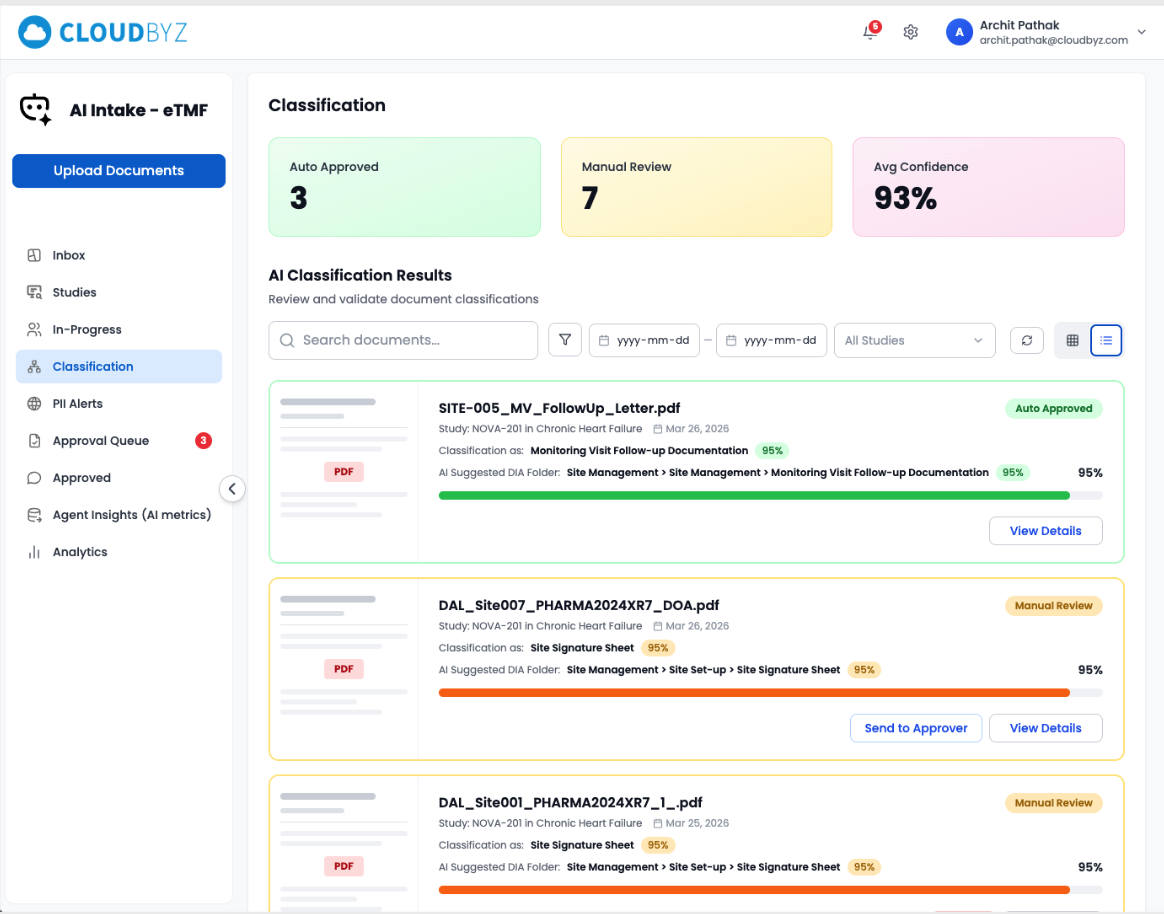
An AI eTMF agent reads the document, identifies it as a Zone 05 / Section 05.1 / Artifact 05.1.01 (IRB/IEC Opinion) based on content, structure, language patterns, and regulatory context -- and applies the classification in seconds, with a confidence score. Documents above a defined confidence threshold are classified and routed automatically. Documents below threshold are flagged for human review with a suggested classification pre-populated.
In production deployments, AI classification accuracy for standard artifact types runs at 93 to 97 percent well above the human accuracy rate under high-volume conditions, and consistent regardless of document volume or time of day.
Metadata Extraction and Normalization
The same AI agent reads the document and extracts structured metadata: site ID, country, IRB name, approval date, expiry date, protocol version covered, and investigator name. Critically, it normalizes this metadata against the study master data reconciling "Dr. Johann Weber" against the site contact record to confirm the match and apply a consistent name string across all documents from that site.
This alone eliminates one of the most persistent sources of inspection risk: the metadata drift that accumulates across thousands of documents submitted by dozens of sites over years.
PHI Detection and Redaction Alerts
Before a document is filed, the AI agent scans for PHI signatures: patient names, dates of birth, addresses, national identification numbers, and other identifiers defined by HIPAA, GDPR, and applicable local regulations. When PHI is detected, the document is quarantined and a redaction alert is generated, with the specific PHI instances highlighted for the document owner to resolve before filing.
In studies where this capability has been deployed, the detected PHI rate at intake has ranged from 1.5 to 4 percent of incoming documents higher than most sponsors estimate, and a meaningful reduction in breach exposure when caught at the gate rather than after filing.
Automated QC Against TMF Reference Model Rules
Post-classification, the AI agent runs a structured QC pass against a rule set aligned to the TMF Reference Model and sponsor-defined business rules: Is the document the correct file type? Does the version number align with the protocol amendment timeline? Is the site activation date consistent with the date range on this monitoring report? Are all required metadata fields populated and internally consistent?
QC findings are generated, categorized by severity, and assigned for resolution without a human specialist having to design and execute the QC pass manually.
The compound effect is significant. Teams that have deployed AI eTMF agents report that automated QC catches 80 to 90 percent of the finding categories that previously required manual sampling to surface.
The Human Effort Transformation: What the Data Shows
Organizations that have implemented AI eTMF agents consistently report a similar pattern of operational change:
Document intake and classification time: Reduced by 70 to 80 percent. What took a 10-person team working a full sprint now requires a 2-person oversight team monitoring the automated pipeline.
Metadata remediation effort at close-out: Reduced by 60 to 75 percent. The most expensive and time-pressured phase of eTMF management the pre-inspection or pre-lock reconciliation is dramatically compressed because metadata errors are caught and corrected at intake rather than discovered in bulk at the end.
Inspection readiness score accuracy: Improved from headline completeness metrics to document-level quality-verified completeness, meaning the score reported actually reflects what an inspector would find rather than what the filing system counts.
Time to inspection-ready state: Reduced from a typical 8 to 12 week pre-inspection mobilization to a continuous readiness posture, where the eTMF is inspection-ready at all times rather than prepared in response to an inspection notification.
PHI breach incidents: Organizations report a reduction to near-zero for documents entering through the AI-monitored intake pipeline, compared to industry baseline estimates of 2 to 5 PHI exposure incidents per 10,000 documents filed manually.
What This Means for Regulatory Affairs as a Profession
I want to be direct about something that sometimes makes RA professionals uncomfortable: this technology is not a threat to the profession. It is a restoration of it.
The regulatory affairs function exists to protect the integrity of clinical evidence and to ensure that health authorities can trust the data submitted in support of product approvals. That requires judgment about completeness, about the meaning of gaps, about the regulatory significance of discrepancies, about how to communicate risk to sponsors and to health authorities.
None of that judgment is automated by an AI eTMF agent. What is automated is the mechanical processing layer that has consumed the majority of RA operational bandwidth for the past two decades. When a TMF operations team is no longer spending 60 to 70 percent of its time sorting and classifying documents, it can spend that time doing what it was actually trained to do: strategic gap analysis, risk-based inspection preparation, proactive communication with site teams about quality issues, and thoughtful engagement with the regulatory record as a coherent body of evidence rather than a filing backlog.
The best outcome I have seen from AI eTMF deployment is not the efficiency metric. It is the moment when a regulatory team for the first time in most of their careers -- actually has enough headroom to read the TMF proactively, understand it deeply, and catch a meaningful clinical risk while there is still time to address it.
That is what regulatory affairs is supposed to be.
How Cloudbyz AI eTMF Agent Delivers This in Practice
When I evaluated AI eTMF solutions, the Cloudbyz AI eTMF Agent stood out as one of the few purpose-built implementations that addresses the full operational lifecycle -- not just document intake, but the entire quality continuum from filing through inspection readiness.
Built natively on the Salesforce platform, which already underpins many sponsor and CRO quality and regulatory workflows, the Cloudbyz AI eTMF Agent brings several capabilities that directly map to the pain points described above.
Intelligent Document Classification aligned to TMF Reference Model. The Cloudbyz agent classifies incoming documents against the DIA TMF Reference Model artifact taxonomy using a combination of large language model reasoning and domain-specific training on clinical trial documentation. It handles multi-language documents, scanned PDFs, and complex compound documents -- the kinds of edge cases that break simpler rule-based systems. Confidence scoring drives automatic filing for high-certainty classifications and intelligent escalation queues for specialist review, keeping the human effort focused where it matters.
Automated Metadata Extraction and Validation. The agent extracts structured metadata -- study, site, country, investigator, document date, version, and artifact-specific fields -- and validates it against the study master data in real time. Cross-field consistency checks catch the date mismatches, name variations, and version conflicts that silently accumulate into inspection risk. For organizations managing multi-study portfolios, this normalization layer alone eliminates hundreds of hours of pre-inspection remediation.
PHI Detection and Redaction Workflow. The Cloudbyz AI eTMF Agent scans every inbound document for PHI signatures prior to filing, covering identifiers defined under HIPAA, GDPR, and applicable country-specific data privacy frameworks. Detected PHI triggers an automated quarantine and a structured redaction alert routed to the document owner -- with the specific flagged content highlighted for efficient resolution. The full detection and resolution workflow is audit-trailed and 21 CFR Part 11-compliant, which matters when health authorities ask how you managed patient data integrity in the trial master file.
Automated QC and Continuous Inspection Readiness. Rather than relying on periodic manual QC sweeps, the Cloudbyz agent runs continuous, rules-based quality checks against every filed document -- validating completeness, consistency, and compliance against sponsor-defined business rules and TMF Reference Model expectations. QC findings are categorized by severity and routed for resolution in real time, so the inspection readiness score at any given moment reflects actual document quality, not just filing volume. For CROs and sponsors under pressure to demonstrate continuous inspection readiness to health authorities and clients alike, this shift from reactive QC to continuous quality monitoring is operationally transformative.
No Rip and Replace: Cloudbyz AI eTMF Agent as a Platform-Agnostic Intelligence Layer
One of the most significant practical barriers to AI adoption in regulated document environments has been the assumption that deploying an AI capability requires migrating to a new system. For organizations with established eTMF platforms, validated workflows, and years of historical document data, that assumption is a showstopper. Revalidating a GxP-compliant document management system is a six-to-twelve month undertaking that most organizations cannot absorb mid-study or mid-portfolio.
The Cloudbyz AI eTMF Agent is built on a fundamentally different premise: it operates as a platform-agnostic intelligence layer that integrates with the eTMF system you already have, rather than replacing it.
Integration with Purpose-Built eTMF Platforms. For organizations running Veeva Vault eTMF, Medidata Rave eTMF, Phlexglobal, IQVIA Trial Master File, or TransPerfect GlobalVault, the Cloudbyz AI eTMF Agent connects via API to the existing platform, extending it with AI classification, metadata extraction, PHI detection, and automated QC without displacing the validated repository or the workflows built around it. The eTMF platform continues to serve as the system of record. The Cloudbyz agent adds the intelligence layer on top enriching incoming documents before they are filed, running continuous quality checks against filed content, and surfacing inspection readiness signals through a unified dashboard.
This matters operationally. A CRO that has built its quality management workflows, client reporting, and regulatory submission processes around Veeva Vault does not need to rebuild any of that to get the benefit of AI-driven document quality. The investment in platform validation and workflow design is preserved. The AI capability is additive.
Integration with Enterprise Document Repositories. Many mid-size sponsors and academic research organizations manage clinical trial documentation in enterprise platforms not purpose-built for eTMF SharePoint, Box.com, or MasterControl often because these platforms are already deployed across the organization and a dedicated eTMF investment has not yet been made. These environments carry a distinct and often underappreciated compliance risk: they lack the artifact taxonomy enforcement, metadata structures, and TMF Reference Model alignment that purpose-built eTMF systems provide. Documents accumulate, but without consistent classification or quality controls, and the gap between what is filed and what would survive regulatory scrutiny is often substantial.
The Cloudbyz AI eTMF Agent can integrate directly with SharePoint, Box.com, and MasterControl to bring TMF Reference Model-aligned classification, metadata normalization, PHI detection, and QC to document repositories that have never had these controls before. For organizations in this situation, the AI agent effectively transforms a generic document repository into a functionally inspection-ready eTMF environment without requiring a platform migration.
A Practical Integration Decision Framework. In my experience advising organizations on eTMF strategy, the integration question usually resolves along two dimensions: where are documents entering the system, and where does quality need to be enforced?
For organizations on established purpose-built platforms, the highest-value integration point is the document intake pipeline ensuring that every document is classified, validated, and PHI-screened before it reaches the repository. For organizations on enterprise document platforms, the value extends further, encompassing the full quality and completeness framework that the platform does not natively provide.
In both cases, the Cloudbyz AI eTMF Agent operates without requiring users to change the systems or workflows they already know. That ease of adoption is not a minor convenience it is the difference between AI eTMF capabilities that are deployed across an organization within weeks and transformation programs that stall in IT governance for years.
The architecture also has an important implication for portfolio-level deployments. A CRO managing studies on behalf of multiple sponsors -- each with a preferred eTMF platform can deploy the Cloudbyz AI eTMF Agent as a consistent quality intelligence layer across a heterogeneous technology environment. The AI capability, the QC rule sets, and the inspection readiness reporting are standardized across the portfolio even when the underlying document repositories are not. That standardization is genuinely difficult to achieve by any other means.
Practical Guidance for Organizations Evaluating AI eTMF Agents
For sponsors and CROs actively assessing this technology, a few principles from the field:
Start with classification confidence calibration. The value of the confidence scoring is only as good as the training data behind it. Insist on seeing validation data from studies with a similar therapeutic area, document mix, and site geography to your own. A system trained primarily on oncology submissions may underperform on rare disease programs with unusual artifact distributions.
Treat PHI detection as a risk control, not a convenience feature. This should be a validated, 21 CFR Part 11-compliant function with audit trail and documented sensitivity/specificity rates. It is not a nice-to-have.
Design your human oversight tier intentionally. The goal is not to eliminate human review. It is to focus human review on the documents and decisions where it adds the most value. Build escalation logic, confidence thresholds, and specialist review queues with the same care you would apply to any quality system.
Measure the right outcomes. Track not just classification throughput but metadata accuracy rates, PHI detection yield, and QC finding resolution time. These are the metrics that predict inspection readiness, not document count.
Integrate with your inspection readiness framework. An AI eTMF agent that operates as a standalone intake tool is less valuable than one that feeds quality-verified data into a live inspection readiness dashboard. The compounding benefit comes from continuous quality monitoring, not periodic batch QC.
Closing Perspective
The clinical trial industry files tens of millions of documents per year into eTMF systems around the world. The health authorities that inspect those systems are sophisticated, experienced, and increasingly focused on data integrity at the document level. The gap between the volume of documentation and the human capacity to manage it with consistent quality has been growing for years.
AI eTMF agents do not close that gap by replacing regulatory professionals. They close it by eliminating the mechanical overhead that has prevented regulatory professionals from doing their jobs properly.
For anyone who has spent a night before an inspection praying that nothing critical is buried in an unreviewed queue -- this technology is the answer to that prayer.
The question is no longer whether AI belongs in the eTMF. It is how quickly we can deploy it responsibly, validate it rigorously, and give our regulatory teams back the time they were always supposed to have.
Subscribe to our Newsletter
