

Request a demo specialized to your need.
How to use CTMS and CTFM to standardize clinical trial site payment terms that sites, sponsors, and CROs can all trust.
Why Inconsistent Site Payment Terms Keep Trials and Sites Under Strain
Site payment terms are one of the most sensitive levers in clinical trial operations. When they are vague or inconsistently applied, the consequences ripple outward: high-performing sites hesitate to take on new studies, coordinators spend hours chasing remittances, and sponsors and CROs struggle to forecast cash needs. Conversely, when terms are clear, standardized, and reliably executed, site relationships strengthen and portfolio-level planning becomes far more predictable.
The Problem with Today's Approach
Many organizations still negotiate payment terms study by study, then manage them in spreadsheets or vendor-specific tools disconnected from their CTMS. This gap produces a set of familiar, costly problems:
- Eligibility rules that live in people's heads rather than in systems
- Mismatches between visit logs and invoices that generate disputes and delays
- No portfolio-level visibility into whether payment practices are fair and timely
Industry groups like the Society for Clinical Research Sites (SCRS) have extensively documented how extended payment cycles and opaque policies threaten site sustainability and, ultimately, patient access.
A Better Path: Embedding Payment Terms Inside CTMS
Cloudbyz offers a fundamentally different approach: putting site payment terms where they belong: inside CTMS and Cloudbyz Clinical Trial Financial Management (CTFM), expressed as rules attached to the same operational events that clinical teams already manage.
Instead of treating payment terms as contract boilerplate, sponsors and CROs can define a standard catalogue of payment conditions and SLAs and encode them directly into CTMS and CTFM configuration. Visits, startup packs, closeout tasks, and pass-throughs become rateable units with eligibility logic and timelines that everyone can see.
The benefits of standardizing terms on a CTMS backbone are significant:
- Payment practices become transparent and auditable, with exceptions that stand out rather than get buried
- Forecasting tools can predict cash needs with greater confidence, because they know how quickly events turn into payables
- Sites gain predictable cash flow and a clearer understanding of how their work is recognized and rewarded
- Over time, sponsors and CROs can differentiate themselves in a competitive site environment, not just on science, but on the reliability of their financial operations
Configuring CTMS and CTFM for Standardized Payment Rules
Standardizing site payment terms in CTMS and CTFM requires turning often-vague contract clauses into explicit, machine-readable rules. That work starts with a taxonomy of rateable units and ends with eligibility logic that Cloudbyz can evaluate consistently across countries, sites, and studies.
Step 1: Define Standard Payment Building Blocks
| Category | Examples |
|---|---|
| Visits | Completed and verified subject visits by template; unscheduled visits tied to adverse events; high-burden procedures like imaging or complex labs |
| Startup & Closeout | Regulatory and ethics approvals, contract execution, banking and tax setup, training, eTMF readiness, database lock |
| Pass-Throughs | Travel, imaging, home health, local labs |
Step 2: Map Building Blocks to Standard Terms and SLAs
Working with legal, compliance, and site-facing teams, each building block should be mapped to clearly defined payment terms that specify:
- Event-to-payable timelines (e.g., 30 days from verified visit)
- Thresholds for releasing startup and closeout fee tranches
- Treatment of partial or cancelled visits
- Documentation requirements for pass-throughs
Step 3: Configure Eligibility Rules in Cloudbyz CTFM
Cloudbyz CTFM then becomes the engine that enforces these standards. For each rateable unit, eligibility rules reflect agreed terms:
- A visit becomes payable only when CTMS shows it as completed and verified, required EDC fields are present, and no critical queries remain
- A startup fee tranche becomes payable only when all sub-milestones in the pack are complete
Each rule also carries a target SLA, enabling Cloudbyz to measure event-to-payable cycle times across the entire portfolio. With standardized units and rules in place, forecasts and reconciliations become far more reliable, and disputes can be resolved by pointing to CTMS evidence rather than conflicting trackers.
Governance and Transparency: Making Standard Terms Stick
Configuration alone is not enough. The final challenge is making standard terms stick across protocols, studies, regions, and partners. Governance, transparency, and continuous improvement are the levers that turn configuration into everyday practice.
Establish a Cross-Functional Site Payment Council
A dedicated council spanning clinical operations, site-facing teams, finance, and legal should own the master set of terms and their expression in CTMS and CTFM. On a regular cadence, this group reviews:
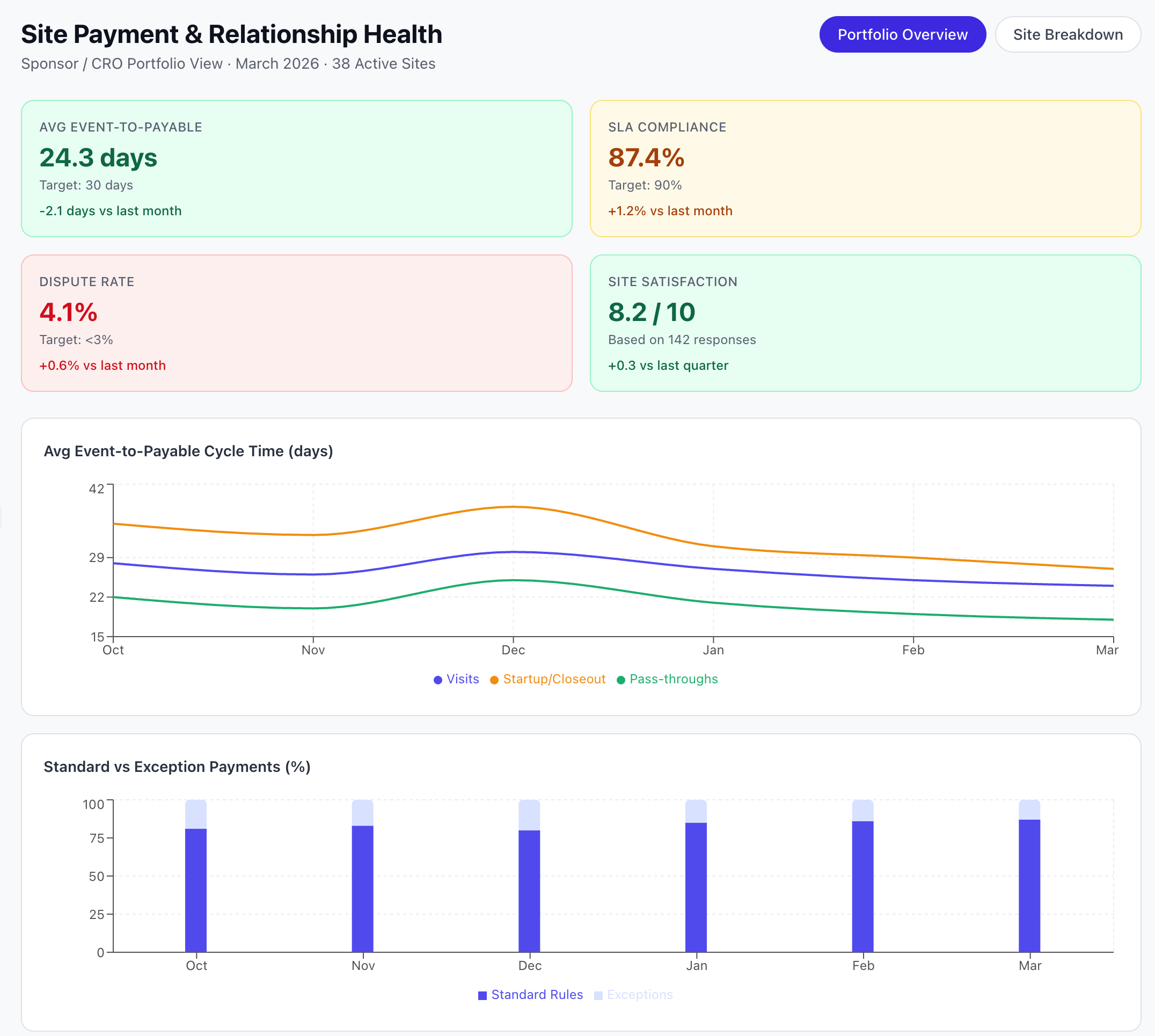
- Event-to-payable and payable-to-cash cycle times by geography and site tier
- Percentage of payments processed under standard rules versus exceptions
- Volume and root causes of payment disputes
Leverage Cloudbyz Dashboards for Portfolio Visibility
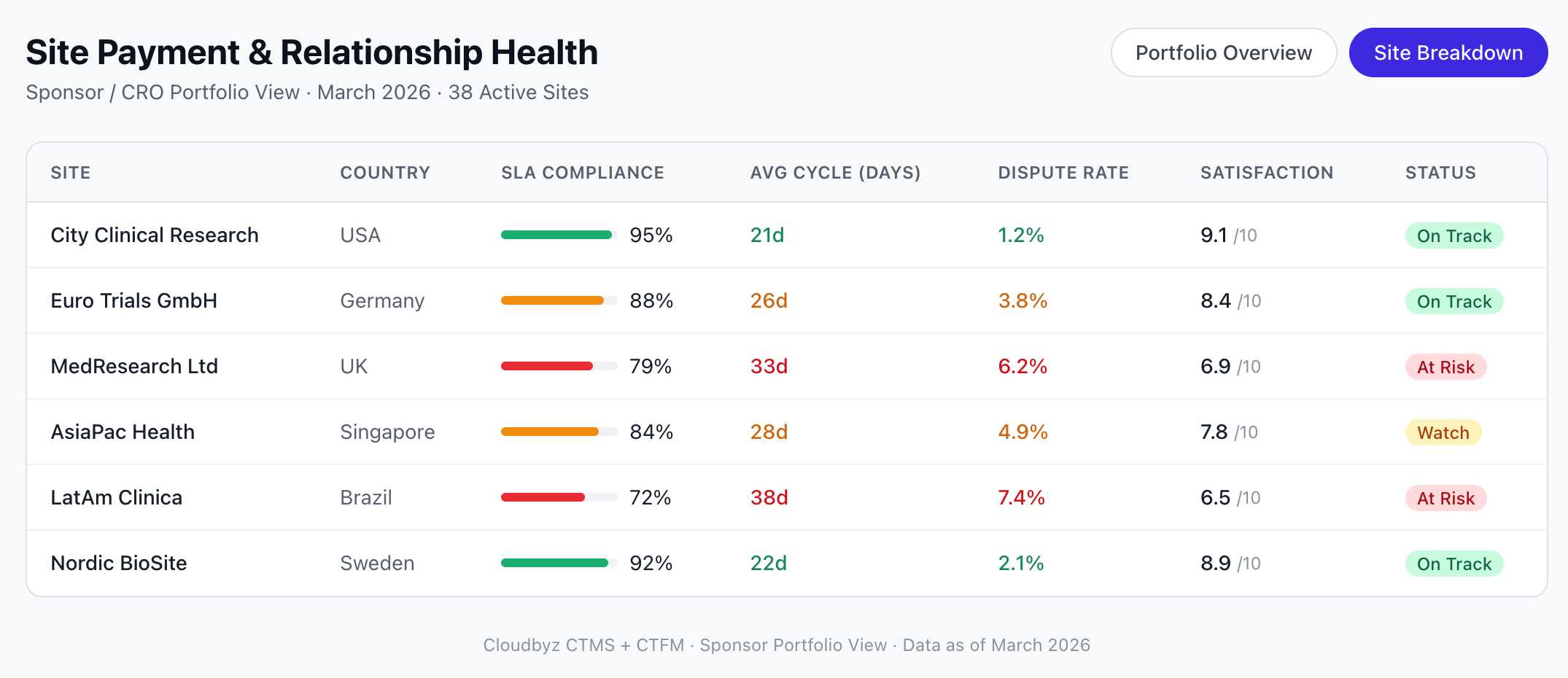
Cloudbyz dashboards make patterns visible at both the study and portfolio level, showing:
- Where payment SLAs are being met or missed
- Which countries or CRO partners generate the most overrides
- How standard terms correlate with site satisfaction and retention
When issues arise, teams can drill into CTMS to determine whether configuration, data quality, or process discipline is at fault.
Extend Transparency to Sites
Portals backed by Cloudbyz CTMS and CTFM can give investigators and site finance teams real-time visibility into what has been approved, what is pending, and which rules apply. Linking to neutral educational resources on budgeting and fair market value can turn payment conversations into collaborative problem solving rather than recurring conflict.
The Long-Term Asset
Over time, standardized terms managed in CTMS become a strategic asset in their own right. Sponsors and CROs can show auditors and regulators a clear chain from policy to configuration to evidence. Sites, meanwhile, can choose partners based not only on protocol pipelines but also on the reliability and transparency of their payment practices, a differentiator that will only grow in importance as competition for high-quality sites intensifies.
Getting there requires commitment: investment in taxonomy design, cross-functional governance, and systematic measurement. But the payoff, in site trust, financial predictability, and operational efficiency, makes it one of the highest-value improvements available to clinical trial organizations today.
Subscribe to our Newsletter
