
Request a demo specialized to your need.
Here's a question every Head of Clinical Operations should be able to answer in under a minute:
"What are we paying investigators at our top 10 sites for a Phase II oncology study and why?"
Try it. Ask your team right now.
What you'll usually get back is a trail of email threads, three versions of a spreadsheet, a PDF from a CRO that's six months old, and one senior person who remembers the context "because she was in the room when we negotiated it."
That's the uncomfortable truth about investigator grants in 2026: even organizations that have modernized site payments, forecasting, and accruals still negotiate grants like it's their first rodeo. Every study. Every site. Every time.
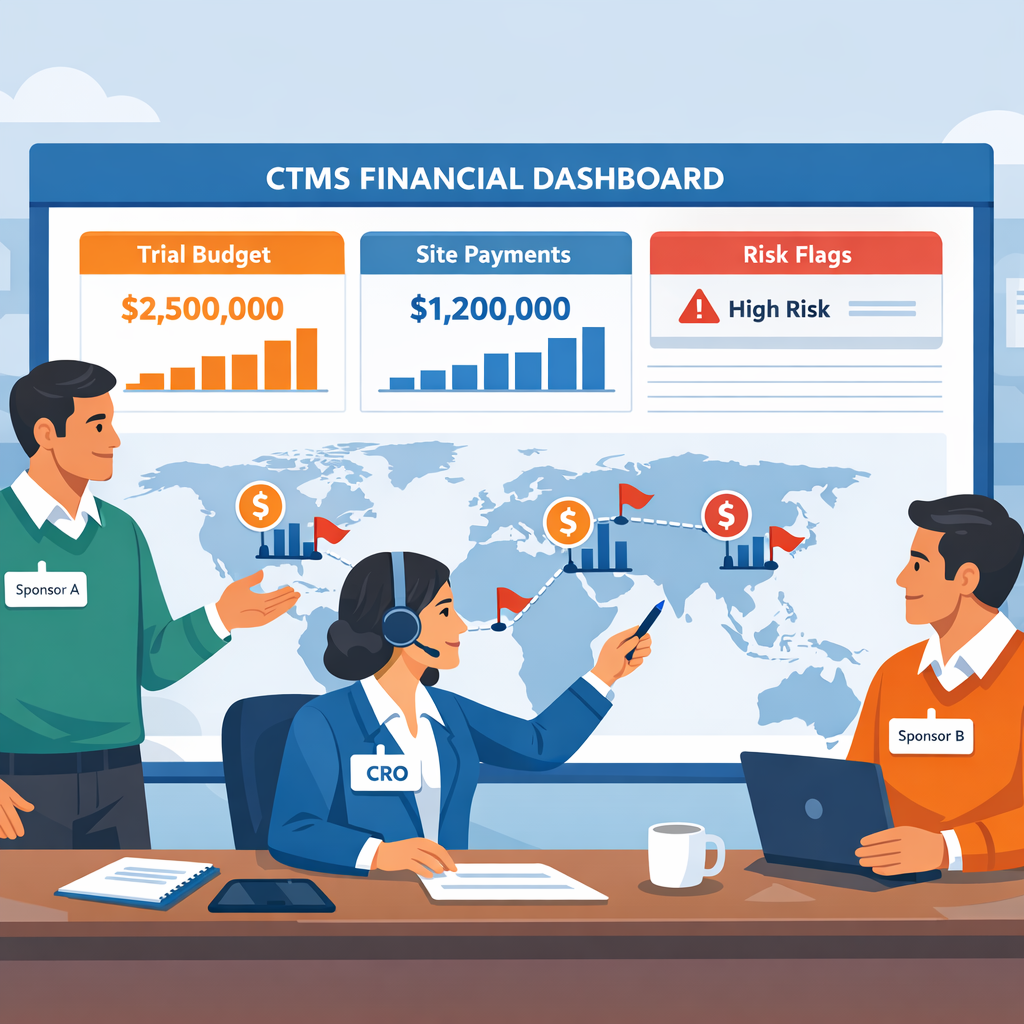
The Hidden Tax on Clinical Operations
The cost of treating every grant as a one-off isn't just administrative. It's structural — and it shows up in four places:
- Inconsistent rates. Two nearly identical sites, running nearly identical protocols, end up with grants that differ by 30% — and nobody can explain why.
- Slow start-up. Grant negotiation is quietly one of the biggest causes of site activation delays. Not the contract language. Not the IRB. The numbers.
- Audit and board pain. When a CFO or an auditor asks "why did we pay this site $450K and that one $320K for the same work?" — the honest answer is often "because that's what they asked for."
- Investigator frustration. PIs talk to each other. When they find out their peers got better rates for comparable work, trust erodes fast. And trust, once lost at a site, is expensive to rebuild.
None of this is because clinical and finance teams are careless. It's because the tools they've been given treat grants as documents, not as data. And you can't govern what you can't structure.
The Shift: From Documents to a Governed Product
Here's the reframe that changes everything.
Stop thinking of investigator grants as contracts. Start thinking of them as a product family.
A product family has templates. It has variants. It has pricing logic. It has version control. It has owners. It has metrics. Most importantly — it has a backbone that everyone agrees on, so local flexibility doesn't turn into chaos.
Investigator grants can work the same way. And the backbone already exists inside your CTMS and CTFM.
Think about what a typical grant actually is, stripped down:
- Start-up effort — activation, training, regulatory work
- Per-subject and per-visit work — the actual trial execution
- Oversight and safety responsibilities — monitoring, SAE handling, reviews
- Closeout and reporting — database lock, final reconciliation
That's four buckets. Four. And within each one, there are well-understood variations by phase, by therapeutic area, by site type, by geography. First-in-human oncology needs more intensive safety review than a Phase IV observational study — that's not a negotiation, that's a fact.
So why are we pretending every grant is a blank sheet of paper?
What "CTMS-Driven Grants" Actually Looks Like
Here's the practical model — and it's simpler than most people think.
Step 1: Define the grant templates once. Sit down with clin ops, finance, and legal. Agree on baseline templates for your most common study types: Phase I oncology, Phase II/III across top 3 therapeutic areas, observational, device, whatever your portfolio actually runs. Each template specifies the four buckets above, with baseline values.
Step 2: Encode them in Cloudbyz CTMS + CTFM. Each template becomes a configurable object inside the system. The template knows which CTMS events trigger which payments — for example:
- Per-subject payments release when the visit is verified, not when it's scheduled.
- Safety oversight fees release on cohort milestones.
- Start-up portions split: part on site activation, part on first-patient-in.
- Closeout fees release on database lock and reconciliation.
This is the same event-driven logic Cloudbyz already uses for site payments and accruals. Applying it to investigator grants brings the same transparency to a domain that has historically been opaque.
Step 3: Let CTMS attributes do the selection work. When a new study starts, CTMS already knows the phase, the therapeutic area, the country, the site tier, whether it's academic or private. Those attributes automatically pull the right template. No spreadsheet. No email thread. No "let me check what we paid last time."
Step 4: Anchor templates in FMV and historical actuals. Layer fair-market-value benchmarks and your own historical data onto the templates. Now your starting point isn't guesswork — it's grounded in real data, adjusted for geography and investigator profile. Negotiation becomes refinement, not invention.
Step 5: Handle exceptions as exceptions. Genuinely unusual protocols — a novel procedure, an unusual site constraint — still get bespoke treatment. But the 80% of grants that are not unusual stop being treated like they are. That's where the time savings compound.
What Standardization Is Not
Before anyone panics: standardizing grants does not mean paying every site the same. It does not mean ignoring local market realities. It does not mean stripping negotiation power from regional teams.
It means agreeing on the backbone the structure, the triggers, the logic so that the differences that do exist are explainable, defensible, and based on real factors, not on who happened to negotiate that particular site.
A PI in Seoul and a PI in Boston don't need to earn the same grant. But both should be able to look you in the eye and get a clear answer when they ask "why am I being paid this amount?"
That answer — "because our template for your site tier, phase, and indication looks like this" — is the one most organizations can't give today.
The Governance That Makes It Stick
Here's where most standardization projects die: someone builds beautiful templates, they work for six months, and then drift sets in. A "one-time exception" here. A "special case" there. A year later, everyone's back to negotiating from scratch.
The fix is a grants council — a small, cross-functional group (clin ops, finance, legal, a regional lead or two) that owns the template library the way a product team owns a product roadmap. They:
- Approve changes to templates.
- Review metrics on how templates are performing in the field.
- Retire templates that have outlived their usefulness.
- Decide when a repeated "exception" should become a new template.
And the metrics that feed this council come straight from CTMS + CTFM:
- Effective grant rates by geography, site type, and therapeutic area
- Time-to-signature and time-to-activation
- Exception frequency — which templates are triggering the most renegotiation
- Dispute rate — where grants are generating friction with sites
When exceptions start clustering in a specific country or indication, the council knows the template needs an update. When a template hasn't been touched in 18 months but keeps working cleanly, they know it's doing its job. This is product management, applied to grants.
What Changes When You Get This Right
Sponsors stop flying blind on what they're actually paying across the portfolio. Finance can forecast grant spend with real confidence. Clinical teams stop losing weeks to negotiation. Auditors and boards get answers in minutes, not weeks. And — maybe most importantly — investigators get faster, more predictable, more transparent treatment, which is one of the underrated factors in site satisfaction and retention.
Grants stop being a bespoke, opaque activity. They become a governed, scalable process — with CTMS and CTFM as the backbone holding it all together.
That's not a cost-cutting exercise. It's a credibility exercise. And in a market where every clinical dollar is under a microscope, credibility is the currency that matters most.
See it for yourself. If your investigator grants still live in spreadsheets and email threads we'd love to show you what it looks like when they live inside CTMS and CTFM instead.
At Cloudbyz, we've built CTMS and CTFM to treat investigator grants as a governed product family, not a pile of one-off contracts. Templates. Triggers. FMV anchors. Real-time dashboards. All driven by the operational data your CTMS already captures.
👉 Book a 30-minute demo and we'll walk you through exactly how it works on your kind of portfolio.
Subscribe to our Newsletter
