

Request a demo specialized to your need.
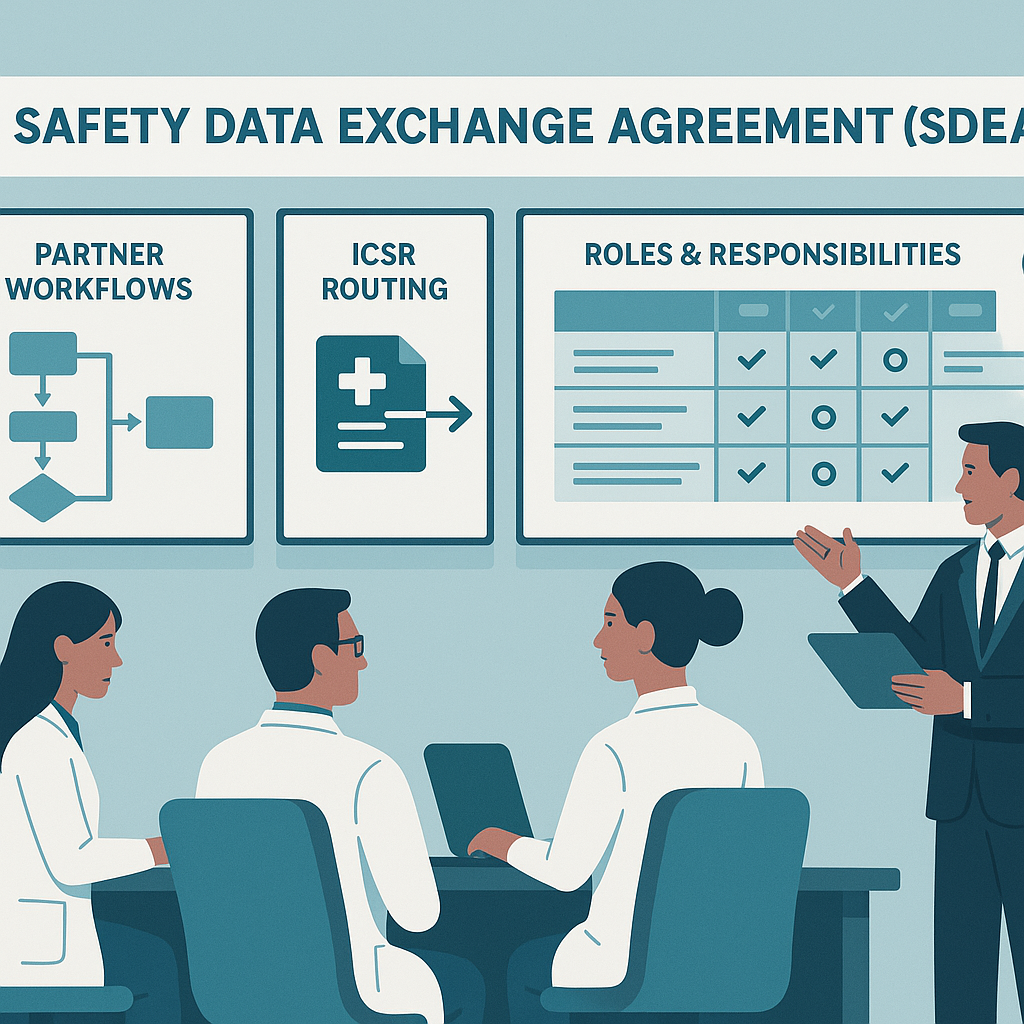
How to design SDEAs that ensure compliant, audit-ready safety exchange.
From Contract to Control System: Rethinking the Safety Data Exchange Agreement
In today’s regulatory environment, Safety Data Exchange Agreements (SDEAs) are no longer static legal artifacts. They are living operational blueprints that define how pharmacovigilance truly functions across organizational boundaries. When done well, an SDEA becomes the backbone of reliable compliance, predictable partner collaboration, and inspection confidence. When done poorly, it becomes a source of friction, ambiguity, and regulatory risk.
At a minimum, a strong SDEA must establish absolute clarity on who does what, when, and how evidence is produced. But leading organizations go further. They treat the SDEA as an operating manual—explicit, testable, and designed to scale.
Clarifying Responsibilities, Data, and Timelines
The foundation of an effective SDEA is precision. This begins by defining the full scope of safety information exchanged across both pre-authorization and post-authorization contexts. Spontaneous reports, solicited programs, clinical study cases, literature reports, partner complaints, medical inquiries with safety content, and all follow-up information must be clearly enumerated. For each source, expectations around minimum required data, acceptable formats, serialization (where applicable), and transfer mechanisms must be unambiguous.
Equally important is defining when a report becomes “valid,” how duplicates are identified and resolved, and how data-privacy obligations are honored across jurisdictions. Ambiguity in these areas is a common highlight in inspections.
Roles and responsibilities should then be formalized through a detailed RACI model covering intake, triage, medical review, coding, quality checks, ICSR submissions, ACK/NAK handling, periodic reporting, signal detection inputs, and regulatory authority responses. The Qualified Person Responsible for Pharmacovigilance (QPPV) must be explicitly named, along with 24/7 contact details, alternates, and escalation paths.
Where outsourcing or partner delegation exists, accountability does not shift. Regulators have been explicit that the Marketing Authorisation Holder (MAH) retains ultimate responsibility. The MHRA Inspectorate has repeatedly emphasized that PV agreements must be specific, enforceable, and actively overseen by the MAH—not merely signed and filed.
Timelines deserve the same level of rigor. Triage service levels, data-entry targets, medical review turnaround times, E2B(R3) ICSR submission windows by seriousness and region, literature screening frequencies, and periodic reporting calendars must all be defined without room for interpretation. Referencing authoritative sources—such as the UK government’s pharmacovigilance procedures published on GOV.UK—helps anchor expectations in established regulatory frameworks.
Finally, alignment on data standards upfront is essential. MedDRA versions, product dictionary governance, seriousness criteria, causality approaches, narrative expectations, and partner case identifiers should be standardized to simplify reconciliation and downstream analytics. The more explicit the agreement, the fewer operational disputes arise—and the faster daily safety work moves.
Operationalizing Routing, Quality, and Oversight at Scale
A well-written SDEA only delivers value if it is translated into engineered, repeatable workflows. Mature pharmacovigilance organizations design their operations so that business processing—intake, triage, coding, medical review, QC, and reporting—remains consistent regardless of how data arrives, whether through gateways, secure file transfers, or partner portals.
Layered validation is critical at every exchange point. Syntactic checks ensure required fields and XML schemas are correct. Semantic checks enforce business logic, such as seriousness alignment and plausible timelines. Regional conformance checks verify that destination-specific requirements are met before submission. Every transmission should be acknowledged and tracked using correlation identifiers so partners can reconcile submissions and acknowledgments efficiently.
Routing logic must be deterministic. The right authority or partner must receive the right case at the right time, based on product license, geography, case type, and seriousness. Re-submission behavior after failures should be defined, and replay-safe mechanisms must prevent accidental duplicates. For cases originating from clinical trials or post-marketing programs, harmonized intake templates and minimum data thresholds ensure consistent quality across channels.
Quality, however, cannot be assumed—it must be measured. Standardized case quality checklists, auditable narratives, MedDRA coding concordance, and reconciliation cadences between partners provide objective evidence of control. Dashboards highlighting backlogs, late tasks, and first-pass acceptance rates transform the SDEA from a document into an operational management tool. When operational design mirrors contractual commitments, partner friction drops and regulatory confidence rises.
Proving Compliance Through Evidence, Metrics, and Governance
Inspection-ready SDEAs generate evidence as a natural by-product of daily work. Every exchanged case should carry an auditable chain of custody: who sent it, when, through which channel, under which validations and dictionaries, and with what acknowledgment or error response. Role-based dashboards enable QPPVs, safety physicians, PV operations leaders, QA teams, and system owners to see obligations and risks in real time.
Key performance indicators must align with regulatory expectations, not internal convenience. On-time submission rates by case type and region, first-pass acceptance, reconciliation variances, literature detection-to-case cycle time, and backlog aging are the metrics inspectors expect organizations to understand and act upon.
Governance completes the picture. A cross-functional change board should own SDEA updates, dictionary upgrades, routing logic changes, and validation packages—each supported by documented impact assessments, versioned redlines, training records, and rollback plans. Scenario-based training playbooks, covering real-world challenges such as late seriousness upgrades or duplicate case merges, further demonstrate operational maturity.
Anchoring SDEAs and SOPs to authoritative references—such as GOV.UK pharmacovigilance procedures and MHRA Inspectorate guidance on outsourced PV oversight—allows reviewers to quickly verify alignment with regulatory expectations.
The Strategic Payoff
When SDEAs are explicit, version-controlled, and operationalized with measurable controls, compliance becomes predictable rather than reactive. Partner collaboration improves, inspection outcomes stabilize, and—most importantly—patients are protected through timely, high-quality safety reporting. In an increasingly complex safety ecosystem, the SDEA is no longer just a contract. It is a strategic control system for pharmacovigilance excellence.
Subscribe to our Newsletter
