

Request a demo specialized to your need.
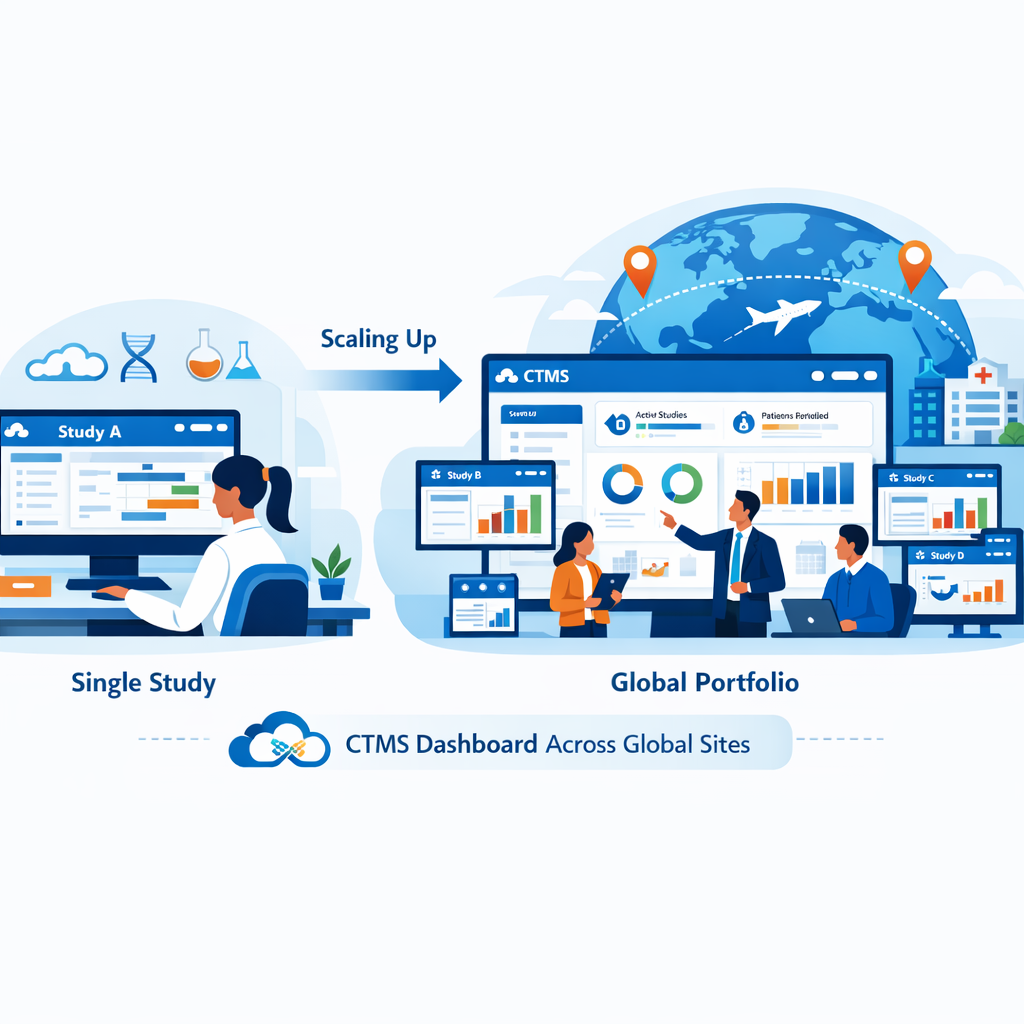
Explores how growing biotechs can scale CTMS from first study to multi-trial portfolios without losing financial and operational control.
From One-Study CTMS to a Scalable Backbone for a Biotech Portfolio
For many small and mid-sized biotechs, the first Clinical Trial Management System (CTMS) deployment is a pragmatic response to immediate pain: too many spreadsheets, limited visibility into site performance, and manual coordination across CROs and vendors. The system is configured around one or two pivotal trials, a handful of sites and countries, and a small core team that knows every nuance of the setup. At that stage, CTMS can feel like a point solution—even if the long-term goal is to build a scalable platform.
The real test comes when the portfolio grows. As more studies, partners, and geographies come online, leadership begins to ask questions that a single-study mindset can't answer:
- What is happening across our entire trial portfolio right now?
- Where are we carrying operational or financial risk?
- How do protocol changes and new programs affect our cash runway?
Without a CTMS strategy that anticipates this shift, organisations often respond by layering new trackers and reports on top of the original configuration—recreating the very fragmentation they set out to avoid.
Scaling CTMS for growing biotechs means treating the system as the backbone of clinical operations and financial oversight, not just as another database. Cloudbyz's CTMS implementation best practices frame this as building a foundation for scalable, data-driven clinical operations, where master data, integration patterns, and analytics are designed from day one with growth in mind. When that foundation is combined with integrated budgeting and financial tracking through Clinical Trial Financial Management (CTFM), CTMS stops being just a tracker of visits and becomes the system that explains how clinical work translates into budgets, payments, and runway.
External case studies on scaling clinical operations highlight the same themes: standardization, automation, and continuous visibility into document and data readiness are what let lean organizations grow without losing control. For biotechs using Cloudbyz, CTMS and CTFM play a similar role as the central nervous system of the clinical organization—coordinating not only documents but also events, budgets, and payments across an expanding portfolio.
From Pilot Study to Multi-Program, Multi-Vendor Operating Model
Once the first CTMS deployment is live and stable, the next challenge is moving from a single-study configuration to an operating model that can support multiple programs, partners, and geographies. At this stage, gaps in architecture, processes, and governance become more obvious. Study teams may start to diverge in how they use visit templates and status fields; vendors and CROs may ask for different integration patterns; finance may see inconsistent mappings between CTMS events and budgets.
Scaling CTMS effectively means treating that first deployment as a prototype to be industrialized, not as a one-off project.
Start with Standardization
A practical path begins with standardization. Cloudbyz CTMS implementation best practices recommend using a library of reusable study and visit templates, status models, and workflows rather than inventing new structures for each trial. As the portfolio grows, those templates can be refined based on what worked in earlier studies—such as which monitoring schedules were sustainable, which country mixes drove predictable enrolment, and which decentralised elements created data or operational complexity. CTMS should become the system of record for those patterns, so new programs can start from proven designs instead of blank canvases.
Expand the Integration Footprint
At the same time, the integration footprint almost always has to expand. A single-study pilot might rely on a straightforward connection between CTMS and EDC; a multi-trial environment typically needs more robust links to eTMF, safety systems, ERP, and possibly external site payment platforms.
Cloudbyz guidance on CTMS with budgeting and finance tracking shows how integrating CTFM into this picture turns CTMS into both an operational and financial backbone, enabling real-time oversight of budgets, site payments, and forecasts in the same dashboards that show enrolment and milestones. For a scaling biotech, that dual view is essential: leadership wants to know not only which studies are on track scientifically, but also how trial economics affect runway and partnering options.
External commentary on managing clinical trial portfolio growth reinforces this point. Analyses aimed at small and mid-sized biopharma leaders argue that the inflection point from a few trials to a broad portfolio requires systems that deliver real-time visibility, standardized processes, and automation across sites and vendors—not just more headcount or spreadsheets. A well-architected CTMS, integrated with CTFM, becomes the core of that infrastructure.
Governance, Playbooks, and Metrics for Scaling
To keep CTMS scalable as the portfolio and organization mature, governance and metrics need to evolve alongside technology. A growing biotech can no longer rely on a single project team making ad hoc decisions about fields and workflows; it needs formal structures that balance flexibility with consistency.
Establish a Cross-Functional Governance Council
Cloudbyz resources on CTMS governance councils describe the kind of cross-functional body that works well at this stage: clinical operations, data management, finance, quality, and IT meet on a regular cadence to own templates, KPI definitions, integration roadmaps, and change control.
Define Portfolio-Level KPIs
Those councils should define a small set of portfolio-level CTMS and financial KPIs—site activation speed, enrolment versus plan, protocol deviation rates, query resolution times, cost per subject, and event-to-cash cycle times—and ensure that each is calculable in the same way across studies. Cloudbyz's centralized dashboard guidance shows how these metrics can be displayed in real time for executives and study teams, replacing static slide packs with live, drillable views. When leadership discussions are grounded in those shared views, CTMS naturally becomes the center of gravity for operational and financial decisions.
Invest in Training and Change Management
Scaling also depends on training and change management. Each new wave of studies and hires creates an opportunity for drift if teams invent their own ways of working around CTMS. Best-practice material on CTMS user training stresses that role-based, scenario-driven education is key: coordinators, CRAs, and finance analysts should learn how to answer their everyday questions in CTMS and CTFM, not in side systems. For a scaling biotech, investing in that training early pays dividends in data quality and user adoption as the platform spreads.
The Bottom Line
Over time, a well-governed CTMS lets the company scale complexity without proportional chaos. New indications, modalities, and geographies can be added through reusable patterns instead of bespoke configurations. Vendor and CRO models can be compared using consistent metrics. Finance can read trial economics directly from CTMS and CTFM instead of reconstructing them in Excel.
For growing biopharma organizations, that is the difference between a CTMS that was "implemented once" and a CTMS that truly scales with the pipeline.
Subscribe to our Newsletter
