

Request a demo specialized to your need.
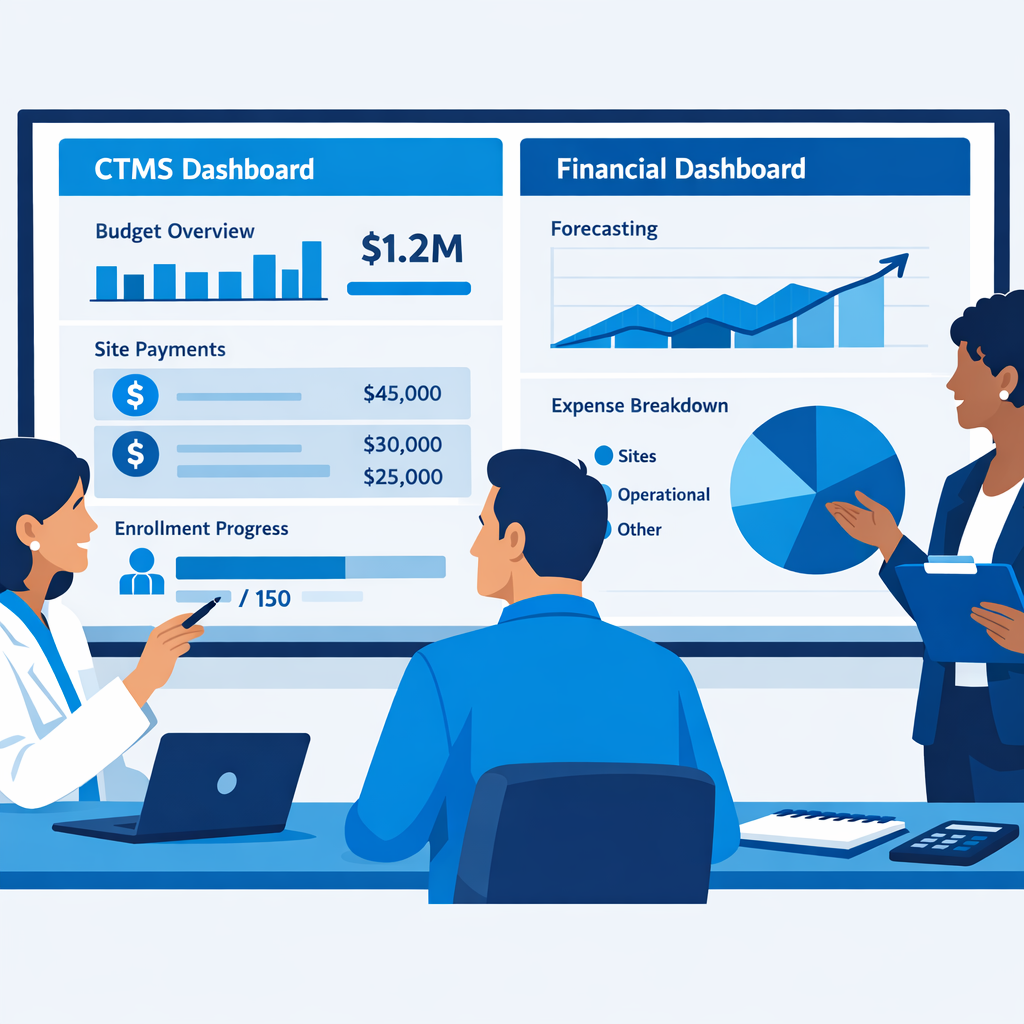
Deep-dive best practices for running clinical trial budgets and payments on CTMS and CTFM data instead of spreadsheets.
CTMS & CTFM: Moving Clinical Trial Financials Beyond Spreadsheets
Clinical trial teams have long relied on spreadsheets to bridge the gap between operational events and financial reality. Study managers track site activations and subject visits in their Clinical Trial Management System (CTMS), then rebuild those timelines in Excel to explain budget variances. Finance partners pull enrollment and monitoring data into offline models to estimate accruals. Site-payment specialists reconcile invoices against local trackers that rarely match CTMS states.
Over time, every function maintains its own version of the truth — and quarter-end becomes an exercise in forensic accounting rather than a straightforward readout of how the trial actually ran.
Why Spreadsheets Keep Winning (And Where They Break)
The persistence of spreadsheets isn't irrational. They're flexible, familiar, and fast to spin up. But that flexibility comes at a cost. Each workbook encodes critical knowledge about how work, risk, and money flow through a trial — knowledge that is fragile, hard to audit, and invisible to downstream tools.
Most organizations, when they take a candid inventory, discover dozens of these "shadow systems": Excel workbooks used to allocate budgets across regions, locally maintained trackers for pass-through expenses, manual logs of vendor milestones, and accrual models that only a handful of people can interpret.
The problem isn't analysis in Excel per se. The problem is using spreadsheets as the financial engine rather than the operational system of record.
The CTMS- and CTFM-Centric Model
A CTMS- and Clinical Trial Financial Management (CTFM)-centric approach flips the traditional pattern. Instead of treating CTMS as a reporting system and spreadsheets as the real financial engine, organizations use:
- CTMS as the operational backbone — where studies, countries, sites, subjects, visits, and milestones are defined once, with clear states and standard templates.
- CTFM as the policy layer — where budgets, rate cards, eligibility rules, tax and FX policies, and payment schedules live, expressed directly in terms of those CTMS entities.
When these two systems share a common data model, the same actions that keep trials moving — activating sites, verifying visits, closing queries, locking databases — also generate the evidence required for budgets, accruals, and site payments. Transparent, audit-ready financials become a natural output of how the trial is run, not a separate reconciliation effort.
Designing Workflows for Budgets, Payments, and Forecasting
Define Rateable Units in CTMS Terms
The first design decision is how to anchor financial logic to CTMS data:
- Investigator grants should tie per-visit and per-procedure fees to standard visit templates and pass-through categories — not free-text line items that vary by site.
- Startup and closeout packs should be modeled as named milestone bundles with clear entry and exit criteria: ethics and regulatory approvals, contracts, training, banking and tax setup, system access, query closure, and eTMF health.
- CRO and vendor fees should map to explicit units — country activations, database builds, monitoring visit types, safety-case volumes — so invoices can be reconciled directly to CTMS events.
Encode Eligibility Rules as Operational Thresholds
A subject visit should not become payable simply because a date was entered. It should cross a clear threshold: visit completed in CTMS, data present in EDC or eCOA, verification performed by an authorized role, and no open critical queries.
When eligibility logic is encoded this way, CTFM can automatically generate payables and accruals from CTMS data. Every amount on a forecast, invoice, or payment run becomes traceable back to concrete events — not opaque formulas in offline files.
Build Rolling Forecasts from Live Operational Data
With budgets and eligibility wired into CTMS and CTFM, rolling forecasts become natural extensions of the same model. Live enrollment and visit behavior feed driver-based projections. CTFM applies rate cards, tax and FX rules, and event-to-cash lags to produce study- and portfolio-level cash curves.
As actual CTMS activity diverges from assumptions — faster enrollment at a high-cost site, slower startup in a key country, an amendment that adds imaging-heavy visits — the forecast updates automatically. Leaders can see not just that spend has shifted, but why: whether the driver was volume, rate, mix, timing, or FX and tax.
Governing the System: Keeping It Reliable Over Time
Designing robust workflows is only half the battle. Without deliberate governance, rate cards drift out of sync with contracts, eligibility rules accumulate exceptions, and teams quietly fall back to spreadsheets when the system no longer reflects reality.
Establish a Cross-Functional Design Council
A practical governance starting point is a design council that includes clinical operations, FP&A, study finance, vendor management, site-payments specialists, quality, and IT. This group owns the standard dictionaries — visit and milestone templates, pass-through categories — as well as the financial mappings that tie those templates to CTFM rate cards and eligibility logic.
When a new trial design arrives, the council's job is not to micromanage every budget line, but to ensure the study leverages existing standards wherever possible and that any deviations are explicit, justified, and reflected consistently across systems.
Make the Protocol-to-Payables Chain Visible
CTMS- and CTFM-driven dashboards should surface the entire financial picture alongside operational KPIs. For each study, leaders should be able to see budget burn versus plan, accrual coverage, and site-payment SLA performance next to enrollment, startup, data quality, and monitoring metrics.
When a variance appears, the question should always have a data-backed answer: which driver moved, and what CTMS evidence supports that explanation?
- Volume-driven overspend? CTMS should show which countries, sites, or visit types are off-plan.
- Rate-driven overspend? CTFM should reveal which grants, vendor fees, or FX assumptions changed.
- Timing issues? Milestone and event-to-payable cycle-time histories should highlight where work is stalling.
Build Audit Readiness Into Normal Operations
Audit readiness should be a by-product of how the system is run — not a separate project. Every configuration object (rate cards, eligibility rules, tax and FX tables, integration mappings) should carry owners, effective dates, test evidence, and approval records. Every payment and accrual entry should be traceable back to the visits, milestones, or vendor events that justified it, and onward to the contracts and protocols that defined the terms.
Quarterly sample-based reviews — walking a handful of payments and accruals from GL entries all the way back to CTMS events — can reveal where workflows or data quality are fraying, and feed directly into system improvements and training plans.
The Payoff
When CTMS and CTFM are designed and governed this way, running trial financials on operational data stops being an aspiration and becomes the default. Month-end closes get smoother. Board conversations become more grounded. And inspections become far less stressful — because the audit trail was built in from day one, not assembled in a hurry at the end.
The shift starts with a simple question: if a number is going to appear in a forecast, invoice, payment run, or GL entry on a recurring basis, does the logic that generates it belong in a system — or in someone's desktop file?
For most organizations, answering that question honestly is all it takes to start moving forward.
Subscribe to our Newsletter
