
Request a demo specialized to your need.
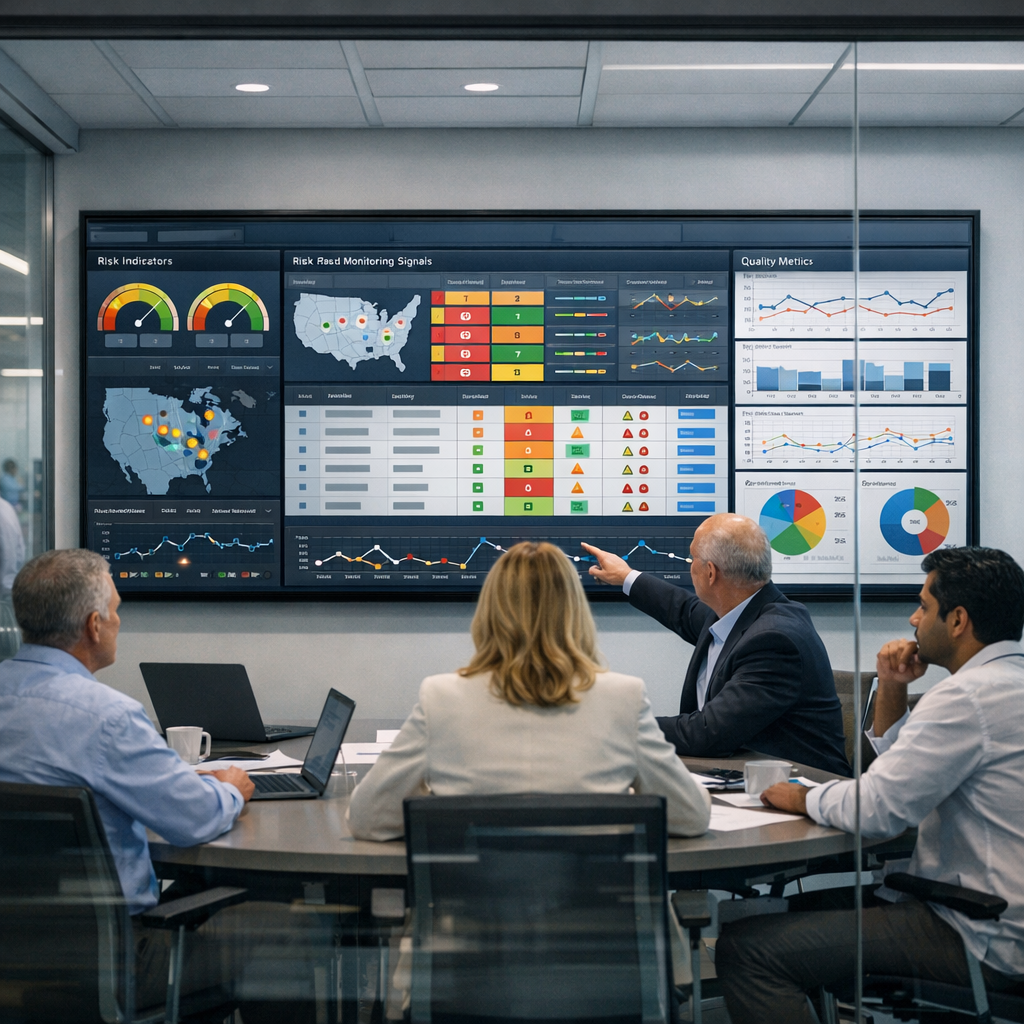
How Salesforce-native Cloudbyz CTMS KRI dashboards and RBM signals give Clinical Operations leaders live visibility into activation, quality, and R3 risk.
Why backward-looking KRIs fail Clinical Operations leaders
Key risk indicator dashboards are only as credible as the data and decisions they represent. For too long, Clinical Operations leaders have reviewed attractive but retrospective reports that surface problems only after they have happened. In the regulatory environment shaped by ICH E6(R3), that is no longer sufficient.
VPs and Directors of Clinical Operations, Clinical Project Managers, and Heads of Clinical Ops across Biotech and CROs have spent years looking at dashboards that tell them where site activation, data quality, or monitoring went wrong — after the fact. By the time a risk heatmap lands in a governance meeting, the window to intervene has usually closed.
The emerging standard under ICH E6(R3) expects sponsors to demonstrate live, metadata-backed oversight that is proportionate to risk. Static, spreadsheet-powered KRI reports make that expectation very difficult to meet. What the moment demands is a Salesforce-native CTMS that connects activation speed, operational quality, and financial impact in a single, continuously updated view — so Clinical Operations leaders can act on signals before they become findings.
|
By the time those dashboards land in governance meetings, the opportunity to prevent delays, contain monitoring spend, or address emerging protocol-implementation issues has often already passed. |
01 — THE CORE PROBLEM
The anatomy of a backward-looking KRI program
On a fragmented technology stack, KRIs and risk-based monitoring dashboards typically sit one or two steps removed from where risk is actually generated. EDC captures query spikes and late data entry. CTMS records deviations, missed visits, and monitoring backlogs. Finance tools track spend against budget. Each system generates data, but none of them speak directly to each other in real time.
The result is a familiar and costly workflow: analytics teams pull periodic extracts, stitch them together in spreadsheets, and produce colour-coded heatmaps that summarise last month's activity. Clinical Operations leaders review findings that are weeks old, in reports assembled manually from data sources never designed to integrate. Risk signals that should trigger immediate protocol-implementation corrections instead become agenda items for the next steering committee.
|
WHERE THE GAPS APPEAR A fragmented KRI stack typically creates three distinct blind spots in clinical oversight:
|
ICH E6(R3) does not object to dashboards per se. What it does require is that sponsors use live data and metadata — including audit trails — to drive risk-proportionate oversight. When KRIs are powered by static exports, demonstrating that standard to a regulator becomes a significant challenge.
02 — THE REGULATORY CONTEXT
What ICH E6(R3) actually requires from risk oversight
The revised ICH E6(R3) guideline on Good Clinical Practice represents a meaningful shift in how regulators expect sponsors to manage trial risk. The core principle is that oversight should be proportionate, continuous, and demonstrably connected to trial behaviour. A quality management system under E6(R3) is not a collection of procedures filed in a binder — it is a live operational framework that can show, for any given study, how risk was identified, what decisions were made in response, and what effect those decisions had on data quality and subject protection.
For Clinical Operations teams, this translates into concrete requirements. Risk thresholds must be defined upfront and documented. Changes to those thresholds must be recorded with rationale. When a KRI crosses a threshold, the triggered actions and their outcomes must be traceable. That chain of evidence — from signal to decision to outcome — is what makes an inspection-ready quality management program defensible.
A dashboard generated from last month's data extract, with no record of how its thresholds were configured or what actions it prompted, cannot meet that standard. The evidence trail simply does not exist in a form that regulators can evaluate.
03 — THE SOLUTION ARCHITECTURE
Building KRIs and RBM signals on a unified Salesforce spine
Cloudbyz CTMS addresses this problem at the architectural level by treating KRIs and risk-based monitoring signals as first-class objects on a unified Salesforce-native data spine, rather than as reporting outputs generated downstream from the system of record.
Because Cloudbyz CTMS reads directly from Cloudbyz EDC and CTFM, KRI dashboards reflect live trial behaviour rather than periodic snapshots. Site activation duration by country, start-up cycle time by investigator site, query and deviation density on critical endpoints, monitoring task completion rates, data-entry timeliness metrics, and spend-versus-value signals are all updated continuously — not assembled retroactively.
|
● |
Activation duration By country and site, tracked against expected timelines in real time |
|
● |
Query density On critical endpoints from EDC, surfaced directly in CTMS dashboards |
|
● |
Spend vs. value Financial signals from CTFM connected to operational quality metrics |
|
● |
Monitoring task completion Backlogs and completion rates visible before they become protocol deviations |
|
● |
Audit trail integrity ALCOA+ aligned records of KRI configuration, threshold changes, and triggered actions |
|
● |
Portfolio-level view Risk signals aggregated across studies for VP and Head of Clinical Ops oversight |
04 — AUDIT TRAIL AND COMPLIANCE
Making ICH E6(R3) quality management concrete and defensible
Cloudbyz Audit Trail and e-Signature, aligned with ALCOA+ principles, records the configuration of KRIs, changes to risk thresholds, and the actions triggered when risk levels shift. This creates the evidence chain that ICH E6(R3) requires and that inspection teams will look for: a documented record of how risk was identified, how the system responded, and what effect that had on trial operations.
For a Biotech sponsor preparing for a regulatory inspection, this means being able to demonstrate — for a specific study or across an entire portfolio — how CTMS-defined KRIs surfaced risk, which risk-based monitoring steps were taken in response, and how those decisions affected activation timelines, data quality indicators, and inspection-readiness scores. The answer is not a narrative assembled from disconnected systems after the fact. It is a native audit trail that exists in the system where the risk decisions were actually made.
For CRO leaders managing multiple sponsor relationships, the same architecture provides the operational transparency that sponsors increasingly expect. Monitoring backlogs, deviation trends, and data-entry quality signals are visible to CRO management and sponsor oversight teams through a single shared view, reducing the friction of governance reporting.
|
ICH E6(R3) quality management becomes concrete: you can show, for a specific study or portfolio, how your CTMS-defined KRIs surfaced risk and how that affected activation timelines, data quality, and inspection-readiness. |
05 — STRATEGIC IMPLICATIONS
Risk-based oversight as daily portfolio steering, not quarterly slideware
The distinction between a backward-looking KRI program and a live risk-based monitoring capability is not merely a technical one. It reflects a fundamental difference in how Clinical Operations leaders engage with risk information and what they can actually do with it.
Quarterly slideware creates the appearance of risk oversight while removing the possibility of timely action. By the time a deviation trend is visible in a governance report, the window to intervene — to reallocate monitoring resources, escalate site-specific issues, or adjust protocol implementation support — has typically closed. The cost of that missed window shows up in trial timelines, monitoring budget overruns, and data quality issues that require remediation during database lock.
Live KRI dashboards built on a Salesforce-native CTMS spine change the operating model. Risk signals become part of daily portfolio steering rather than periodic review. Clinical Project Managers see monitoring task backlogs before they escalate. VPs of Clinical Operations see activation duration trends across countries before they affect first-patient-in milestones. Finance and operations signals are connected rather than parallel, so the true cost of a risk event is visible when there is still time to contain it.
For Biotech and CRO leaders, Cloudbyz CTMS becomes the place where risk-based oversight actually happens — not just where it is reported. That is the distinction that ICH E6(R3) is designed to enforce, and it is the capability that separates clinical operations programs built for the current regulatory environment from those still running on the assumptions of the previous one.
|
KEY TAKEAWAYS
|
Subscribe to our Newsletter
