

Request a demo specialized to your need.
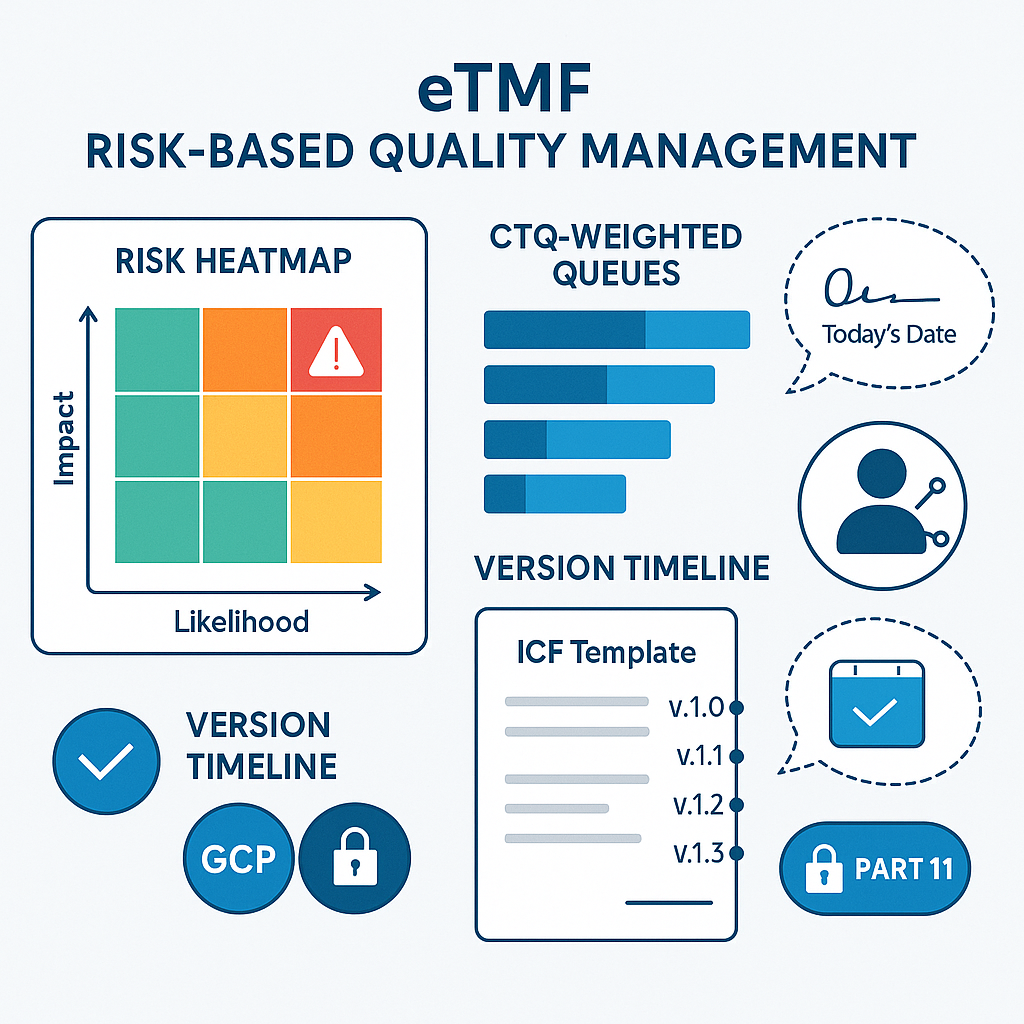
Make eTMF RBQM-ready with explainable AI, metrics, and evidence.
A Buyer’s Guide to Risk-Based Quality Management in the Trial Master File
Executive Perspective: Why eTMF Quality Is Under Scrutiny
For sponsors and CROs, the electronic Trial Master File (eTMF) is no longer just a compliance repository—it is the primary evidence regulators use to assess trial quality. Health authorities increasingly expect organizations to demonstrate how quality is designed, monitored, and controlled throughout the trial lifecycle.
Risk-Based Quality Management (RBQM) has become standard practice in clinical operations, but its application to eTMF has often lagged behind. Most eTMF systems still rely on checklists, static completeness metrics, and retrospective QC, which answer what is missing but fail to explain why quality risk exists or how it is being controlled.
For modern eTMF buyer personas—TMF leaders, clinical operations heads, QA, and inspection readiness teams—RBQM for eTMF represents a critical shift: from documenting quality to proving it, continuously and defensibly.
The Limitation of Traditional eTMF Quality Models
Conventional eTMF quality management focuses on surface-level indicators:
-
Artifact presence vs. absence
-
Timeliness against expected dates
-
Periodic QC sampling
While necessary, these controls are reactive. They flag issues after risk has already materialized and provide little insight into systemic drivers such as site behavior, document complexity, operational bottlenecks, or process deviations.
Most importantly, they do not align with regulators’ evolving expectations under ICH E6(R3), which emphasize risk identification, proportional control, and continuous oversight. In inspections, the question is no longer “Is your TMF complete?” but “How do you know your TMF reflects trial conduct and risk is controlled?”
Reframing RBQM for the eTMF
RBQM for eTMF applies the same principles used in trial execution—identify risk early, focus controls where impact is highest, and continuously monitor effectiveness—but embeds them directly into document management workflows.
This approach shifts the eTMF from a passive archive to an active quality intelligence system, where risk signals are detected as documents flow in, not months later during QC cycles.
At its core, RBQM for eTMF answers three inspection-critical questions:
-
Where is TMF quality at risk right now?
-
Why is that risk occurring?
-
What controls are in place to prevent recurrence?
The Role of AI: From Metrics to Meaning
AI is the enabling force that makes RBQM for eTMF scalable and defensible. Instead of relying solely on human review and static rules, AI introduces continuous, data-driven quality intelligence.
Risk Identification at the Source
AI analyzes documents at intake to identify quality risks such as:
-
Misfiled or misclassified artifacts
-
Missing or inconsistent metadata
-
Incorrect country, site, or study associations
-
Artifacts that deviate from expected content patterns
This shifts quality detection from downstream QC to upstream prevention.
Pattern-Based Risk Detection
Rather than treating each document in isolation, AI evaluates patterns across:
-
Sites and countries
-
Artifact types
-
Vendors and functional owners
-
Time and workload trends
This enables early identification of systemic risk, such as sites consistently submitting late or vendors producing high-error document types.
Contextual Quality Scoring
AI assigns dynamic quality and risk scores based on multiple factors—not just completeness. These scores evolve over time, reflecting whether issues are isolated, recurring, or escalating.
How RBQM-Driven eTMF Works in Practice
In a modern RBQM-enabled eTMF environment, quality management becomes continuous and role-specific.
Documents are analyzed automatically as they enter the system. AI flags risk indicators and routes only high-risk artifacts for focused human review, while low-risk content flows through with minimal friction. Quality trends are monitored in real time, enabling proactive intervention long before inspection readiness is threatened.
For TMF leaders, this means moving from periodic TMF health checks to always-on quality oversight.
What This Means for the Cloudbyz eTMF Buyer Persona
For buyers evaluating next-generation eTMF platforms, RBQM-driven AI fundamentally changes the value proposition.
TMF & Clinical Operations Leaders
-
Reduced QC workload through intelligent prioritization
-
Early visibility into sites or regions driving quality risk
-
Confidence that TMF quality reflects real trial conduct
Quality & Compliance Teams
-
Defensible, inspection-ready evidence of risk management
-
Clear lineage from risk detection to corrective action
-
Reduced dependence on last-minute remediation
Executive & Program Leadership
-
Objective, data-driven insight into trial health
-
Predictable inspection outcomes
-
Lower operational and compliance risk at scale
RBQM for eTMF Is Not Automation—It Is Assurance
A critical distinction for buyers: RBQM-driven AI is not about replacing human judgment. It is about amplifying it.
Human-in-the-loop workflows ensure that AI findings are reviewed, confirmed, and acted upon by accountable roles. Every decision—automated or manual—is logged, versioned, and auditable. This combination of intelligence and governance is what regulators expect when organizations claim to operate under RBQM principles.
Why This Matters Now
As trials grow more decentralized, global, and data-rich, eTMF volume and complexity will only increase. Scaling quality through headcount and periodic QC is no longer sustainable.
RBQM for eTMF enables organizations to:
-
Scale trials without scaling compliance risk
-
Shift from inspection preparation to inspection confidence
-
Demonstrate quality proactively, not defensively
For Cloudbyz buyers, this capability aligns directly with an AI-first, unified clinical operations strategy—where quality is built into workflows rather than enforced after the fact.
Conclusion: AI That Proves Quality, Not Just Claims It
RBQM for eTMF represents the next maturity level in TMF management. It moves quality from a static outcome to a continuously proven state, supported by AI, governance, and transparency.
For sponsors and CROs seeking inspection confidence, operational efficiency, and future-ready compliance, AI-driven RBQM is no longer a differentiator—it is the new baseline. Cloudbyz eTMF buyers who embrace this model are not just managing documents; they are demonstrating control, accountability, and quality by design.
Subscribe to our Newsletter
