

Request a demo specialized to your need.
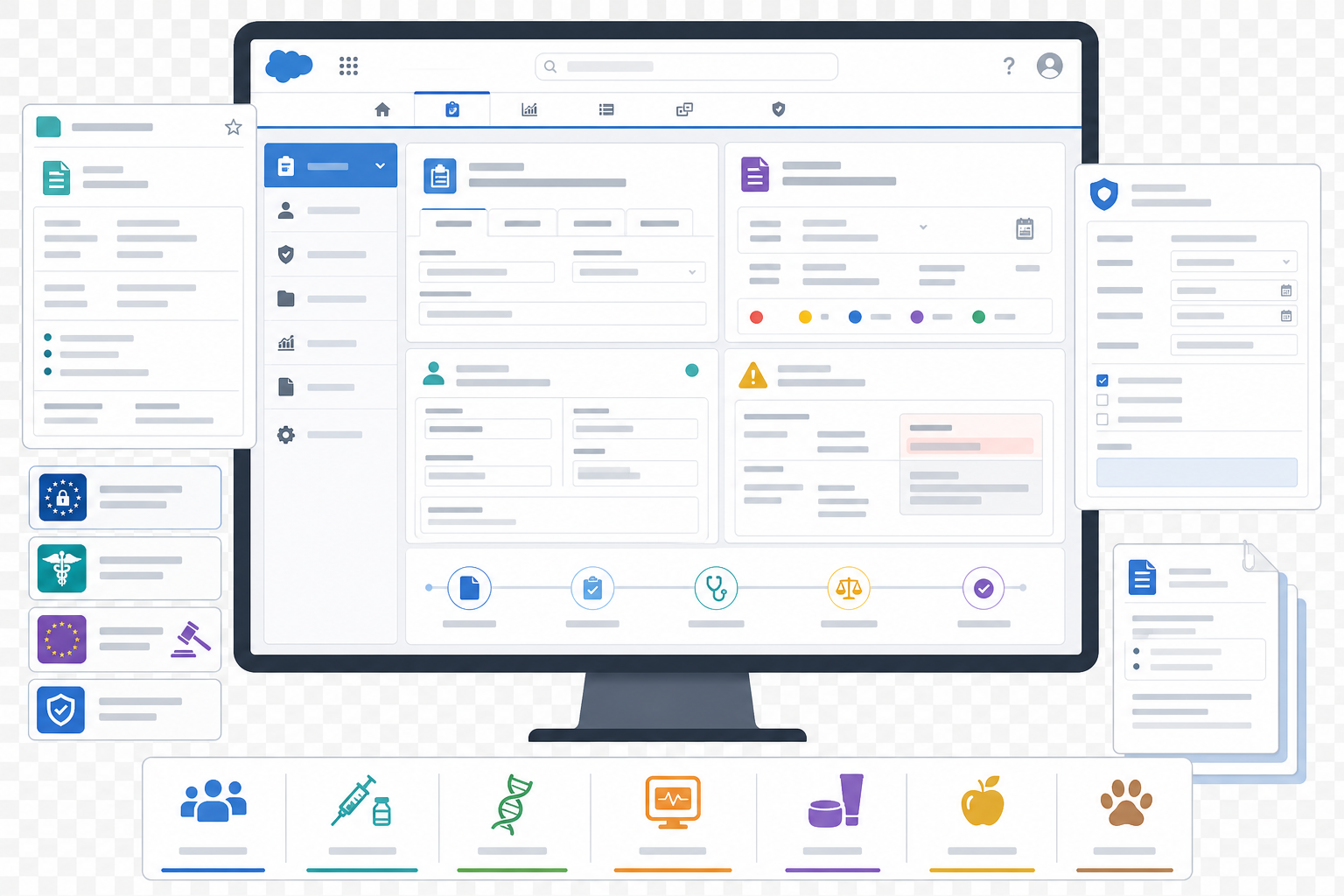
How clinRedact AI inside Cloudbyz Safety makes GDPR Article 9, HIPAA, EMA Policy 0070, and GVP VI Addendum II practical across multivigilance safety workflows.
Why Sidecar PII Workflows Are a Compliance Liability in Multivigilance Safety
And how privacy-by-design inside Cloudbyz Safety closes the gap
The uncomfortable reality for Drug Safety Officers, Pharmacovigilance leads, Regulatory Affairs Directors, Medical Monitors, and DPOs running multivigilance portfolios: GDPR Article 9 does not stop applying because a document is "for regulators." Neither does HIPAA's treatment of protected health information, EMA Policy 0070's expectations for anonymising clinical data before publication, nor the masking logic emerging from EMA's GVP Module VI Addendum II draft.
These obligations collide daily with a messy toolchain — and the gap between what your SOPs promise and what you could reconstruct in an inspection is wider than most teams realise.
The Sidecar Problem
Today's typical workflow looks like this: safety narratives, CIOMS forms, line listings, and attachments are authored or stored in a safety system, exported as files, redacted in generic office tools, passed through separate "anonymisation" utilities, and then re-uploaded to portals and drives that sit outside your core audit trail.
Every hand-off multiplies uncontrolled copies of personal data. Every manual redaction step introduces variation in how direct identifiers — names, addresses, national IDs — and quasi-identifiers — dates, rare diseases, small geographies — are treated. By the time a submission or disclosure package is finalised, nobody can reliably account for how many uncontrolled copies of PHI or EU health data exist.
This is the sidecar problem: privacy controls that sit outside the workflow they are meant to protect.
What the Regulatory Frameworks Actually Require
The major frameworks are consistent in their direction, even if they differ in scope and jurisdiction.
GDPR Article 9 (Regulation (EU) 2016/679) treats health data as a special category of personal data. Processing is prohibited unless an Article 6 lawful basis and one of the Article 9(2) conditions apply, with appropriate safeguards — including data minimisation — in place. This applies in the UK context as well, restated under UK GDPR.
EMA Policy 0070 adds explicit expectations for anonymising clinical study reports and related documents before they enter the public domain.
GVP Module VI Addendum II (currently in draft) addresses masking of personal data in ICSRs submitted to EudraVigilance, specifying which ICH E2B(R3) data items should be masked and confirming that this is part of the same privacy story as Policy 0070.
HIPAA's de-identification standard defines when protected health information can be treated as de-identified, requiring that 18 specific categories of identifiers be removed or otherwise handled.
Across human pharmacovigilance, vaccine vigilance, biovigilance, device safety, cosmetovigilance, nutrivigilance, and veterinary vigilance, the themes are consistent: identify where personal data live, minimise them, and ensure that any masking applied before ICSRs move into authority systems — or clinical documents move into the public domain — is systematic, explainable, and auditable. Legacy safety stacks fight those expectations at every turn.
Privacy-by-Design Starts With Where You Run Safety
Cloudbyz's position is straightforward: the right place for privacy controls is inside the safety workflow itself, not bolted on afterward.
Cloudbyz is the only 100% Salesforce-native unified eClinical platform in this space — a unifier that runs Safety, EDC, and CTMS on the same Salesforce data, security, and audit model. Adverse events move from Cloudbyz EDC into Safety without file exports, middleware, or manual reconciliation. Trial context — protocol, country, site, IRB/IEC status — flows in from CTMS automatically. Roles, permissions, and audit trails are shared across the entire platform.
Within that platform, clinRedact AI — Cloudbyz's confirmed ClinicalWave.ai capability for automated PII redaction in safety documents — operates as an in-workflow control rather than a sidecar tool. It acts on documents where they actually live: inside Cloudbyz Safety, as part of the same lifecycle that handles case assessment and ICSR preparation.
How clinRedact AI Works Inside Cloudbyz Safety
clinRedact AI does three things within the safety workflow:
Detection. It identifies direct identifiers and configured indirect identifiers in narratives, CIOMS forms, line listings, and attachments — names, contact details, free-text addresses, medical record numbers, full dates, small subgroups, rare phenotypes, and sensitive location-diagnosis combinations.
Masking and generalization. It proposes redactions aligned with your governance rules per vigilance line. Exact dates can be replaced with month/year or age bands; initials can be masked; locations can be generalized; rare combinations that heighten re-identification risk can be suppressed. GVP Module VI Addendum II is explicit that masking must protect data subjects without destroying interpretability — clinRedact AI operates on structured fields and free text with that constraint in mind. The clinical narrative, timelines, and MedDRA-coded data remain usable, while identifiers move toward forms suitable for the package being generated.
Reviewer oversight. Suggested redactions are presented to PV and privacy reviewers in the Cloudbyz Safety UI for accept, tighten, or override decisions. Each choice is captured in the same audit fabric as case assessment and ICSR preparation.
Because Cloudbyz Safety shares a platform with EDC and CTMS, clinRedact AI can also respect operational context:
- Clinical trial narratives can follow masking patterns tuned to the diversity of indication, geography, and sample size.
- Post-authorization vaccine or device cases can use stricter generalization where community re-identification risk is higher.
- Veterinary vigilance workflows can operate with rules optimized for owner-identifying data, while still recognising that animal identifiers may be sensitive under certain local frameworks.
The practical shift for PV teams: instead of training staff to remember dozens of redaction conventions in off-platform tools, you codify the rules once, let clinRedact AI apply them inside Cloudbyz Safety, and focus human attention on the edge cases that genuinely require judgement.
The Governance Layer: Making Automation Defensible to Regulators
Automation is only as good as the governance that makes it auditable. Cloudbyz Safety is deliberately conservative here.
Rule sets are grounded in published frameworks. Cloudbyz lets you configure clinRedact AI by portfolio, region, and vigilance line. You can define redaction and generalisation rules that differ between EU and US submissions, or between clinical-trial and post-marketing contexts, while keeping consistent logic across all vigilance lines. You can calibrate masking strength for specific document types — ICSR exports to EudraVigilance, MedWatch-equivalent outputs, periodic and aggregate reports, Policy 0070 packages, responses to data-subject access requests — without rewriting the underlying workflow. Mappings from case fields into the E2B(R3) elements covered by GVP Module VI Addendum II reduce the risk that masking either misses required data or over-suppresses clinically material information.
Every action is part of the audit trail. Each detection, suggested change, user acceptance, tightening, or override is logged with a timestamp, user, and context. For EU portfolios operating under ICH E6(R3) — effective in EU/EEA from 23 July 2025 — this plugs directly into Section 4.2.3's requirement that review of trial-specific data and metadata, including audit trails, be planned, risk-based, and documented. For US portfolios, the same Salesforce-native audit fabric can be validated against 21 CFR Part 11 expectations for electronic records and signatures.
Oversight is continuous, not episodic. PV and privacy leaders can monitor which identifiers are most frequently flagged, and where human reviewers most often override or tighten suggestions. They can identify portfolios, vigilance lines, or partners where redaction exceptions cluster. They can trace exactly which masking rules were in force for a given submission or disclosure package, and how they were applied in practice. Because Cloudbyz Safety sits on the same unified platform as EDC and CTMS, these governance dashboards reflect live behaviour — not static reports produced after the fact.
The Practical Point
For Drug Safety Officers, Pharmacovigilance leads, Regulatory Affairs Directors, Medical Monitors, and DPOs who are tired of reconciling static SOPs with messy operational reality: privacy-by-design for safety documents stops being a compliance aspiration and becomes observable system behaviour.
GDPR Article 9 data minimization, EMA Policy 0070 anonymization, HIPAA de-identification, and GVP Module VI Addendum II masking stop being separate, manual tasks managed in disconnected tools. They become intrinsic stages in the lifecycle of a safety document — governed, auditable, and aligned with the same unified platform that runs your clinical operations.
That is the difference between a sidecar workflow and a safety platform designed with privacy built in from the start.
Cloudbyz is the only 100% Salesforce-native unified eClinical platform serving pharma, biotech, and CRO organizations across CTMS, CTFM, eTMF, EDC, and Safety & Pharmacovigilance. clinRedact AI is a confirmed ClinicalWave.ai capability within Cloudbyz Safety.
Subscribe to our Newsletter
