

Request a demo specialized to your need.

How to design scalable pharmacovigilance operating models that combine cloud-native software, automation, and clear roles so growing biotechs stay inspection-ready.
Mapping a Scalable Pharmacovigilance Value Stream for Biotechs
Biotechnology companies often establish their first pharmacovigilance capabilities just in time to support an early pivotal study or an initial marketing authorization. At that stage, a small team of experienced professionals, a foundational safety database, and a limited set of standard operating procedures may be sufficient to satisfy regulatory authorities and development partners. The model works because volumes are manageable, products are limited in scope, and reporting pathways are relatively simple.
As pipelines expand and products move from narrow indications into broader populations and multiple geographies, that early operating model begins to strain. Case volumes increase, post marketing surveillance becomes more complex, and safety information begins to flow from clinical trials, spontaneous reports, literature, patient support programs, and structured real world data sources. Outsourcing relationships multiply, regional requirements diverge, and inspection pressure intensifies. Without a deliberate redesign, safety teams can quickly find themselves overwhelmed by manual work, fragmented systems, and inconsistent processes.
Designing a scalable pharmacovigilance operating model is not simply a matter of purchasing a larger database. It requires thoughtful alignment of people, processes, and platforms across the product lifecycle. Growing biotechs must decide which pharmacovigilance activities remain in house and which are delegated to partners, how safety data move across clinical development, medical affairs, and post market functions, and which system will serve as the single source of truth for cases, signals, and risk management activities. Just as importantly, they must determine how automation and artificial intelligence will be deployed while preserving oversight, traceability, and data integrity.
A practical starting point is to map the pharmacovigilance value stream from intake to insight. On the intake side, organizations should define every relevant source of adverse event and product complaint information. For each source, they should specify who captures the data first, which system receives it, and how quickly it must be available for triage. From there, the value stream should follow each step of case processing, coding, medical review, regulatory reporting, signal detection, and risk management. Every handoff should be visible, and every point of evidence that a regulator would expect during an inspection should be clearly identified.
With this map in place, the next step is to select a technological backbone that supports the operating model rather than constraining it. Cloud native platforms such as Cloudbyz Safety & Pharmacovigilance, built on Salesforce, are designed to unify intake, case processing, coding, and reporting within a single data model. This approach enables configurable role based workflows, complete audit trails, and direct linkage between safety activities and related clinical or commercial data. Global regulatory bodies such as the European Medicines Agency and the World Health Organization, as well as expert groups like Council for International Organizations of Medical Sciences, consistently emphasize traceability, timely access to safety data, and the ability to adapt processes as portfolios evolve. A scalable value stream aligns closely with these expectations.
Automating Intake and Triage Without Losing Control
As safety programs mature, manual intake and triage processes often become a bottleneck. Emails, call center transcripts, electronic health record extracts, partner feeds, and literature reports all compete for attention. Teams worry that introducing automation may create a black box that is difficult to explain during inspections. The solution is not to avoid automation, but to embed it deliberately within the operating model.
Automation should be treated as an extension of defined roles and responsibilities. Each automated step must have a clear purpose, defined inputs and outputs, and explicit escalation pathways. Artificial intelligence powered agents can parse free text reports, extract structured data elements, classify seriousness, and suggest MedDRA coding. However, the operating model must define when medical reviewer confirmation is required and how confidence thresholds are applied. Oversight remains central, even as efficiency improves.
Platforms such as Cloudbyz Safety & Pharmacovigilance make this integration practical because workflows, business rules, and AI assistance operate within a unified environment. Intake agents can ingest reports from multiple channels, identify key safety elements using natural language processing, and pre populate case records that move through configurable review pathways. When automated coding does not reach a predefined confidence level, the system can route cases to qualified coders and capture feedback that strengthens future model performance.
Downstream activities can also benefit from controlled automation. Narrative generation from structured templates, preparation of aggregate report line listings, and assembly of submission ready files are often repetitive and error prone when performed manually. Configurable workflows, E2B gateways, and AI enabled redaction capabilities can streamline these steps while preserving traceability. The key is to validate each automated function in line with regulatory expectations and to document its operation in standard operating procedures and validation artifacts.
By documenting automated tasks with the same rigor as human roles, organizations maintain clarity and control. When an AI agent flags a case as serious and unexpected, the process should clearly define who reviews the determination, within what timeline, and based on which evidence. When automated triage routes a case incorrectly, the correction process should be transparent and auditable. This disciplined approach ensures that automation accelerates performance without compromising compliance.
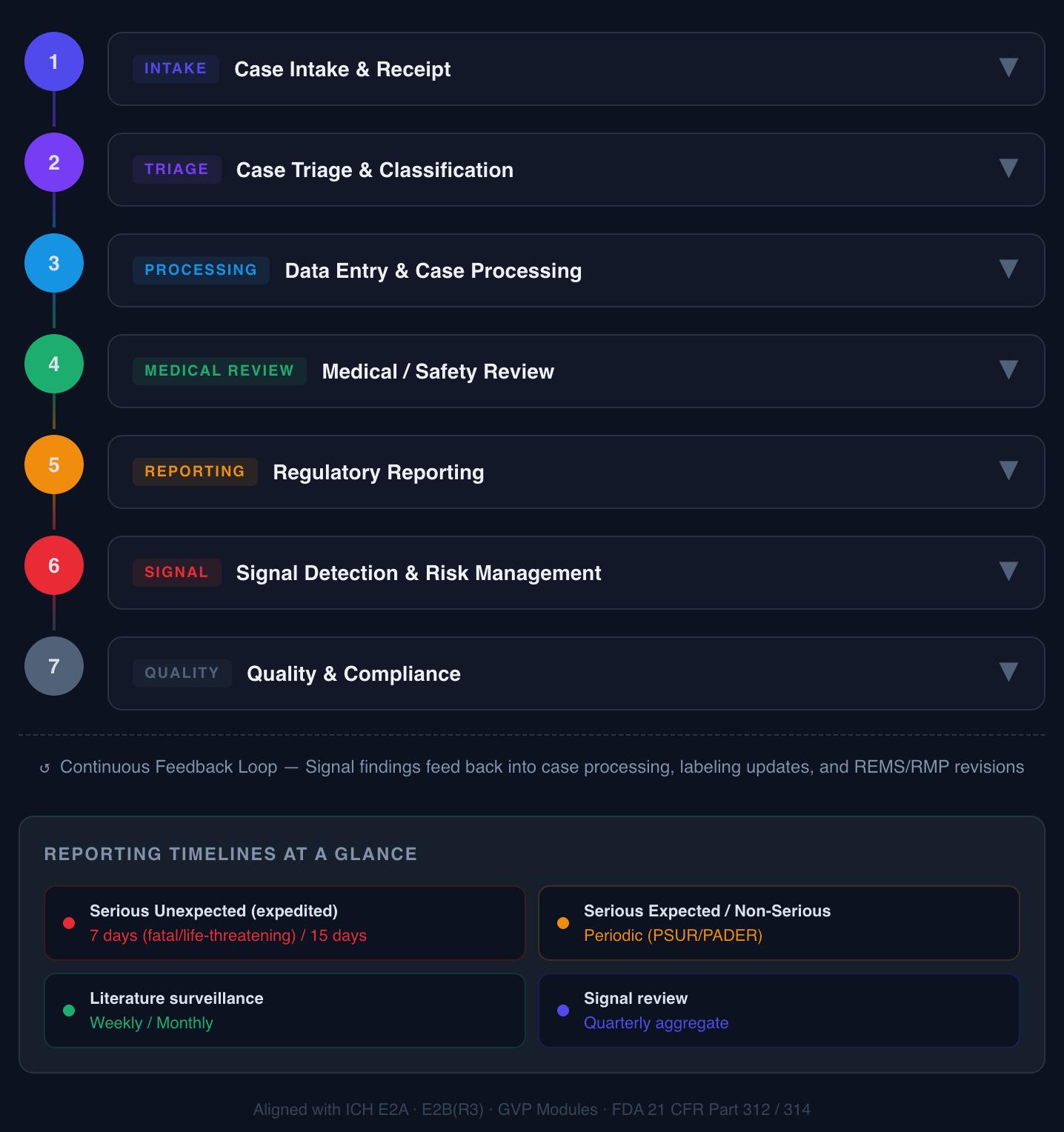
Governing Pharmacovigilance Across Products and Regions
As portfolios diversify, governance becomes the true differentiator between reactive safety operations and scalable excellence. Each new product, region, or outsourcing arrangement introduces subtle variations in process. Without a central blueprint, these variations accumulate and create confusion about responsibilities, system ownership, and data flows.
A scalable pharmacovigilance model requires formal governance. A cross functional safety council that includes pharmacovigilance leadership, regulatory affairs, quality, clinical development, information technology, and vendor management should own the operating blueprint. This group should define how core processes are applied across products and geographies and should update templates when business realities change. Whether expanding into new therapeutic modalities such as cell and gene therapies or entering additional regulatory regions, updates should be deliberate and documented rather than improvised.
Practical governance begins with standardized artifacts. A core process map that spans intake through aggregate reporting and risk management provides a shared foundation. RACI charts clarify sponsor, partner, and vendor responsibilities. Standard data exchange agreements define how safety information moves between organizations. Baseline system configurations ensure that new products start from a consistent and validated template rather than from scratch.
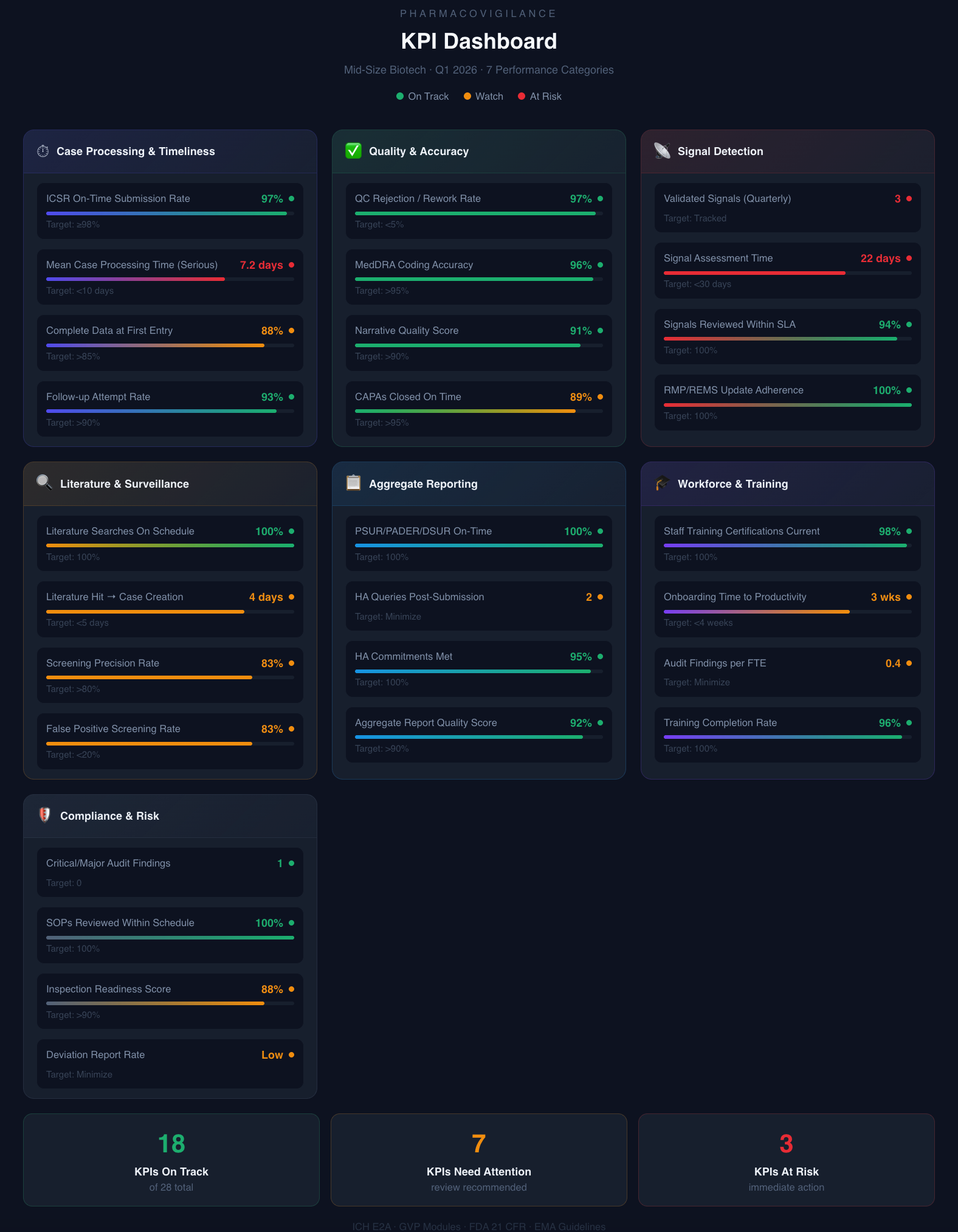
Metrics complete the governance framework. Inspection readiness improves when organizations consistently monitor a focused set of key performance indicators. These may include case intake cycle time by source, coding accuracy, narrative quality measures, on time submission rates, signal validation lead times, and the effectiveness of risk minimization measures. Importantly, these metrics should be derived directly from the safety platform that supports daily operations rather than from disconnected spreadsheets assembled before audits.
When the operating model, technology platform, and governance forums are aligned, pharmacovigilance becomes a strategic asset rather than a reactive function. Biotechs can onboard new products more quickly because roles and workflows are predefined. They can respond confidently to inspection questions because documentation and dashboards reflect how work is actually performed. They can scale into new regions and partnerships without rebuilding safety processes each time.
For growth stage biotechnology companies, mapping a scalable pharmacovigilance value stream is not merely an operational exercise. It is a foundation for sustainable expansion, regulatory confidence, and long term patient safety.
Subscribe to our Newsletter
