

Request a demo specialized to your need.
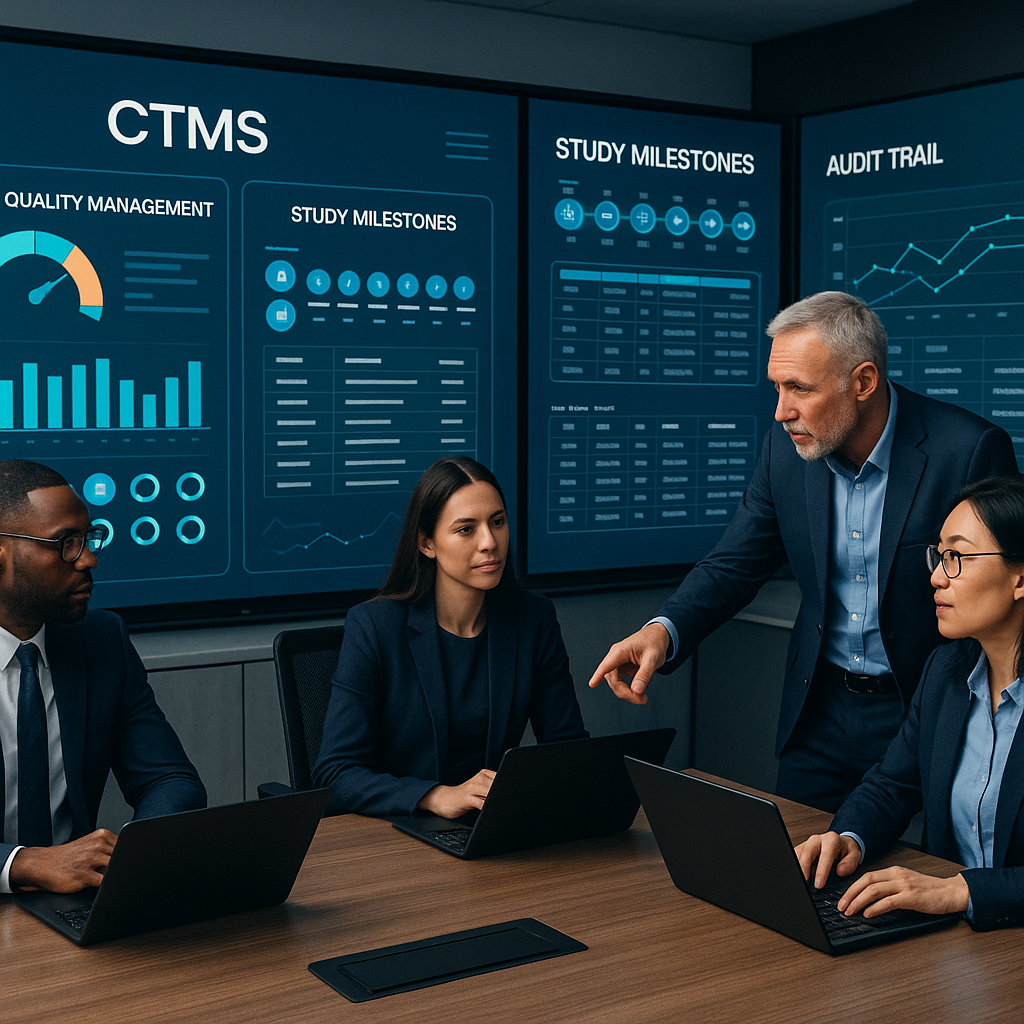
A step-by-step guide to mapping E6(R3) risk-based quality into daily CTMS work.
Operationalizing ICH E6(R3): Turning GCP Principles into CTMS-Driven Execution
The release of ICH E6(R3) marks a decisive evolution in Good Clinical Practice. Rather than prescribing static checklists, E6(R3) codifies a modern philosophy of clinical oversight—one that emphasizes critical thinking, proportionality, and risk-based quality management across the trial lifecycle.
For sponsors and CROs, the challenge is no longer understanding the principles. The challenge is making them real—operational, repeatable, inspectable, and scalable. This is where the Clinical Trial Management System (CTMS) becomes a strategic control layer, not just a tracking tool.
Translating E6(R3) Principles into Actionable CTMS Workflows
At the heart of E6(R3) is the concept of Critical-to-Quality (CTQ) factors: the endpoints, data, and processes that most directly impact participant safety and the reliability of trial results. Operationalizing this principle requires moving beyond generic task lists and embedding CTQ awareness directly into CTMS structures and workflows.
The first step is intentional design. Sponsors should identify CTQ factors during protocol development and explicitly model them within CTMS objects—studies, countries, sites, visits, milestones, issues, and risks. When CTQ context is embedded into these foundational entities, prioritization becomes systemic rather than subjective. Teams no longer rely on individual judgment alone; the system itself surfaces what matters most.
Role-based workflows should then be aligned to ensure CTQ and risk considerations are visible from study start-up through closeout. Site activation, for example, can be gated on completion of protocol-specific risk assessments rather than administrative checklists alone. Monitoring plans can embed quality tolerance limits (QTLs) that directly reflect CTQ endpoints, while protocol deviations can be automatically linked to issue management and CAPA workflows.
Well-designed CTMS dashboards complete the loop by clearly differentiating routine operational tasks from CTQ-related activities. This distinction enables clinical teams to allocate time and attention proportionally, reinforcing E6(R3)’s expectation that oversight is intentional, focused, and risk-driven rather than uniformly applied.
Implementing Risk-Based Quality and Data Integrity by Design
Risk-based quality management (RBQM) is no longer a parallel process or a monitoring-only concern. Under E6(R3), it is a continuous, end-to-end discipline that must be built into daily trial execution. CTMS platforms play a central role in making RBQM operational rather than aspirational.
Effective implementation begins with a structured protocol risk assessment that evaluates both impact and probability for critical processes and data. These risks should then be explicitly linked within CTMS to monitoring strategies—on-site, remote, or centralized—and to predefined data checks that scale with risk level. Quality tolerance limits should be clearly attributed to specific endpoints or processes and monitored through automated signals rather than periodic manual reviews.
Equally important is data integrity by design. CTMS must maintain complete and immutable audit trails, enforce role-based access controls, and preserve traceability across decisions, findings, and actions. Integration with eTMF and EDC systems is no longer optional; synchronization of milestones, documents, and data reduces transcription risk and strengthens the evidentiary chain regulators increasingly expect.
Change control workflows are another critical element. Protocol amendments should automatically cascade through country and site plans while capturing rationale, impact assessments, and approvals. When risk, quality, and change management are unified within CTMS, organizations can respond faster to emerging signals while remaining aligned with both the letter and spirit of GCP.
Sustaining Inspection Readiness Through Evidence-Rich Operations
E6(R3) reframes inspection readiness as a state of being, not a pre-inspection exercise. Regulators increasingly expect sponsors to demonstrate how oversight decisions were made, not just that procedures existed. This demands evidence-rich operations sustained throughout the trial lifecycle.
CTMS should serve as the system of record for inspection readiness by providing living dashboards that summarize high-risk processes, QTL excursions, unresolved issues, and associated CAPAs. Every decision—monitoring adjustments, site escalations, risk mitigations—should be traceable to underlying data and documented with approvals, timestamps, and ownership.
Organizations should institutionalize periodic risk reviews at key milestones and require that lessons learned are fed back into templates, configurations, and SOPs. Training should reinforce CTQ-driven triage so teams consistently align effort with risk. Simulated inspections can further validate readiness by tracing a critical finding from initial signal through resolution across CTMS, eTMF, and EDC, confirming the completeness and coherence of the documentation chain.
Sponsors and CROs that operationalize E6(R3) in this way move beyond compliance toward confidence. They achieve clearer oversight, faster issue resolution, fewer inspection surprises, and a durable regulatory posture that scales with portfolio complexity.
How Cloudbyz CTMS Operationalizes ICH E6(R3) at Scale
The finalization of ICH E6(R3) represents a fundamental shift in how Good Clinical Practice is expected to be executed. GCP is no longer defined by static procedures or retrospective documentation. Instead, regulators are signaling a clear expectation: continuous, risk-based oversight driven by critical thinking, proportionality, and evidence-rich decision-making.
Meeting this expectation requires more than policy updates or incremental process tweaks. It requires a new operating model—one in which the Clinical Trial Management System (CTMS) evolves from a task tracker into a unified risk and quality control plane for clinical operations.
This is precisely where Cloudbyz CTMS differentiates itself.
Cloudbyz CTMS: A Unified Control Plane for Risk, Quality, and Oversight
Traditional CTMS platforms were designed to answer a narrow question: Is the study on track?
E6(R3) demands a far more sophisticated answer: Is the study under control—and can you prove it?
Cloudbyz CTMS is architected as a control plane that continuously connects risk, quality, execution, and evidence across the clinical lifecycle. Rather than treating risk management, monitoring, deviations, and inspection readiness as downstream activities, Cloudbyz embeds them directly into how studies are designed, activated, executed, and closed.
At the foundation is explicit modeling of Critical-to-Quality (CTQ) factors. During study setup, sponsors define which endpoints, data, and processes most impact participant safety and data reliability. These CTQs are not stored in static documents; they are embedded directly into CTMS objects—studies, countries, sites, visits, milestones, issues, and risks—so that prioritization is systemic and continuous.
As a result, Cloudbyz CTMS does not merely record activity. It actively orchestrates attention, ensuring teams focus on what matters most under E6(R3).
Operationalizing Risk-Based Quality Management by Design
Risk-Based Quality Management (RBQM) sits at the center of E6(R3), and Cloudbyz treats RBQM as a first-class operational capability—not a monitoring add-on.
Protocol risk assessments within Cloudbyz CTMS translate directly into executable controls. Risks are scored for impact and probability, then linked to monitoring strategies (on-site, remote, centralized), oversight intensity, and data review cadence. Quality Tolerance Limits (QTLs) are configured as live operational thresholds tied to endpoints or critical processes, with automated signals when tolerances are approached or exceeded.
This design enables continuous risk sensing rather than periodic review. Monitoring plans adapt dynamically, oversight scales proportionally, and decisions are always traceable back to predefined risk logic—exactly as regulators now expect.
Equally important is data integrity by architecture. Cloudbyz CTMS enforces role-based access, immutable audit trails, and traceable relationships between study plans, monitoring findings, deviations, CAPAs, and decisions. Native unification with eTMF and EDC ensures that operational status, documentation, and data remain synchronized—reducing transcription risk while strengthening the evidentiary chain.
Embedding Oversight into Everyday Clinical Execution
E6(R3) elevates oversight from a periodic activity to a continuous responsibility. Cloudbyz CTMS operationalizes this shift by embedding quality and risk signals directly into daily workflows.
Site activation can be gated on completion of protocol-specific risk assessments rather than administrative readiness alone. Protocol deviations automatically trigger issue workflows, root cause analysis, and CAPAs—linked to both monitoring findings and CTQ impact. Amendments propagate across country and site plans through controlled change workflows that capture rationale, approvals, and downstream impact.
Dashboards within Cloudbyz CTMS intentionally separate routine operational tasks from CTQ-driven activities, enabling clinical leaders to allocate resources proportionally rather than uniformly. This distinction transforms oversight from reactive management to proactive control.
Inspection Readiness as a Continuous State, Not an Event
Under E6(R3), inspection readiness is no longer achieved through last-minute document reconciliation. Regulators increasingly assess how decisions were made, not just whether procedures existed.
Cloudbyz CTMS supports sustained inspection readiness by serving as the living system of record for oversight. Real-time dashboards summarize high-risk processes, QTL excursions, unresolved issues, and CAPA status. Every decision—monitoring strategy changes, site escalations, risk mitigations—is timestamped, approved, and linked to underlying data.
Organizations can simulate inspections directly within the platform, tracing a critical finding from initial signal through resolution across CTMS, eTMF, and EDC. This capability not only validates readiness but also reinforces a culture of accountable, evidence-driven execution.
The Strategic Advantage: Confidence at Scale
Sponsors and CROs that rely on fragmented systems struggle to demonstrate coherence under E6(R3). Those that adopt Cloudbyz CTMS as a unified risk and quality control plane gain something far more powerful than compliance: operational confidence.
They see risks earlier, respond faster, allocate resources intelligently, and engage regulators with clarity and credibility. Oversight becomes durable, scalable, and defensible—aligned not just with the requirements of E6(R3), but with its intent.
In the E6(R3) era, CTMS is no longer a system of record. With Cloudbyz, it becomes the system of control.
Subscribe to our Newsletter
