

Request a demo specialized to your need.

How Salesforce-native Cloudbyz CTMS unifies activation, finance, and eTMF to cut site delays and budget drift.
In an industry where a single day of site activation delay can cost a sponsor upwards of $600,000 in lost trial revenue, the hidden drag from three separate systems that never talk to each other is no longer a technology problem — it is a competitive liability.
The problem in depth
Why Fragmented CTMS, Finance, and eTMF Stacks Stall US/EU Site Activation
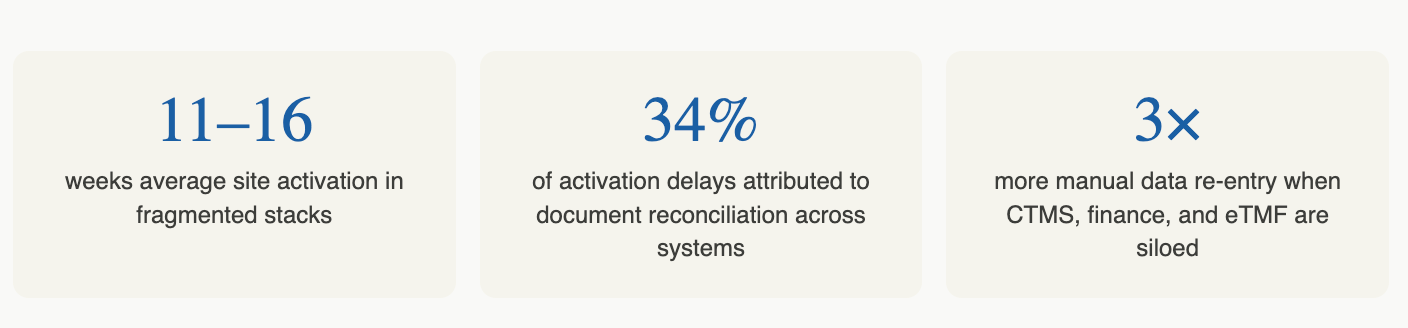
Site activation is not a single event. It is a multi-threaded workflow that demands near-perfect coordination across clinical operations (CTMS), financial management (CTFM), and essential document archiving (eTMF). When these three systems exist on separate platforms — often maintained by different IT teams, with different data models and access controls — every handoff between them becomes a candidate for delay, error, or audit finding.
The anatomy of a siloed site activation
Consider the sequence a typical site coordinator and CRA team navigate before a site's first patient can be enrolled. Regulatory documents must be executed (informed consent, investigator agreements, financial disclosure forms), budget and payment terms must be locked and approved, IRB/IEC and competent authority submissions must be filed, and the eTMF must reflect the current state of each document at each site — often in near-real time to satisfy ICH E6(R3) TMF completeness requirements.
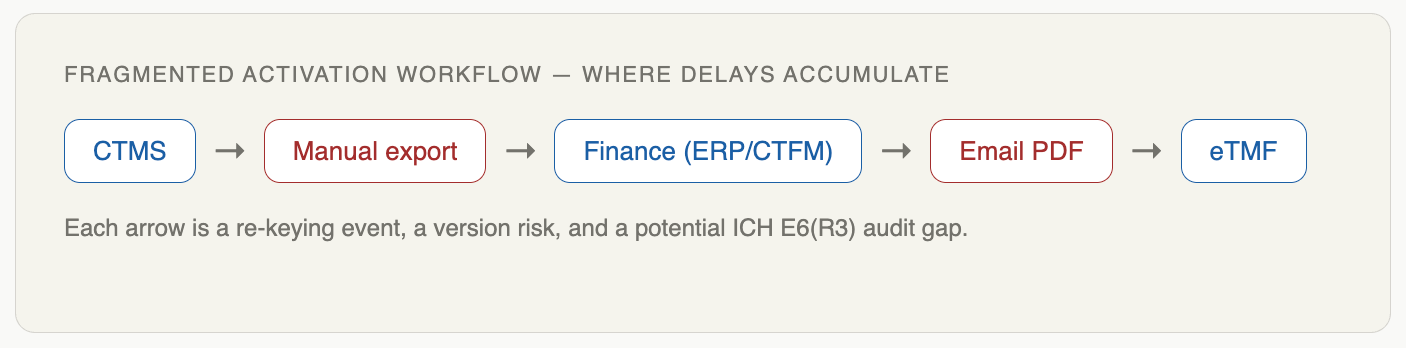
In a fragmented stack, the regulatory document team uploads a final Site Agreement into a standalone eTMF. The CTMS has no visibility into that filing. The finance team is simultaneously negotiating a budget amendment in a separate ERP module. When the site's IRB approval is received, the CRA files it into the eTMF — but the CTMS milestone "IRB Approval Received" must be manually updated by a separate team member, often days later. The eTMF and the CTMS are now describing different realities about the same site.
"We had sites that were contractually ready and financially approved but couldn't open because the eTMF index showed essential documents as outstanding. The documents existed — they were just filed in the wrong system." — Head of Clinical Operations, Top-10 CRO
The US/EU regulatory double burden
US IND studies operate under 21 CFR Part 312, which requires sponsors to maintain adequate and accurate records. EU CTR 536/2014 and EudraCT/CTIS submissions impose their own country-specific essential document requirements, including local regulatory authority approvals that vary by member state. Running parallel US and EU activations through a fragmented stack means maintaining two separate compliance tracks with no automated cross-referencing.
|
Activation checkpoint |
System traditionally responsible |
Fragmented risk |
Frequency of re-work |
|
Site contract executed |
CTFM / Legal system |
CTMS milestone not auto-updated |
High |
|
Budget amendment approved |
CTFM / ERP |
eTMF financial disclosure docs out of sync |
High |
|
IRB/IEC approval filed |
eTMF |
CTMS still shows milestone "pending" |
High |
|
Protocol deviation log opened |
CTMS |
eTMF deviation section not auto-populated |
High |
|
Site initiation visit documented |
CTMS / eSource |
eTMF SIV report filed separately and manually |
High |
Each row in that table represents a manual reconciliation cycle — typically managed by a dedicated TMF reconciliation coordinator whose entire job is synchronizing data across platforms that should never have been separated in the first place.
The ICH E6(R3) inflection point
The 2023 adoption of ICH E6(R3) — and its explicit requirement for a quality management system (QMS) embedded within clinical trial processes — places new pressure on sponsors and CROs to demonstrate real-time oversight. The guidance states that the QMS should be proportionate to the risk and complexity of the trial, and that trial master files should be maintained in a way that ensures completeness, legibility, and retrievability at all times during and after the trial.
A fragmented stack cannot satisfy this in practice. "Completeness" means something specific when your CTMS says a site has 14 of 17 essential documents filed, your eTMF says 11 of 17, and your finance system has locked a budget that references a protocol version different from the one in your eTMF. These discrepancies are not hypothetical — they surface in every FDA inspection of fragmented environments and are a primary driver of form 483 observations related to clinical records.
- Inspection readiness gaps: TMF index does not match CTMS milestone status in real time, creating "version drift" that inspectors flag immediately.
- Budget lock delays: finance systems approve amended budgets days after site contracts are counter-signed, blocking CTMS activation gates.
- Document attribution errors: manual re-entry of site contact and IRB information across three systems creates name, address, and date discrepancies that trigger GCP queries.
- Cross-border EU complexity: country-level regulatory approvals require filing in the eTMF against specific site and country records that may not exist yet in the CTMS, creating chicken-and-egg dependency loops.
The architecture of connection
CTMS ↔ CTFM ↔ eTMF on Salesforce: From Siloed Delays to Connected Activation
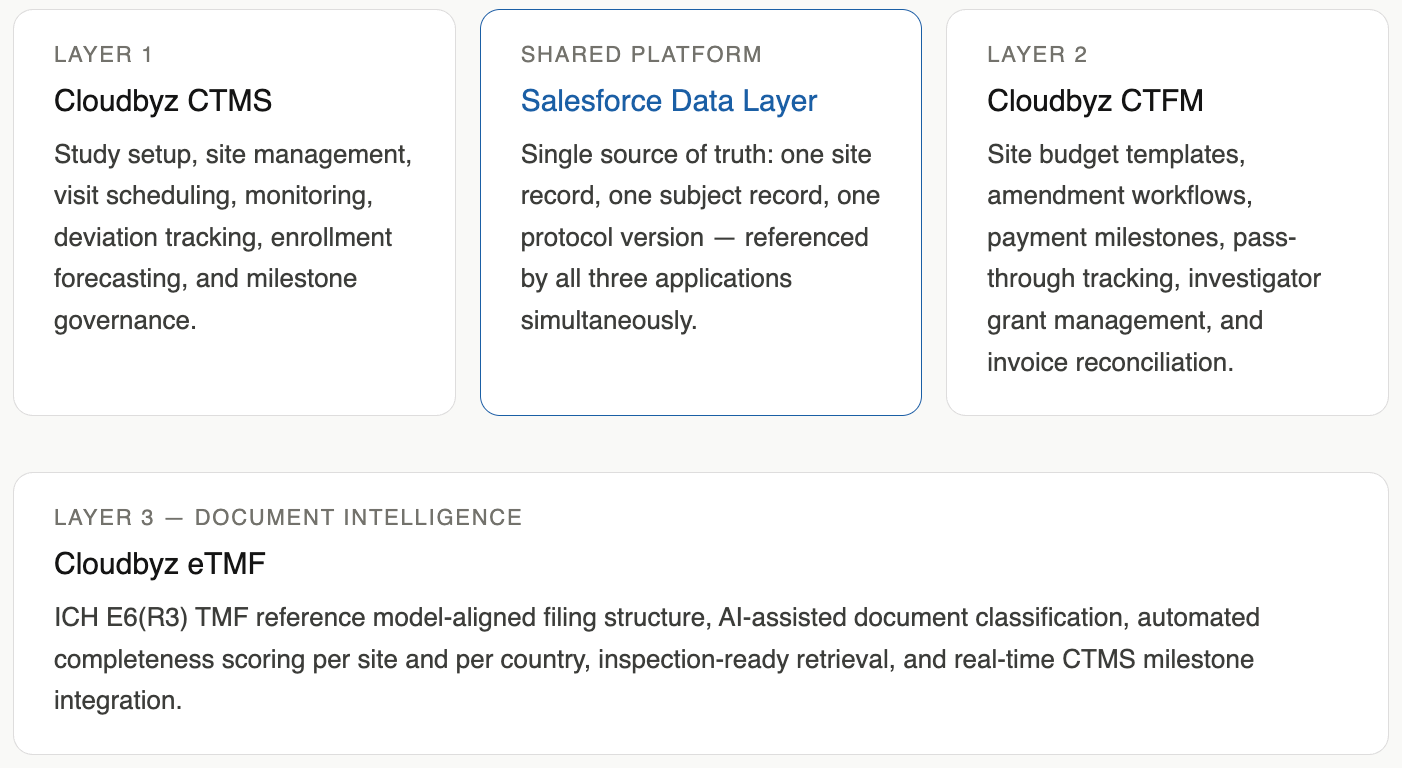
The case for a unified platform is not merely organisational convenience — it is a structural response to the data-dependency model that site activation actually demands. When CTMS, Clinical Trial Financial Management (CTFM), and eTMF share a common data layer, activation milestones cease to be manual checkboxes and become system-enforced outcomes of document and financial events that have already been recorded.
Why Salesforce as the clinical spine
Salesforce provides something that point-solution stacks cannot: a governed, audit-trailed, configurable data model that is native to relationship management at scale. Clinical trials are fundamentally relationship graphs — sponsors to CROs, CROs to sites, sites to investigators, investigators to IRBs, all annotated by document states, financial agreements, and regulatory filings. Salesforce's object model maps to this graph naturally, and its platform audit trail (field history tracking, object history) satisfies 21 CFR Part 11 electronic records requirements without custom middleware.
When Cloudbyz CTMS, CTFM, and eTMF are all built on the Salesforce platform, a document filing in the eTMF can immediately update a CTMS milestone record and trigger a financial workflow in CTFM — not through a nightly batch integration, but through platform-native automation that executes in the same transaction.
Connected activation in practice: what changes
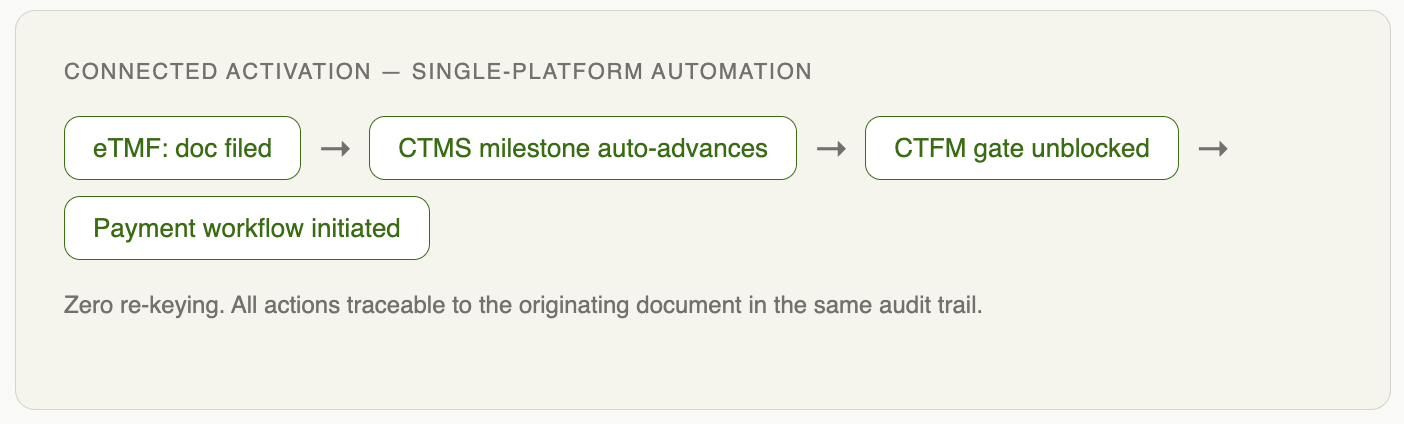
When a site coordinator uploads a signed Site Agreement into the eTMF, the document classifier assigns it to the correct TMF reference model artifact (e.g., 06.02 — Investigator's Curriculum Vitae placeholder is separate from 06.01 — Protocol Signature Page). Simultaneously, a platform automation fires against the linked CTMS Site record, advancing the milestone "Site Contract Executed" from "Pending" to "Complete." The CTFM budget workflow, which was waiting on contract execution as a prerequisite gate, is automatically unblocked and routed for financial approval.
Financial-clinical bidirectional triggers
The CTFM integration runs in both directions. When a site's patient enrollment milestone is reached in the CTMS — say, the 10th subject enrolled at a site — a CTFM payment milestone trigger fires automatically, generating a provisional invoice for the investigator grant increment. The eTMF completeness check runs in parallel: if essential documents for the relevant visit window are outstanding, the invoice is held pending document resolution rather than silently paid against an incomplete TMF.
This bidirectional architecture eliminates the category of error where sites are financially settled against incomplete regulatory records — a scenario that creates both financial reconciliation problems and GCP compliance exposure at inspection.
|
Activation KPI |
Fragmented stack (typical) |
Unified Salesforce platform |
|
Median site activation cycle time |
11–16 weeks |
6–9 weeks |
|
TMF completeness at SIV |
62–74% (TUFMS benchmark) |
>90% automated enforcement |
|
Manual data re-entry events per site |
30–50 per activation cycle |
2–5 (exception handling only) |
|
Budget amendment cycle time |
18–24 days |
4–7 days |
|
Inspection readiness preparation time |
6–12 weeks before audit |
Continuous / on-demand |
US/EU parallel activation: the multiregional advantage
For global studies running US IND and EU CTR submissions in parallel, the shared Salesforce data model provides a single protocol and site record that supports multiple regulatory overlays without duplicating the underlying clinical data. A US site record and a matched EU site record for the same principal investigator share the same contact, facility, and financial data. Country-specific eTMF structures (EU member state essential documents, competent authority correspondences) are maintained as child filing structures beneath the same study, giving global study managers a unified completeness dashboard across geographies.
Cloudbyz CTMS supports regulatory-jurisdiction-aware activation checklists: a US site activation checklist auto-populates with FDA Form 1572 and IND safety reporting obligations, while a parallel EU checklist populates with CTIS submission status, member state approval tracking, and Annex I protocol compliance fields — both visible from the same Salesforce Study record.
Quality by design
ICH E6(R3) Quality Management on a Unified CTMS Spine
ICH E6(R3) does not merely update the language of good clinical practice — it reframes the entire quality paradigm from retrospective documentation to prospective risk management. Where E6(R2) asked sponsors to document what happened, E6(R3) asks them to demonstrate that they designed quality into their processes from the outset, monitored for risk signals in real time, and escalated findings through a governed quality system.
This is an architectural challenge as much as a process challenge. A QMS embedded in a separate document management system, with no live connection to study execution data in a CTMS, cannot provide the real-time oversight ICH E6(R3) contemplates. Quality events — protocol deviations, eligibility query patterns, TMF completeness signals — must be visible as they occur, not reconstructed for a periodic quality review.
The E6(R3) QMS requirements mapped to system capabilities
- Risk-based quality management (RBQM):Sponsors must define critical-to-quality factors (CQFs), establish KRIs, and monitor for threshold breaches. On the Cloudbyz CTMS spine, KRI calculations run against live enrollment, protocol deviation, and data query records — not against lagged exports to a separate analytics platform.
- TMF completeness as a QMS output:E6(R3) explicitly frames the TMF not as an archive but as an active management tool. eTMF completeness scores in Cloudbyz update in real time and feed a quality dashboard visible to the sponsor's quality assurance team, study management, and site coordinators — three audiences who previously received three different views of the same TMF at different lag times.
- Deviation management linked to document state:When a protocol deviation is opened in the CTMS, the system checks the eTMF for the current approved protocol version at that site and the current informed consent version on file. If either is outdated, the deviation record is flagged with a linked document resolution task — an E6(R3) critical-to-quality linkage that a fragmented stack would require manual triage to achieve.
- Sponsor oversight of CRO-managed sites:For studies managed through a CRO, E6(R3) preserves the sponsor's non-delegable responsibility for overall trial quality. The unified platform provides sponsor-level read access to CTMS milestone status, CTFM financial compliance, and eTMF completeness across all CRO-managed sites — without requiring the CRO to generate and send periodic status reports.
- Audit-ready electronic records:21 CFR Part 11 and EU Annex 11 compliance requires that electronic records be attributable, legible, contemporaneous, original, and accurate (ALCOA+). Salesforce's native field history and object audit trail, combined with Cloudbyz's e-signature integration and document version control in the eTMF, provides a single ALCOA+ compliant record system across all three functional domains.
Quality by design: building activation gates into the data model
The most powerful E6(R3) capability in a unified CTMS is the ability to make quality a structural property of the activation workflow rather than a parallel process. Activation gate logic — the set of conditions that must be true before a site can progress from "Selected" to "Initiated" to "Active" — can be encoded directly into the CTMS as record validation rules and field dependencies.
For example: a site cannot transition to "Initiated" status unless the eTMF shows a completeness score ≥ 85% for the "Before First Subject Enrolled" artifact set, the CTFM budget record shows an "Approved" status, and the CTMS checklist has no open critical items. These are not reminders — they are hard gates enforced by the platform. A CRA cannot manually override them without a formal quality exception record, which is itself captured in the QMS and available for inspection.
This is the E6(R3) vision of proportionate quality management made operational: quality is not a department that reviews outputs after the fact. It is a set of governed constraints embedded in the clinical data model, firing at every meaningful transition point in the site lifecycle.
Continuous inspection readiness as an operational posture
The traditional model of "inspection preparation" — a 6–12 week scramble to reconcile TMF contents, close deviations, and assemble study binders before an announced FDA or EMA inspection — is a symptom of fragmented systems. When the TMF reflects the current state of study execution at all times, when every deviation has a resolution record linked to the protocol version in effect at the time, and when every financial transaction is traceable to an approved budget amendment and a corresponding TMF filing, inspection readiness is not a project. It is a state of the system.
Cloudbyz eTMF provides an inspection mode dashboard that replicates the view an FDA inspector would have of the TMF index — filterable by site, by artifact category, by filing date, and by expected versus actual document count. Running this view weekly as part of standard quality operations is categorically different from generating it for the first time upon receiving an inspection notification.
Looking ahead: AI-assisted quality signals
The next generation of CTMS-embedded QMS capability moves beyond rule-based gate enforcement to predictive quality signalling. Machine learning models trained on historical deviation patterns, site performance data, and TMF completeness trajectories can identify at-risk sites weeks before a formal threshold breach — enabling targeted remote monitoring, site coaching, or resource reallocation before the risk materialises as a GCP finding.
On a unified Salesforce platform, this AI layer has access to the full clinical, financial, and regulatory document signal simultaneously — the kind of multi-dimensional risk view that a fragmented stack cannot produce without a bespoke data warehouse and a team of analysts to run it.
The bottom line for sponsors and CROs
Fragmented CTMS, CTFM, and eTMF stacks are not a technology legacy problem waiting for a future migration budget. They are an active cost — measured in delayed site activation, redundant headcount, audit exposure, and the compounding drag of manual reconciliation across every study, every cycle, every inspection.
A unified platform on Salesforce, with CTMS, CTFM, and eTMF sharing a single data model and a single automation layer, converts activation from a coordination problem into a system outcome. ICH E6(R3)'s quality management requirements stop being a compliance obligation managed in parallel and start being a native property of how the study executes.
For organisations running five studies today and planning to run twenty in three years, that is not a product feature. It is the foundation that makes scale possible without scaling the headcount and the risk in equal measure.
Subscribe to our Newsletter
