

Request a demo specialized to your need.

Make month‑end close predictable with event‑driven payables and audit‑ready evidence.
How Modern Clinical Trial Financial Management Turns a Monthly Fire Drill into a Predictable Process
Month-end close is one of the most stressful and least loved activities in clinical trial finance. For sponsors and CROs managing multiple studies, vendors, and countries, closing the books often means late nights, spreadsheets, reconciliations, and last-minute explanations.
In Clinical Trial Financial Management (CTFM), the challenge is amplified. Unlike corporate finance, trial costs are driven by enrollment behavior, protocol activity, site performance, and contract triggers—all of which change continuously. When finance systems cannot keep up with operational reality, month-end close becomes slow, fragile, and hard to defend.
Modern CTFM platforms are changing this narrative. By embedding real-time accruals, contract intelligence, and audit-ready controls, organizations can achieve a month-end close that is fast, defensible, and—finally—done on time.
Why Month-End Close Breaks Down in Clinical Trials
Traditional financial close processes were never designed for the dynamics of clinical research. Common failure points include:
-
Accruals estimated manually using outdated enrollment data
-
Site payments tracked separately from visit completion
-
Vendor invoices arriving late or mismatched to scope
-
Budget changes not reflected in current forecasts
-
Limited audit trails tying numbers back to trial activity
As a result, finance teams spend most of close reconciling discrepancies instead of validating outcomes. Each close becomes a one-off exercise rather than a repeatable process.
Reframing Month-End Close as a Continuous Process
The most important mindset shift is this:
Month-end close should not be something you start at the end of the month.
It should be something that is already 90% complete before the month ends.
In modern CTFM, close readiness is built continuously through the month as trial activity occurs. Accruals, obligations, and variances are captured in near real time, so close becomes a confirmation step—not a reconstruction exercise.
Core Capabilities of a Fast, Defensible CTFM Close
1. Real-Time, Activity-Based Accruals
Instead of estimating accruals at month-end, advanced CTFM systems calculate them continuously based on:
-
Patient enrollment and visit completion
-
Site and vendor contract terms
-
Milestone and per-event payment triggers
By the time the month ends, accruals already reflect what actually happened in the trial—not what finance hopes happened.
2. Contract-Driven Financial Logic
A defensible close depends on one thing: alignment between contracts and financials.
Modern CTFM platforms embed contract logic directly into accrual and payment calculations. This ensures:
-
Accruals match contractual obligations
-
Payments are triggered only when conditions are met
-
Variances can be explained using contract language
When auditors ask “Why was this accrued?”, the answer is traceable and immediate.
3. Automated Reconciliation Across Stakeholders
Month-end close often stalls at reconciliation—between:
-
Accruals vs actuals
-
Sponsor vs CRO records
-
Finance vs Clinical Operations
With unified CTFM, these reconciliations happen automatically throughout the month. Discrepancies are flagged early, assigned to owners, and resolved before close—not during it.
4. Built-In Controls and Audit Trails
Speed without control is risk. A defensible close requires:
-
Versioned budgets and amendments
-
Approval workflows for accrual adjustments
-
Electronic audit trails for every financial change
-
Clear linkage between trial activity and financial entries
Modern CTFM systems generate audit evidence as part of normal operations, eliminating the scramble when auditors arrive.
What a Modern Month-End Close Looks Like in Practice
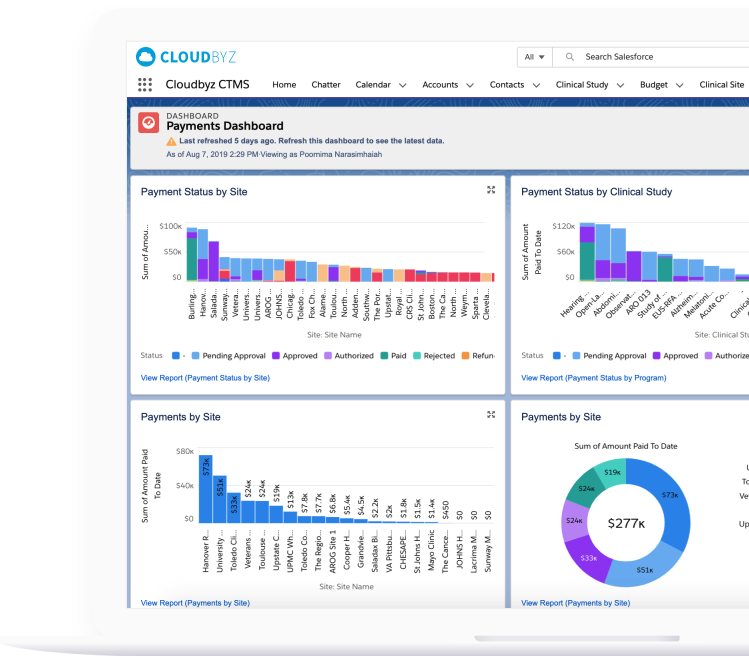
In high-performing organizations, the close process now follows a predictable rhythm:
-
Daily and weekly monitoring of accruals, payments, and variances
-
Pre-close validation of high-risk studies, sites, or vendors
-
Minimal manual adjustments at month-end
-
Rapid close sign-off with confidence in the numbers
What once took weeks now takes days—or hours.
Business Impact: Why This Matters Beyond Finance
For Finance Leaders
-
Shorter close cycles
-
Reduced reliance on spreadsheets
-
Stronger audit confidence
-
Predictable financial reporting
For Clinical Operations
-
Fewer disruptive finance queries
-
Clear understanding of cost impact tied to trial activity
-
Better collaboration with finance teams
For Executives and Boards
-
Timely, reliable trial burn visibility
-
Improved cash forecasting and runway planning
-
Fewer surprises at quarter-end
Month-end close becomes a strategic enabler, not a monthly liability.
The Role of Automation and AI in Closing Faster
Leading CTFM platforms increasingly use AI to:
-
Detect accrual anomalies early
-
Predict where close delays are likely to occur
-
Recommend adjustments based on historical patterns
-
Explain variances in plain language
This moves finance teams from manual reconciliation to intelligent oversight.
Common Questions About CTFM Month-End Close
What is month-end close in CTFM?
It is the process of finalizing clinical trial accruals, payments, and financial statements for a given month, based on actual trial activity.
Why is CTFM close harder than standard accounting close?
Because trial costs are driven by dynamic operational events—enrollment, visits, milestones—not fixed schedules.
How can sponsors close faster?
By using real-time accruals, contract-driven calculations, and automated reconciliation within a unified CTFM platform.
Conclusion: Close with Confidence, Not Compromise
Month-end close does not have to be slow, painful, or risky. With modern Clinical Trial Financial Management, it becomes fast, defensible, and repeatable.
When accruals reflect reality, contracts drive calculations, and controls are embedded by design, finance teams can stop firefighting and start leading.
In today’s environment—where capital discipline, audit scrutiny, and operational speed all matter—a strong CTFM month-end close is not just a finance win. It is a competitive advantage.
Subscribe to our Newsletter
