

Request a demo specialized to your need.
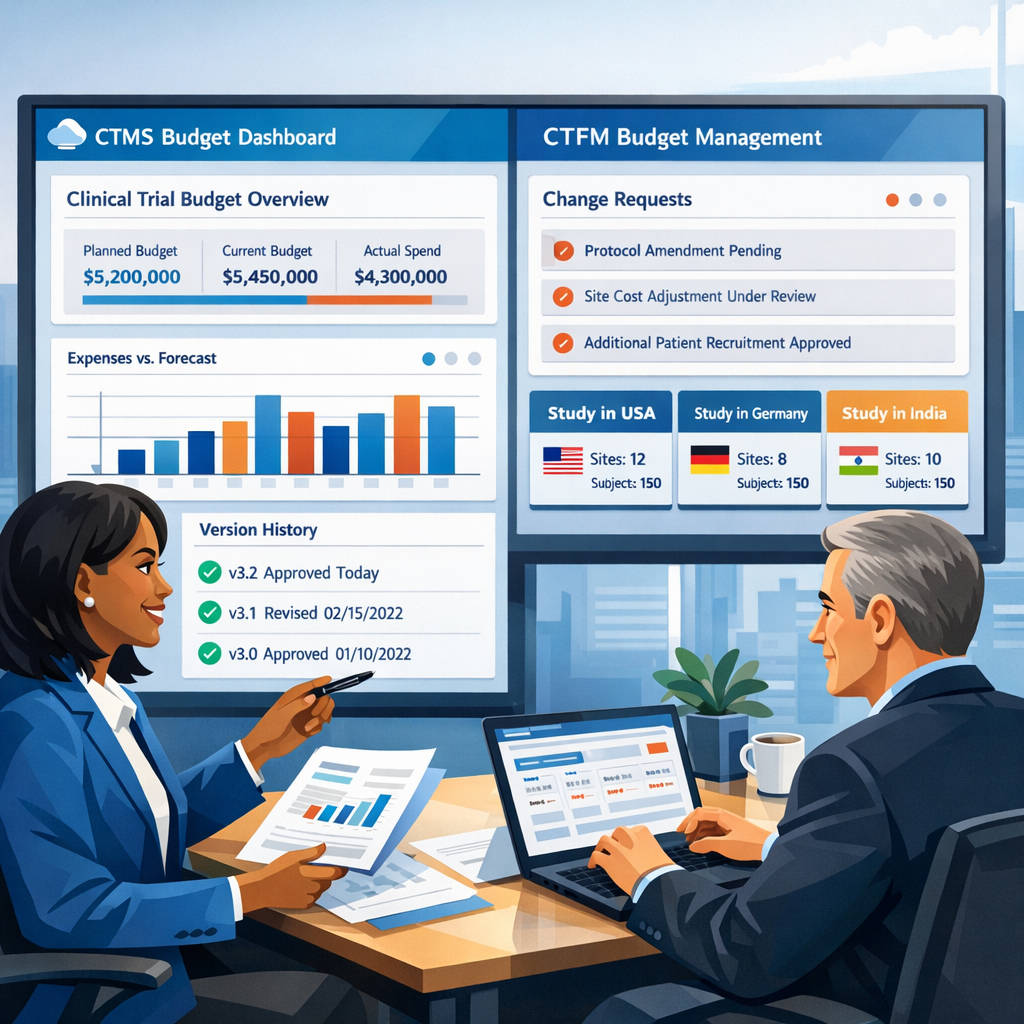
How to manage clinical trial budget amendments on a CTMS and CTFM backbone so changes stay fast, transparent, and auditable.
Why Clinical Trial Budgets Break — And How to Fix the Backbone
The problem isn't that budgets change. It's that change has no home.
Every sponsor and CRO knows the feeling: a protocol amendment lands, enrollment projections shift, a region underperforms, and suddenly the finance team is deep in a tangle of spreadsheets, email chains, and competing versions of the truth. By the time decisions are reflected in core systems, weeks have passed. Month-end reconciliation becomes a heroic effort. Audit trails are thin, approvals are implied rather than documented, and nobody can say with confidence which budget is the real budget.
This is not a technology failure. Most organizations already have a Clinical Trial Management System (CTMS) and Clinical Trial Financial Management (CTFM) platform in place. The failure is structural: critical financial decisions are being made around these systems rather than inside them. Until that changes, no amount of software investment will deliver the control and transparency that regulators, boards, and operations leaders need.
The Amendment Problem Is Bigger Than It Looks
Protocol amendments are inevitable. Regulatory feedback, safety signals, enrollment surprises, and site performance variation all create legitimate pressure to revise plans. The issue is not the frequency of change; it's the cost of managing it poorly.
Research consistently shows that a single mid-study protocol amendment can consume hundreds of thousands of dollars in unplanned spend, with ripple effects across site payments, vendor contracts, monitoring intensity, and cash flow timing. And a significant portion of that burden is preventable. Amendments driven by design flaws, unrealistic feasibility assumptions, or weak startup planning look identical in most systems to those driven by unavoidable regulatory requirements. Without that distinction, organizations cannot learn, benchmark, or improve.
The first step toward control is recognizing that not all amendments are equal, and that your systems should reflect that.
Building a Change-Control Taxonomy That Sticks
Meaningful budget change control starts with classification. An IRB-driven safety change that adds visits and procedures is a fundamentally different event from a vendor repricing exercise or a country timeline shift. When these are tracked the same way, or not tracked at all, the cumulative picture becomes unreadable.
In a well-configured CTMS, every amendment should be captured as a structured object, not a task or a note. That means standard fields for amendment type (protocol, contract, operational), affected entities (countries, sites, visits, vendors, timelines), cause code (regulatory, safety, design flaw, feasibility, commercial), and status. Crucially, each change request should link directly to the CTMS entities it touches, so that when a safety visit is added, the system knows which studies, sites, and visit templates are in scope before a single dollar figure is discussed.
This taxonomy does more than organize records. It creates the foundation for governance reporting: how many amendments per study, broken down by phase, therapeutic area, and avoidable versus unavoidable cause. Over time, that data sharpens both protocol design and budgeting practice in ways that no spreadsheet audit ever could.
From Ad Hoc Modeling to Structured Scenario Planning
Once a change request exists, the natural next question is: what does this do to the budget? In most organizations today, that question triggers someone to copy a baseline Excel file and start making edits. The result is a proliferation of versions, lost context, and decisions that are hard to reconstruct later.
A better approach uses CTFM for structured scenario planning before any baseline is touched. When a protocol amendment is proposed, teams should clone the current budget into test scenarios (current-state, sponsor proposal, internal recommendation) and express the proposed changes as configuration deltas: revised visit templates, updated rate cards, altered country mix, new vendor fees. The system can then surface the resulting budget curves and cash projections side by side.
This changes the nature of the conversation. Instead of debating which spreadsheet is correct, decision-makers can weigh genuine trade-offs: Does absorbing a higher per-patient cost preserve data quality and timeline? Is it better to extend enrollment in a slow region or open additional sites? How does adjusted monitoring intensity offset the cost of added procedures? When those discussions happen on a shared, structured data set, the decision itself becomes documentable, and the chosen scenario can be promoted to a new baseline with a complete record of what was considered and why.
Approval Workflows That Close the Loop
Scenario modeling only delivers value if approvals are captured with the same rigor. Role-based routing through clinical leadership, FP&A, regional operations, and QA as appropriate should be built into the amendment workflow, not bolted on afterward via email. Each approval step should attach to a specific scenario delta, not just to a document or a meeting.
When a path is chosen, CTFM marks the selected scenario as the new baseline and archives the alternatives. CTMS then generates the downstream tasks: updating startup packs, revising monitoring plans, triggering contract change orders, notifying CRO partners and sites. Site and vendor portal views update automatically to reflect revised budgets, rate cards, and payment thresholds.
The result is a closed loop, from the moment a change is proposed to the moment it is reflected in payments and accruals, with every step documented and traceable.
Making Amendments Visible at Every Level
Control without visibility is incomplete. Finance and clinical leaders need to see the cumulative effect of amendments over time, and they need to see it at the level where decisions are made.
At the study level, a clinical-finance cockpit should display the original budget, the current baseline, and a timeline of amendments, each tagged with its drivers and outcomes. A click on any amendment marker should reveal which protocol or contract change it corresponded to, how volume, rate, mix, and timing shifted, and what happened to enrollment and cash in the weeks that followed. Buffers and contingencies should be visible against actual consumption, not buried in footnotes.
At the portfolio level, governance bodies should review amendment patterns as a standing agenda item. Are certain therapeutic areas or phases consistently over-amended? Are contingency buffers systematically insufficient? Is a particular CRO or region driving outsized change requests? These are strategic questions that CTMS and CTFM data can answer, but only if amendments are consistently captured, classified, and reported there.
The Single Source of Truth Imperative
None of this works unless teams and partners treat CTMS and CTFM as the authoritative record of financial change. This is partly a technology question and partly a culture one.
On the technology side, it means ensuring that CROs and sites see their amendment-related actions reflected in portal views that pull directly from core systems, not from separately distributed files. It means regulatory and audit teams can pull complete chains of evidence, from protocol and contract redlines through scenario models to final budgets and payment patterns, without assembling them manually.
On the culture side, it means training project managers to understand that slide decks and spreadsheets are communication tools, not systems of record. Decisions belong in CTMS. Models belong in CTFM. Everything else is a derivative.
The Payoff: Amendments That Explain Themselves
When budget change control lives on a single backbone, the operational benefits are real and immediate. Month-end reconciliation becomes routine rather than heroic. Board and investor conversations are better grounded in operational reality. Regulatory inspections can focus on the quality of decisions rather than on whether the organization can prove what happened.
More importantly, the organization learns. Cause codes accumulate into benchmarks. Patterns become visible. Protocol design improves. Budgeting assumptions sharpen. The cost of amendments, both financial and organizational, comes down over time.
The goal was never a perfect budget that never changes. It was always a system where change is controlled, visible, and understood. With CTMS and CTFM as the backbone, that system is well within reach.
Subscribe to our Newsletter
