

Request a demo specialized to your need.
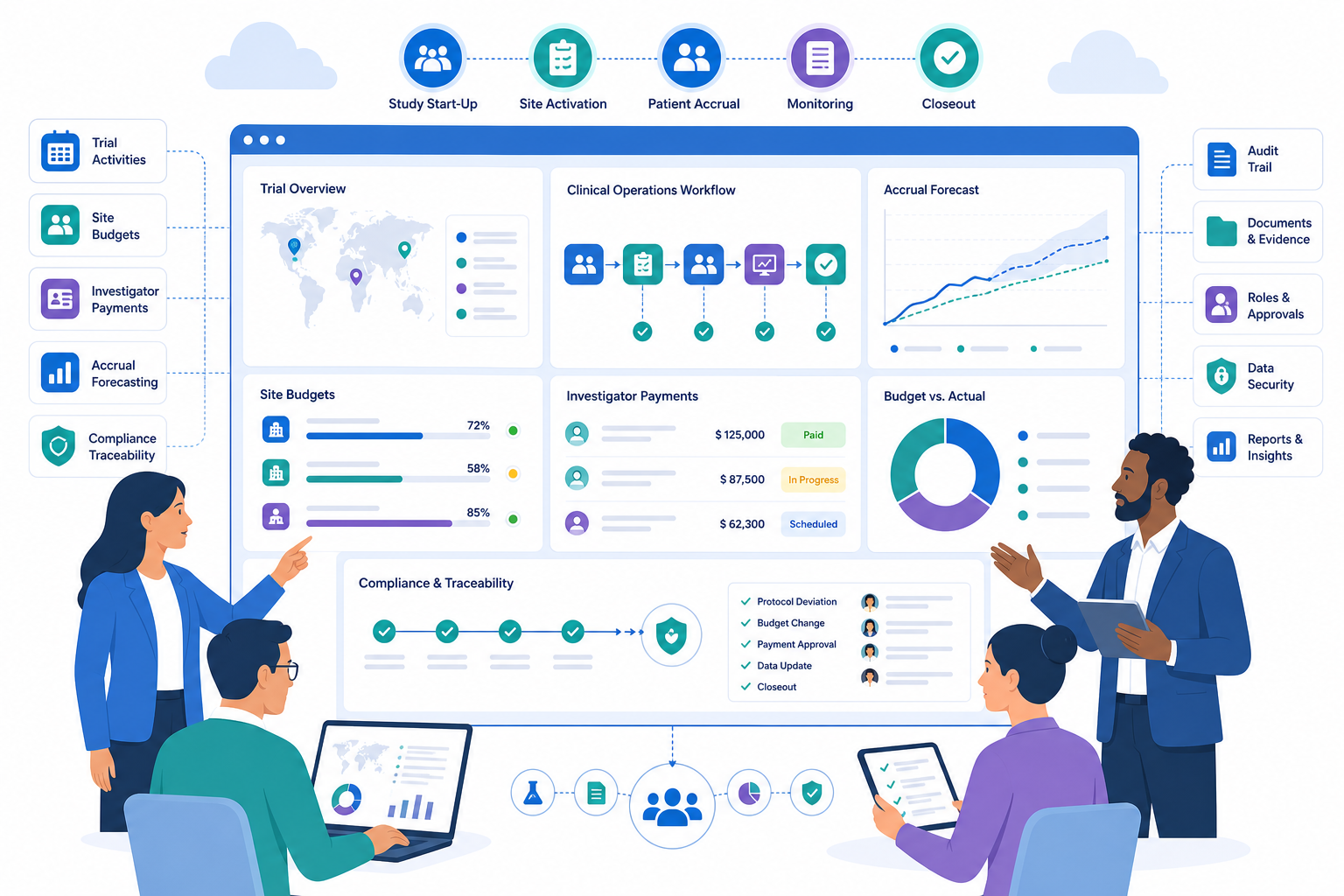
How Cloudbyz connects CTMS activity to site payments, accruals, and transparency before spend drifts.
Your CTMS Says the Trial Is on Track. Your Budget Tells a Different Story. Here's Why.
Quick answer: Trial budgets don't fail in one dramatic moment — they drift, because Clinical Operations and Finance are tracking two different versions of the same trial. CTMS reflects what's actually happening operationally. Finance reflects a spreadsheet-and-email reconstruction of that reality, assembled after the fact. The longer that gap runs, the slower site payments get, the staler accruals become, and the more reactive budget conversations turn. Cloudbyz closes the gap by running CTMS, CTFM, and eTMF on one Salesforce-native platform, so financial consequence is generated directly from operational activity not translated into it by hand.
You're managing two versions of the same trial
Clinical Operations knows startup milestones are moving, visits are being completed, sites are progressing. Finance is often still confirming what should be paid, accrued, or forecast through spreadsheets, email approvals, or disconnected tools.
Neither team is wrong. They're just working from different pictures of the same trial, updated on different clocks. That gap is where budget control actually starts to weaken long before an overrun ever shows up on a report.
Where the drift actually costs you
Once operational activity and financial execution move apart, the symptoms show up in predictable places:
- Site payments slow down because someone has to manually re-confirm a milestone or visit already happened
- Accruals go stale because they're assembled after month-end instead of generated from current activity
- Budget conversations turn reactive because leaders can't tell if spend reflects the trial as it's running, or the trial as Finance last reconstructed it
- Variances surface late by the time a gap is visible in a report, it's usually been building for weeks
None of these are isolated finance problems. They're symptoms of the same root cause: activity and money moving in separate systems.
A late payment isn't just a finance issue it's a site relationship issue. A stale accrual isn't just an accounting issue it's a portfolio visibility issue. An unresolved negotiation isn't just a startup issue it's an activation and cash planning issue.
Why more spreadsheets won't fix it
Once teams notice the gap, the instinct is usually more reconciliation another tracker, another cross-check meeting, another manual review before month-end close. That treats the symptom, not the cause.
The CMS Open Payments program exists because payments in healthcare need to be traceable back to the event and agreement that caused them (CMS Open Payments). Clinical trial finance faces the same expectation but if financial data sits in a separate chain from clinical execution, that traceability has to be reconstructed after the fact instead of managed continuously. More reconciliation doesn't close that gap. It just makes the gap more manageable to live with, which isn't the same thing as fixing it.
What changes when CTMS, CTFM, and eTMF run as one platform
Cloudbyz connects CTMS, Clinical Trial Financial Management, and eTMF natively on Salesforce one governed operating record instead of three reconciled ones. In practice:
- Startup milestones drive startup fees directly no manual re confirmation step
- Trial activities drive site payment logic a completed visit or milestone triggers the financial consequence automatically
- Accruals reflect real work completed, not a month-end approximation
- Supporting records stay tied to the payment event, so traceability is built in rather than reconstructed during an audit
The result: trial finance stops being a retrospective reporting layer and becomes part of how the trial is actually executed.
What this means, by role
| Role | What changes |
|---|---|
| Clinical Operations | Can see which payments are earned and which budgets are under pressure, in real time |
| Finance | Forecasts against actual study activity instead of a lagging reconstruction of it |
| Sites | Get faster, more predictable payments fewer manual confirmation delays |
| Leadership | Gets a defensible view of where spend is justified and where process friction is creating drag |
This also lines up with where ICH E6(R3) is pushing sponsors: fit-for-purpose systems and quality-by-design record-keeping, instead of disconnected tools reconciled under deadline pressure.
The bottom line
Budget control doesn't break when an overrun appears on a report it breaks earlier, the moment operational activity and financial consequence stop moving together. Reports on spend don't fix that. Operational control over how spend is generated does.
Subscribe to our Newsletter
