
Request a demo specialized to your need.
A Data Manager flags site 014: 47 open eligibility queries, three weeks of bounce-back patterns, and an edit check failure rate twice the study average. She emails the clinical team, copies the CRA, marks it high priority.
Two weeks later, the CRA prepares for a monitoring visit in CTMS. Previous visit findings are clean, action items routine, deviation log unremarkable. CTMS shows nothing unusual. The Data Manager’s email sits in her inbox, not on the site record. She remembers it or she does not. Either way, her preparation workflow cannot see it. She visits the site, documents a training gap in the monitoring report, logs a corrective action in CTMS, and moves on.
Three weeks later, the Data Manager checks EDC. Same queries. Same pattern. Same failures. The corrective action did not work but she cannot see the monitoring report in CTMS. She emails the study manager: “any update on site 014?” Both teams communicated and took action. But their daily platforms carried none of that context. Information moved between people. It never moved between systems.
What that gap costs measured in platforms, not in people
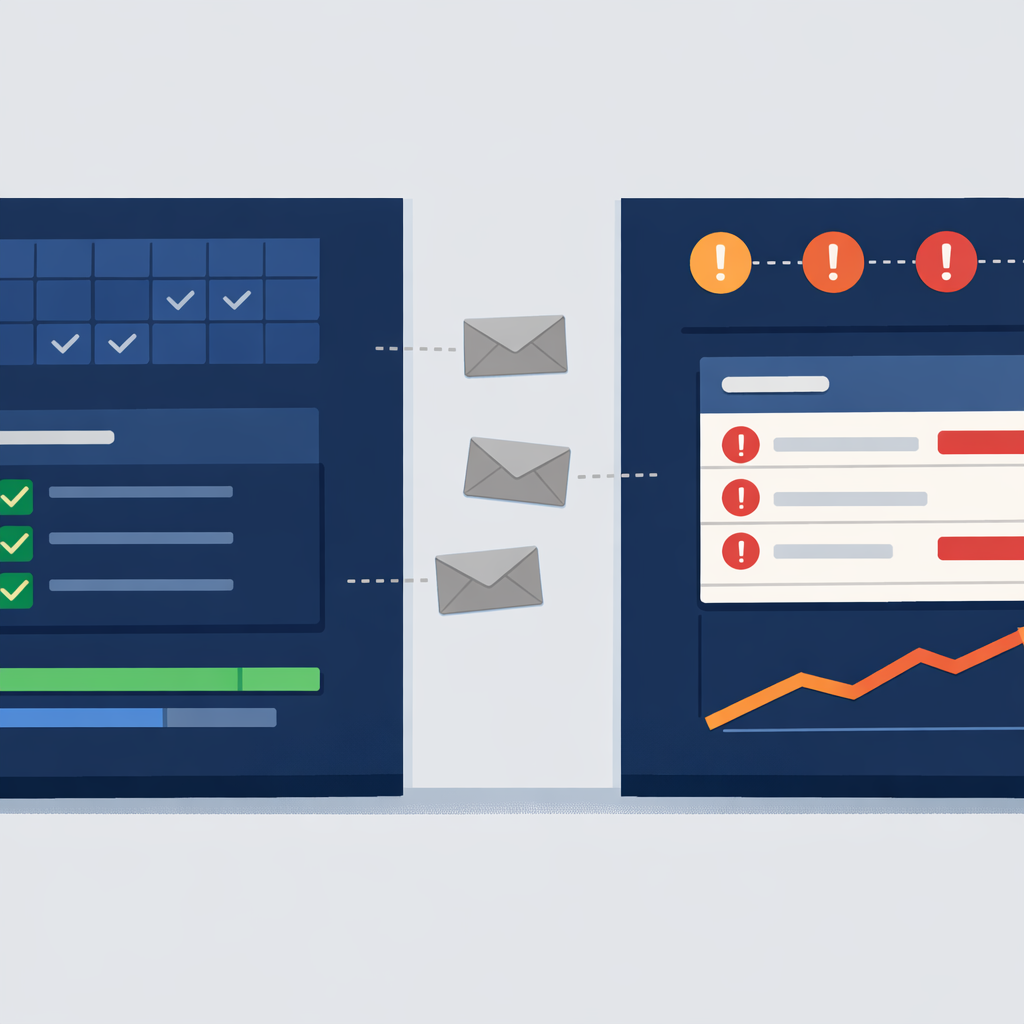
The cost isn't a communication failure. Both teams communicate well. The cost is that every piece of cross-platform context travels by email, lives outside both workflows, and disappears the moment someone opens their actual working system.
| Scenario | The communication | What the platform doesn't carry | What it costs |
|---|---|---|---|
| Visit preparation | CDM emails CRA flagging site level query issues before a visit. CRA reads the email. | When CRA opens CTMS to prepare, the CDM escalation isn't on the site record. Visit preparation is built from CTMS data only the email context is in the inbox, not the workflow. | Visit focus may miss the Data Manager's priority. Not because the CRA didn't read the email because CTMS doesn't know about it. |
| Post-visit feedback | CRA documents findings and corrective action in CTMS monitoring report. Study manager may forward to CDM or summarize in a meeting. | CDM can't see the monitoring report in EDC. The corrective action's data outcome (did query patterns improve?) is visible in EDC but the action that caused it is in CTMS. The feedback loop runs through email, not through either platform. | Corrective actions fail silently. CDM sees the data outcome but not the action. CRA sees the action but not the data outcome. Nobody closes the loop until someone asks by email weeks later. |
| Site risk context | Study manager assembles a combined site health view from both systems for steering committee usually in PowerPoint, usually monthly. | Neither EDC nor CTMS shows a study-level comparison of site risk combining both data quality and operational metrics. The combined picture lives in a spreadsheet or a slide deck already stale by the time it's presented. | Monitoring effort and data priority are aligned once a month in a meeting not continuously in the system where daily decisions are made. |
| Database lock alignment | CDM shares a priority site list for query resolution. ClinOps shares the monitoring visit schedule. Both are shared by email or in a meeting. | The two lists live in different platforms. Nobody compares them inside either system because neither system can see the other's data. Cross-referencing is manual done once, maybe twice, before lock. | Monitoring visits go to clean sites while priority sites wait. Database lock slips not because anyone failed to communicate, but because the platforms couldn't align effort with data reality. |
Root cause in every scenario: The people communicate. The platforms don't. Every piece of context that crosses the EDC-CTMS boundary travels by email and lives outside both workflows.
What changes when both platforms become one platform
Go back to site 014. Same Data Manager, same CRA, same 47 queries but this time, EDC and CTMS are on a single Salesforce-native platform. Same data model. Same site record. Same audit trail.
The escalation lives on the site record, not in an inbox.
When the Data Manager flags site 014 as high priority, that flag is on the same site record the CRA opens to prepare for her visit. She doesn't need to remember an email from two weeks ago. The query trend, the escalation status, and the Data Manager's priority assessment are inside her visit preparation workflow not in Gmail. Her visit plan changes because the platform changed it, not because she happened to recall an email.
The monitoring report is visible where the data lives.
When the CRA files her monitoring report — training gap documented, corrective action logged it's on the same site record the Data Manager is watching in EDC. The Data Manager doesn't email the study manager asking "any update on site 014?" She opens the site record and sees the findings, the corrective action, and the timeline. Three weeks later, when she checks whether the query pattern improved, the answer is on the same screen as the action that was supposed to fix it. The feedback loop closes inside the platform, not inside an email thread.
Site risk is one view, not two exports.
The study manager doesn't build a PowerPoint combining CTMS metrics and EDC metrics from two exports. The site record carries both — operational performance from CTMS and data quality signals from EDC as attributes of the same object. The combined picture is live, current, and available to anyone with access. Monitoring effort and data priority are aligned continuously in the system, not once a month in a meeting.
The priority list and the visit schedule are on the same platform.
The Data Manager's 12 priority sites and the ClinOps lead's monitoring schedule are both visible on the same dashboard. The misalignment — nine priority sites not on the schedule, four scheduled visits at clean sites — is obvious immediately. The correction happens in days, not weeks. Database lock doesn't slip because someone compared two spreadsheets too late.
What this means under ICH E6(R3)
ICH E6(R3), effective in the EU since 23 July 2025, expects sponsors to demonstrate that quality oversight is proportionate, risk-informed, and documented. Section 4.2.3 requires audit trail review as a planned, documented activity.
When EDC and CTMS share one platform, the E6(R3) expectations become operationally practical instead of administratively burdensome:
| E6(R3) Expectation | How a unified platform supports it |
|---|---|
| Monitoring informed by data signals | CDM escalations and query trends are on the same site record the CRA uses to prepare data informs visits inside the workflow, not via email |
| Proportionate oversight | Study managers see operational + data quality signals on one site record effort follows actual risk, aligned continuously |
| Traceable decision-making | Monitoring reports, query trends, escalations, and corrective actions sit on the same platform the thread from signal to decision to outcome is navigable |
| Planned audit trail review (Section 4.2.3) | EDC and CTMS audit trails on the same infrastructure review is a configured activity, not a cross-system reconstruction |
| Feedback loop on corrective actions | Data outcome (EDC) and monitoring action (CTMS) are on the same record sponsors can demonstrate that corrective actions were verified, not just logged |
The last row is the most important one. Under E6(R3), an inspector can ask: "You logged a corrective action at this site. How did you verify it worked?" On a siloed architecture, that answer requires pulling the monitoring report from CTMS, the query trend from EDC, cross-referencing manually, and hoping the dates align. On a unified platform, the answer is one drilldown action and outcome on the same record.
The question worth asking
For ClinOps Directors: how many emails per week carry information from EDC into your CRA's workflow information that disappears the moment she opens CTMS? Each email is a workaround for a platform limitation.
For CDM leads: how many times has your team emailed "any update on that site?" after a monitoring visit because the visit findings are in CTMS and you can't see them? Each email is a feedback loop that should close inside the platform, not inside an inbox. Both teams communicate well. The emails get sent. The copies land. The meetings happen. But every piece of context that crosses the EDC CTMS boundary lives outside both workflows and the moment someone opens their actual working platform, that context is gone.
A unified Salesforce native platform doesn't replace the communication between teams. It makes the communication unnecessary because the context lives where both teams already work, not in the space between their systems.
Book a 30-minute working session with a Cloudbyz Clinical Solutions lead.
Subscribe to our Newsletter
