

Request a demo specialized to your need.
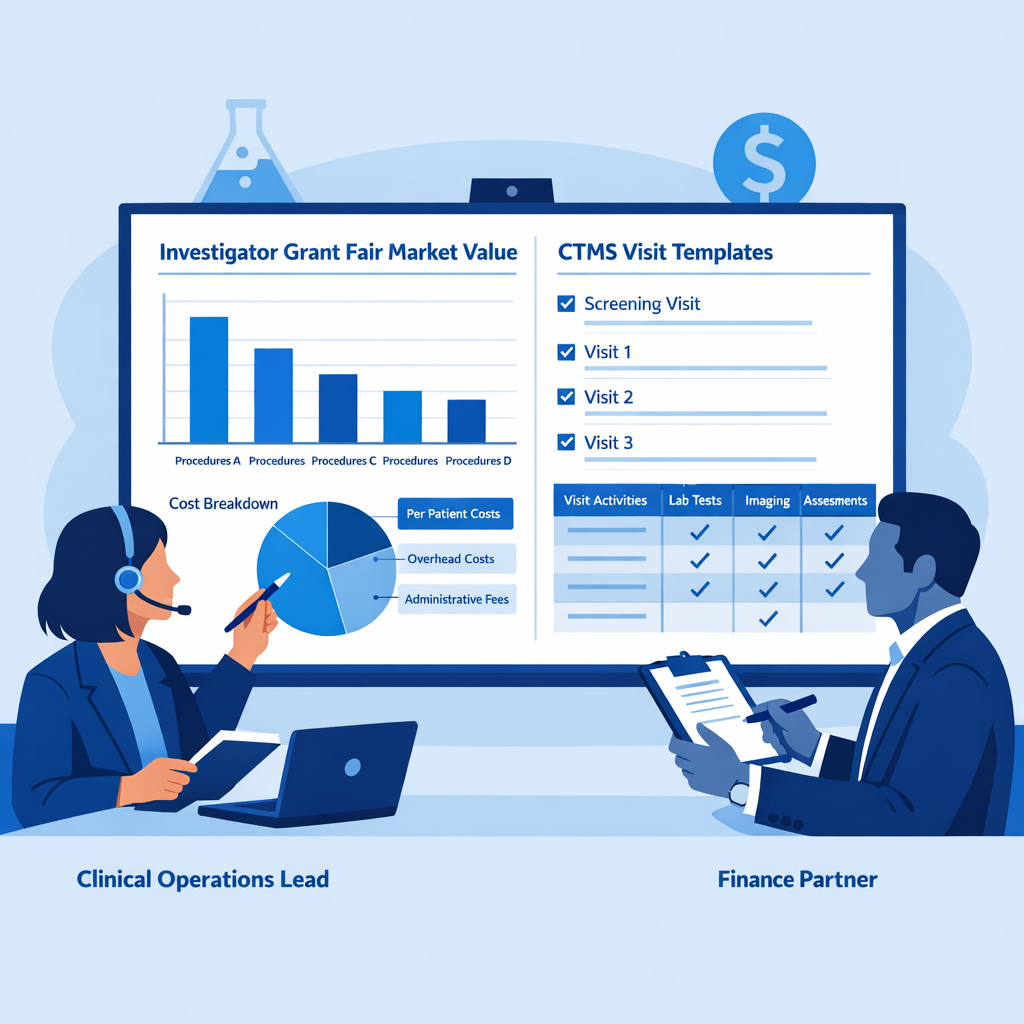
How to govern investigator grants and FMV on a CTMS backbone clinical and finance teams both trust.
Why Investigator Grant Governance Belongs Inside CTMS
Investigator grants sit at the heart of clinical trial economics and site relationships. When compensation is misaligned, the impact is immediate. Grants that are too low can disengage high-performing sites or quietly push them to prioritize other studies. Grants that are too high introduce budget overruns, internal scrutiny, and potential compliance concerns.
Most sponsors and CROs agree that grants should reflect fair market value and actual workload. The challenge is rarely philosophical. It is operational.
In many organizations, investigator grants are still assembled in spreadsheets. They rely on a combination of historical deals, third-party FMV tools, internal benchmarks, and negotiation experience that lives in the heads of a few experts. The Clinical Trial Management System is often used only after agreements are finalized, to track milestones and activity. It does not drive the logic behind what sites are paid.
This separation creates risk. Financial logic lives outside the operational system that actually understands visits, procedures, startup milestones, and subject activity. When auditors, compliance teams, or partners ask how a grant was determined, the answer requires stitching together fragmented files, emails, and assumptions.
A more sustainable approach is to bring investigator grant governance inside CTMS and align it directly with clinical trial financial management. In a unified model such as Cloudbyz CTMS and CTFM, grants are no longer isolated spreadsheets. They are expressions of operational structures and financial rules that can be inspected, defended, and consistently applied.
Instead of treating fair market value as a separate overlay, you use CTMS-native building blocks. Visit types, procedure bundles, startup packages, closeout tasks, and pass-through categories become structured components. These components feed rate cards that finance and legal teams can defend and that sites can recognize as fair.
When protocols evolve or workload assumptions change, templates and rate cards are updated centrally. The impact flows across studies and regions. When auditors request justification for site compensation, you can trace the logic from protocol design through CTMS templates into CTFM calculations. FMV becomes a documented methodology rather than a narrative assembled after the fact.
Designing CTMS Data and Workflows for FMV-Based Investigator Grants
Once organizations accept that investigator grants should be anchored in CTMS events and FMV methodology, the next question becomes practical: how do you design this at scale?
The foundation is a reusable dictionary that connects protocol schedules, site characteristics, and country economics to rateable units. Every protocol contains a schedule of assessments. Too often, that schedule is treated as a static appendix. In a mature CTMS environment, it becomes a structured template.
Within Cloudbyz CTMS, visit templates should define procedures, duration, required roles, complexity flags, and any special infrastructure needs. These attributes transform a protocol schedule into a financial modeling engine. Overlay country-level economic factors and site tiers such as academic versus community or high- versus low-intensity research infrastructure, and you create the raw inputs for consistent FMV-based modeling.
On top of these operational templates sits Cloudbyz CTFM. Instead of maintaining dozens of spreadsheet versions for different countries and sites, structured rate cards are stored and keyed to visit templates, geography, and site tier. FMV ranges can be derived from commercial contract history, benchmark data, and internal analytics. Because the methodology is encoded directly in the system, it becomes auditable and repeatable.
Workflows connect these layers. During study design, clinical operations and finance teams select or refine visit templates and country mixes within CTMS rather than inventing grant schedules from scratch. CTFM uses those selections to generate initial investigator grant schedules within defined FMV bands. These schedules become the structured starting point for negotiation.
When negotiations require deviations, those adjustments are captured as structured exceptions with documented rationale. Instead of free-form email notes, the system records why a site required additional imaging fees, higher overhead, or unique staffing assumptions. Over time, this structured data informs refinements to FMV models.
During trial execution, CTMS and CTFM keep grants grounded in operational reality. If enrollment diverges from plan, if certain procedures drive unexpected cost, or if specific geographies consistently trend toward the top or bottom of FMV ranges, the system surfaces these insights. Grant governance becomes dynamic rather than static.
Integration completes the picture. Investigator grants must align with site-payment workflows, accrual engines, and ERP structures. Because Cloudbyz CTMS and CTFM share a unified data model, verified visit completion in CTMS automatically informs payment eligibility and FMV-aligned rates. Payment batches can be traced back to visit templates and grant logic. This end-to-end traceability transforms FMV from a compliance concept into an everyday operational control.
Embedding Investigator Grant Governance into CTMS Workflows
Technology alone does not create governance. Clear ownership, structured review, and cross-functional collaboration are essential.
Organizations that succeed with FMV-based grant governance typically establish a cross-functional council anchored within their CTMS and budget governance framework. Clinical operations, finance, and site-facing teams share responsibility for maintaining visit dictionaries, updating FMV methodologies, and reviewing exception patterns.
This council operates on a defined cadence. It reviews system-derived metrics rather than anecdotal impressions. Useful indicators include the percentage of grants within defined FMV ranges by geography and site tier, the proportion of grants using standard templates versus custom structures, and variance between planned and actual per-patient costs. These metrics shift the conversation from policy statements to evidence.
Equally important is communication. For investigators, FMV can feel like an opaque constraint. A Cloudbyz-powered site portal can instead present grant schedules in transparent terms. It can show which visits and procedures drive compensation, how overhead is incorporated, and how payment eligibility ties directly to CTMS events. Transparency reduces friction and strengthens long-term relationships.
Internally, training reinforces that CTMS data quality directly affects financial fairness and compliance. Accurate visit verification and milestone tracking are not administrative tasks. They underpin timely site payments, defensible accruals, and regulatory confidence. Finance and legal partners should be comfortable navigating CTMS and CTFM dashboards so they can answer audit and transparency questions using system evidence rather than spreadsheet reconstructions.
Governance must also remain adaptable. As hybrid and decentralized designs introduce new visit types, remote assessments, and digital endpoints, workload and cost structures evolve. By piloting new templates in CTMS, feeding cost data into CTFM, and reviewing performance through governance forums, organizations can adapt investigator grants without losing control.
A Strategic Shift in How Sites Are Compensated
When investigator grant governance lives outside CTMS, compensation logic remains fragmented and reactive. When it is embedded within CTMS and financial management workflows, it becomes structured, transparent, and defensible.
By unifying operational events and financial rules inside Cloudbyz CTMS and CTFM, sponsors and CROs can link investigator compensation directly to real work performed. Trial budgets become more predictable. Audit readiness improves. Site relationships strengthen because compensation is grounded in documented workload rather than negotiation memory.
Ultimately, this shift repositions CTMS from a passive tracking tool to the economic backbone of site relationships. Investigator grant governance does not belong in spreadsheets on the side. It belongs inside the system that understands the work itself.
Subscribe to our Newsletter
