

Request a demo specialized to your need.
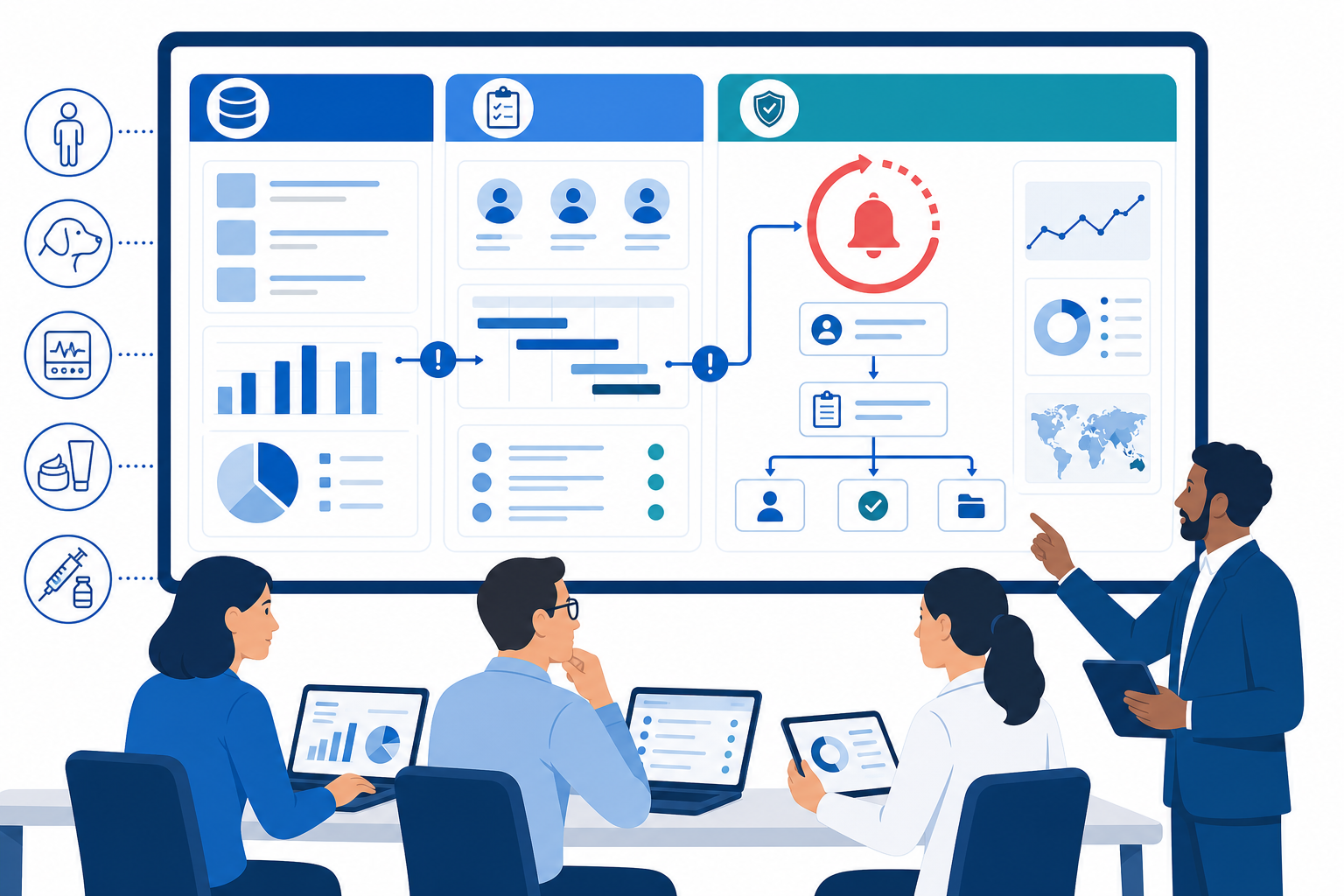
Pharmacovigilance has quietly become one of the highest-risk, highest-visibility functions in the life sciences enterprise. Adverse event volumes are climbing as drug portfolios expand and real-world data sources multiply. Regulators are tightening timelines and raising the bar on data quality. And safety teams — often still stitched together with spreadsheets, shared inboxes, and point solutions — are expected to do more with the same headcount.
Against that backdrop, the pharmacovigilance software you choose in 2026 isn't just a system of record. It's the infrastructure that determines whether your organization can detect a safety signal early, submit an ICSR on time, survive an inspection without a Form 483, and scale into new markets without rebuilding your safety stack from scratch.
This guide connects the core challenges pharmacovigilance teams face today to a concrete, defensible framework for evaluating platforms — so that whether you're replacing a legacy safety database, consolidating point tools, or building PV capability for the first time, you're evaluating against the right criteria rather than the loudest vendor pitch.
The State of Pharmacovigilance in 2026: Why the Old Playbook Doesn't Work
Three structural pressures are reshaping what "good" pharmacovigilance software looks like.
Adverse event volume and complexity are both rising. Expanded label indications, combination therapies, and post-market surveillance obligations mean more cases, from more sources — literature, call centers, social listening, patient support programs, EHR-linked data — flowing into safety teams that were sized for a simpler intake model. Manual triage and duplicate case detection break down long before volume becomes unmanageable in theory; in practice, teams feel the strain well before anyone updates the org chart.
Compliance risk has shifted from "possible" to "probable." Health authorities including the FDA, EMA, and PMDA have progressively tightened expectations around E2B(R3) data quality, aggregate reporting timelines (PBRERs, PADERs, DSURs), and signal management documentation. A single missed 15-day expedited report or a malformed E2B transmission isn't just an operational hiccup — it's an inspection finding with reputational consequences that follow a company across markets.
Workflows remain fragmented across disconnected systems. Case intake in one tool, MedDRA coding in another, aggregate report authoring in Word, signal detection in a separate analytics platform, and regulatory submission tracking in a spreadsheet — this is still the reality at a large share of mid-size and even enterprise sponsors and CROs. Every handoff between systems is a place where data degrades, timelines slip, and audit trails get harder to reconstruct.
None of these problems are new. What's new in 2026 is that AI-native platforms have matured enough to address them directly — which means the bar for what "good enough" pharmacovigilance software looks like has moved.
Core Safety Challenges Mapped to Platform Requirements
Rather than starting with a generic feature checklist, it's more useful to start with the problems your team actually experiences and work backward to what the software needs to do about them.
Challenge 1: Adverse Event Intake Is Slow and Error-Prone
If case intake still depends heavily on manual data entry from source documents — fax, email, PDF, spoken calls — your throughput is capped by headcount, and your data quality is capped by human consistency on a repetitive task.
What to look for: Platforms with AI-assisted case intake that can extract structured data from unstructured source documents (case narratives, literature articles, call transcripts) and pre-populate ICSR fields with confidence scoring, leaving safety scientists to review and validate rather than transcribe. This is one of the clearest areas where AI delivers measurable cycle-time reduction without touching medical judgment.
Challenge 2: Duplicate Detection and Case Triage Consume Scarce Reviewer Time
Duplicate cases and low-value literature hits pull reviewer attention away from genuinely novel or serious events.
What to look for: Configurable, algorithm-driven duplicate detection and case prioritization logic — not just exact-match rules, but fuzzy matching across patient demographics, event terms, and source. The system should let you tune sensitivity by product and indication rather than applying one global threshold.
Challenge 3: E2B(R3) Compliance and Regulatory Timelines Are Unforgiving
Expedited and periodic reporting obligations don't flex for system downtime or manual reconciliation delays.
What to look for: Native, validated E2B(R3) generation and transmission (not a bolt-on export), automated timeline tracking with configurable clock-start rules by jurisdiction, and audit-ready documentation of every submission. Ask vendors directly how their E2B(R3) implementation handles gateway rejections and how quickly it surfaces them to your team — this is where compliance risk actually lives.
Challenge 4: Aggregate Reporting Is a Manual, High-Effort Cycle
PBRERs, PADERs, and DSURs are typically assembled by pulling data from multiple sources into a document that's authored largely by hand, then routed for review across medical, regulatory, and QA.
What to look for: Aggregate report generation that pulls structured case data, signal management output, and literature review results directly from the safety database, with configurable templates aligned to ICH E2C(R2) and regional requirements. The goal isn't a fully automated report — it's collapsing the data-assembly phase so medical writers spend their time on analysis and narrative, not reconciliation.
Challenge 5: Fragmented Systems Undermine Data Integrity and Audit Readiness
When case data, signal detection, and submission tracking live in separate tools, reconstructing a complete audit trail for an inspection becomes a research project.
What to look for: A unified data model spanning intake through signal management, aggregate reporting, and submission tracking — or, where a single-vendor suite isn't realistic, strong, validated integration capability (APIs, not manual file transfer) between your safety database and adjacent systems like your CTMS, eTMF, and regulatory information management platform.
The Platform Selection Framework
With those challenge-to-requirement mappings in hand, here's the practical evaluation framework to apply against any pharmacovigilance platform, whether it's a legacy safety database vendor, an emerging AI-native challenger, or an internal build.
1. Regulatory and Validation Foundation
- Demonstrated support for 21 CFR Part 11, GxP validation, and ALCOA+ data integrity principles
- Native E2B(R3) and, where relevant, upcoming E2B(R3)/ICH ICSR format readiness
- Configurable regulatory clock-start and timeline logic by health authority (FDA, EMA, MHRA, PMDA, and local agencies as your footprint requires)
- Availability of validation documentation (IQ/OQ/PQ or equivalent) to support your own CSV program, not just a vendor assurance letter
2. Case Processing and Workflow Depth
- AI-assisted intake and MedDRA coding support, with human-in-the-loop review built into the workflow rather than optional
- Configurable duplicate detection and triage rules
- Workflow flexibility to model your actual case processing SOPs, not just a generic out-of-the-box flow you have to conform to
3. Signal Management and Analytics
- Built-in or tightly integrated signal detection (disproportionality analysis, trend monitoring) rather than a separate standalone analytics purchase
- Configurable signal evaluation workflows with full documentation trails for inspection readiness
4. Aggregate Reporting Capability
- Template-driven PBRER, PADER, and DSUR generation pulling live data from the case database
- Support for regional variants as your product's geographic footprint grows
5. Interoperability and Data Architecture
- Modern API architecture for integration with CTMS, eTMF, RIM, and literature monitoring tools
- A genuinely unified data model if you're consolidating multiple point solutions — ask for a real data dictionary, not a marketing diagram
6. Scalability and Total Cost of Ownership
- Pricing and infrastructure that scale sensibly from a handful of products to a full portfolio, and from a single market to global operations
- Clarity on what's included in "AI-powered" claims — ask vendors to show the underlying model behavior on your own sample case data, not a canned demo
7. Vendor Viability and Support Model
- Track record specifically in life sciences and specifically in pharmacovigilance — general-purpose CRM or case-management vendors retrofitted for PV often lack the regulatory depth this function demands
- Named implementation and validation support, not just a self-service onboarding portal
- A visible product roadmap that reflects where PV regulation and AI capability are actually heading, not where they were five years ago
Build vs. Buy vs. AI-Native Platform: A Quick Reality Check
Organizations evaluating pharmacovigilance software in 2026 generally land in one of three positions:
Legacy enterprise safety databases offer regulatory maturity and a long track record, but many were architected before AI-assisted intake, modern integration patterns, and cloud-native scalability were standard expectations. Retrofitting AI onto a twenty-year-old data model is a real constraint, not a marketing footnote.
Point solutions stitched together (a case intake tool, a separate signal detection platform, a separate reporting tool) offer flexibility to pick "best of breed," but recreate the fragmentation problem this guide opened with — every integration point is a place where audit trails and data quality can break down.
AI-native, unified platforms, including those built on modern cloud and CRM-grade architectures like Salesforce, are increasingly able to offer the regulatory rigor of legacy systems combined with AI-assisted case intake, aggregate reporting automation, and native interoperability with the broader clinical and regulatory technology stack — CTMS, eTMF, and regulatory information management — without the integration tax of a multi-vendor stitch.
The right answer depends on your current infrastructure, portfolio size, and internal validation capacity — but the direction of travel across the industry in 2026 is clearly toward unified, AI-assisted platforms that reduce manual effort at the case level while strengthening, not loosening, regulatory rigor.
A Practical Evaluation Checklist
Before you shortlist vendors, get internal alignment on these questions:
- What's our current case volume, and what's our realistic three-year growth trajectory across products and markets?
- Where exactly do our current workflows break down — intake, coding, triage, aggregate reporting, or submission tracking?
- What's our appetite and capacity for a validation effort, and how much of that burden can the vendor absorb through pre-validated configurations?
- Which adjacent systems (CTMS, eTMF, RIM, literature monitoring) does this platform need to talk to, and how mature is that integration in practice, not on paper?
- Can the vendor show AI-assisted intake or coding performance on our own case data before we sign anything?
- What does the vendor's regulatory and validation support look like during and after go-live — is it a team, or a ticket queue?
Final Thought
Choosing pharmacovigilance software in 2026 isn't really a software decision — it's a risk management decision with a software component. The platforms that will serve clinical and safety teams well over the next several years are the ones that treat AI-assisted case processing, native E2B(R3) compliance, and true system interoperability as foundational, not as premium add-ons bolted onto an aging architecture.
Start from your actual failure points — where cases stall, where compliance risk concentrates, where your team spends time it shouldn't have to — and let that drive the evaluation. The vendor that can speak fluently to those specific pain points, and show you rather than tell you how their platform solves them, is the one worth a serious pilot.
Subscribe to our Newsletter
