

Request a demo specialized to your need.
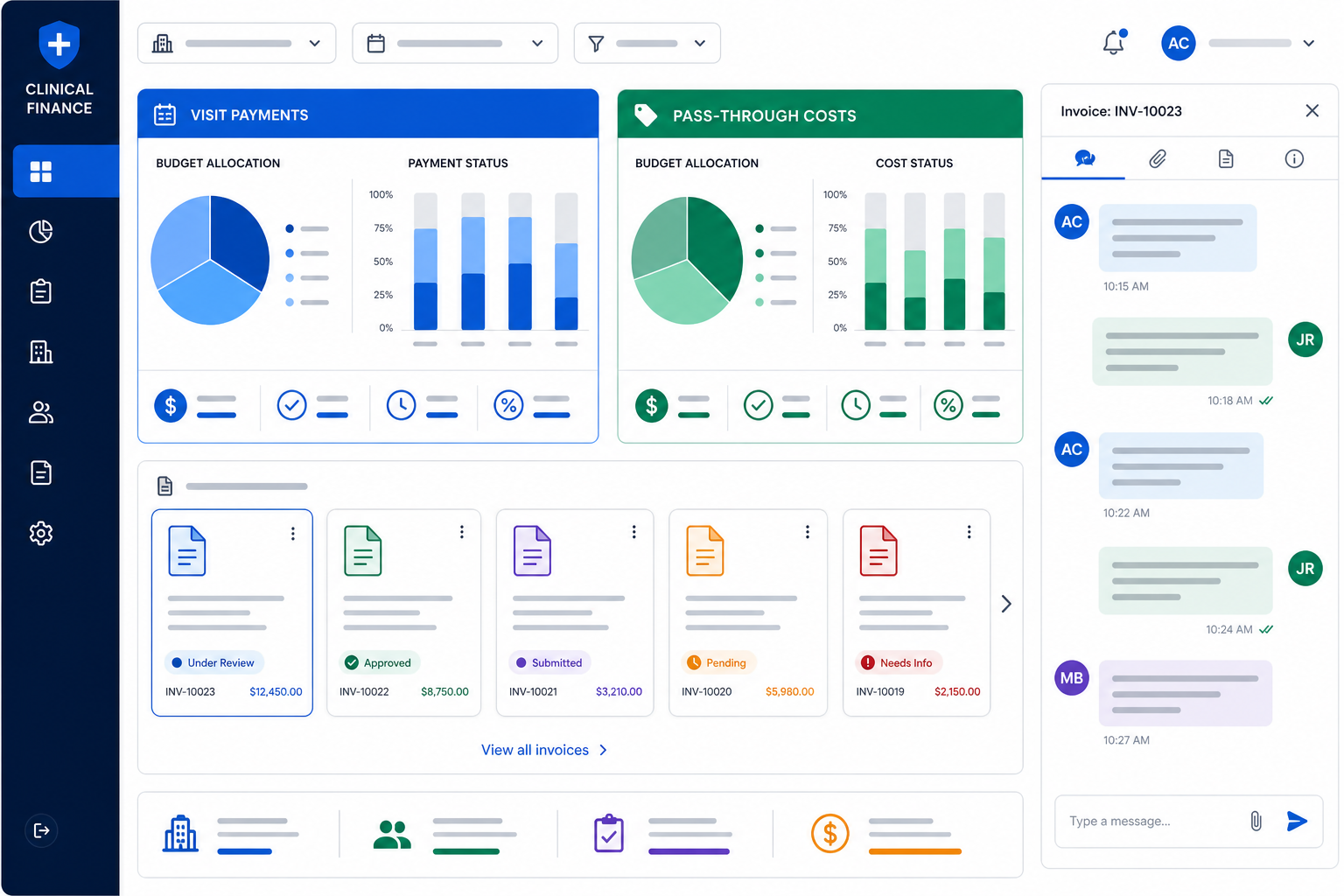
Not every invoice from a site means the same thing. Some are straightforward visit payments a patient came in, a milestone cleared, a payment is owed. Others are pass-through costs a lab fee, an imaging charge, a travel reimbursement, a specialty vendor invoice the site collected and is now forwarding along. Treat those two categories the same way and you end up with exactly the kind of budget confusion that's hard to untangle later: pass-through costs are consistently one of the least controlled line items in outsourced trials, typically making up somewhere between 15 and 25 percent of the total budget, and if they're not tracked as their own category from the start, that's a meaningful chunk of spend nobody can fully account for.
The pain: not knowing what kind of invoice you're looking at
Without a system that distinguishes the two, sponsors often end up with bundled invoices arriving weeks after the activity actually happened, with little ability to check individual line items against the original quote. A visit payment and a pass-through reimbursement get lumped into the same review, the same approval step, the same vague "site invoice" bucket which means a pass-through overcharge is just as likely to slip through as a legitimate visit payment is to get held up behind it.
What CTFM does: visit-based payments trigger automatically once a patient visit or milestone is verified, while pass-through costs are captured at the source, logged against pre-approved line items with supporting documentation attached. Both flow through the same system, but as two distinct, clearly labeled categories not one undifferentiated pile of "site invoices" waiting for someone to sort out which is which.
The pain: matching visit logs against invoices by hand
Even once you know what kind of invoice you're looking at, someone still has to confirm it's correct which visit it corresponds to, whether the amount matches the contract, whether it's already been paid. Done manually, that kind of matching is one of the most persistent drains on a clinical finance team's time, often consuming a fifth to a third of total team bandwidth on nothing more than checking one log against another.
What CTFM does: every procedure, visit, or deliverable is tied to a clearly defined trigger, so invoicing lines up with what actually happened by default. Removing that manual matching step is a big part of why payment cycles at well-run sites shrink from weeks to days rather than the other way around.
The pain: checking on a payment means emailing and waiting
A site wants to know where their payment stands. Historically, that means an email to the study team, a wait for a reply, maybe a follow-up email a few days later when nothing's heard back. Multiply that across dozens of sites and it becomes a real chunk of someone's week, spent answering the same question over and over in slightly different words.
What CTFM does: sites can see their own budget status, payment history, and outstanding invoices directly, without needing to ask. And when the study team does need to reach out a document request, a status update, a clarification that communication happens from inside the system itself, tracked the same way any other in-system correspondence is: sent, seen, responded to, all visible without anyone needing to dig through an inbox to reconstruct what was said and when.
Why keeping this in one place actually matters
None of this is really about eliminating communication. It's about making sure the record of what was paid, why, and what conversation happened around it, all lives in the same place instead of a payment sitting in one system, a pass-through invoice sitting in an email attachment, and the actual conversation about a delay sitting in someone's personal inbox where nobody else can see it.
When every invoice already knows what kind of cost it is, and every conversation about it stays attached to the record, "where does this payment stand" stops being a question that requires an email. It's just something you can look up.
See how CTFM tracks every invoice type and every site conversation in one place. [Book a demo →]
Subscribe to our Newsletter
