
Request a demo specialized to your need.
Why ePRO matters in the first place
Electronic Patient-Reported Outcomes exist because some of the most clinically meaningful data in a trial symptom severity, quality of life, pain scores, medication adherence, how a patient actually feels between visits can't be captured accurately by a site alone.
A coordinator asking a patient to recall two weeks of symptoms during a clinic visit introduces recall bias the industry has spent years trying to design around. ePRO solves that by capturing the data at the moment it happens, directly from the patient, on their own schedule.
That's also why ePRO adoption has grown alongside a broader shift in trial design toward patient-centricity not as a compliance checkbox, but because patient-reported data has become central to endpoints in oncology, CNS, rheumatology, and increasingly in nearly every therapeutic area where quality of life is part of the outcome story.
The problem isn't whether to use ePRO. Most sponsors already have. The problem is what happens when ePRO runs as a separate system from EDC instead of one connected record.
What breaks at the site when EDC and ePRO don't talk to each other
Coordinators end up managing two systems that were never designed to reconcile themselves. A patient's diary entry lives in the ePRO platform. The site's own visit data lives in EDC. Neither system knows what the other recorded, so someone has to manually compare them usually the coordinator, usually after the fact.
That manual layer creates a familiar set of problems:
- Duplicate effort. Coordinators re-enter or cross-check data that already exists in the ePRO system, because EDC has no visibility into it.
- Missed entries go unnoticed. A patient who skips a diary entry doesn't generate an alert anywhere the site is already looking someone has to actively check ePRO compliance separately from checking EDC.
- Chasing becomes reactive. Coordinators find out a patient missed entries days or weeks later, calling to recover data that's harder to recall accurately by then which quietly reintroduces the recall bias ePRO was supposed to eliminate.
- Query resolution doubles. A discrepancy between what the patient reported and what the site recorded generates queries in two systems instead of one coordinated review.
What breaks for the CRA during monitoring
Monitors inherit the same disconnect from the other direction. During SDV, a CRA has to check ePRO compliance and completeness in one system and cross-reference it against EDC in another often without knowing ahead of the visit which patients have gaps.
That turns monitoring visits into reconciliation exercises:
- No single view of PRO completion rates before arriving on-site, so gaps get discovered during the visit instead of anticipated before it
- Manual cross-checking of ePRO timestamps against visit windows to confirm compliance
- Extra time spent documenting and following up on PRO-related findings that a connected system would have already surfaced
- Monitoring visit reports that take longer to close because part of the review is administrative reconciliation, not clinical oversight
None of this is a training or diligence problem. It's a structural one two systems, two data sets, and a human being the only integration layer between them.
Where ICH E6(R3) raises the bar
ICH E6(R3) puts real weight behind two principles that directly implicate this gap: patient-centricity in trial design and conduct, and a risk-based approach to quality management that depends on real-time visibility into data as it's generated not weeks later during a scheduled review. A trial that captures patient-reported data but can't see it alongside site data in real time is structurally behind what R3 expects of modern trial oversight. Reconciliation-after-the-fact is the opposite of the proactive, risk-based monitoring the guidance is built around.
What changes when EDC and ePRO run as one connected platform
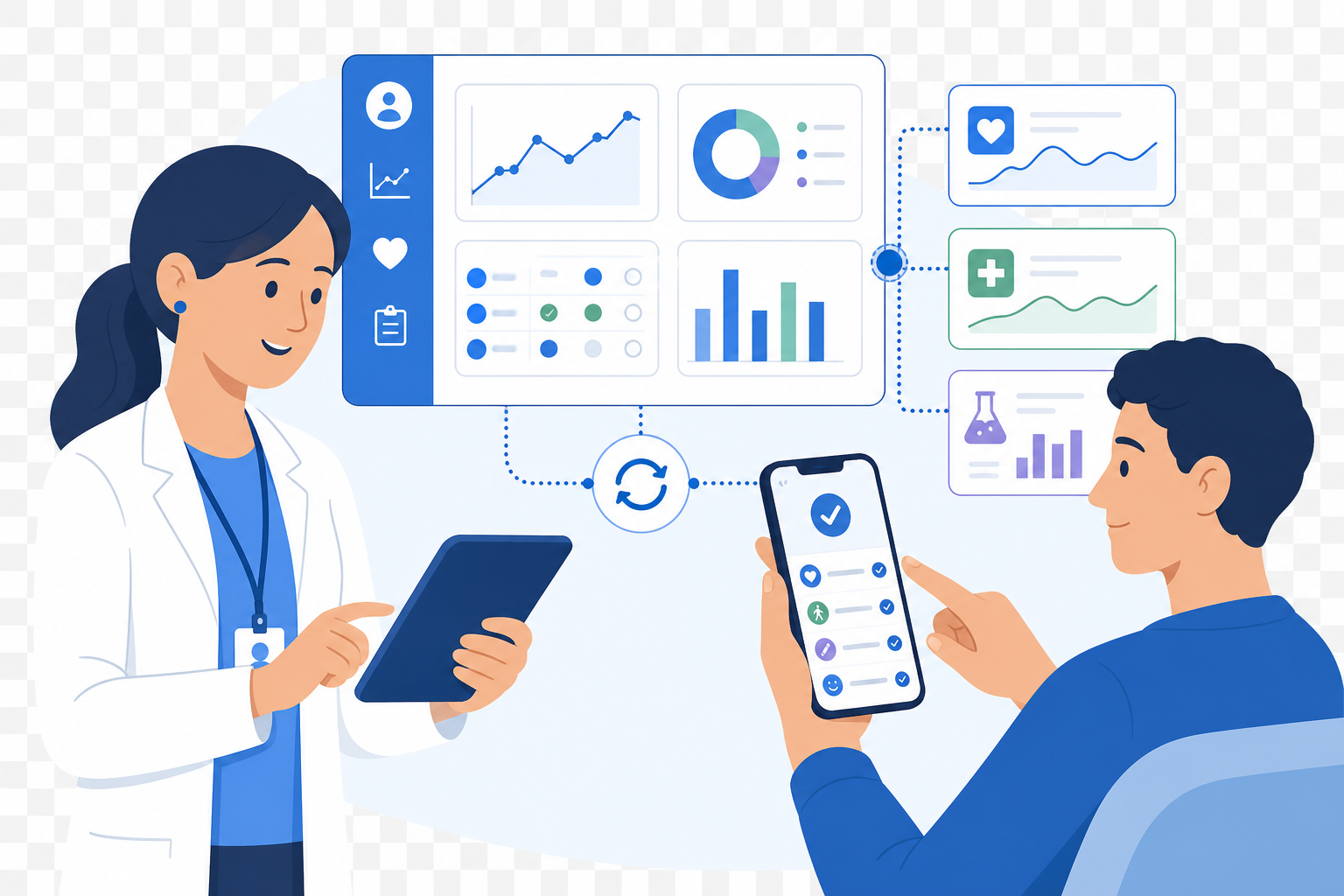
Cloudbyz brings EDC and ePRO/eCOA together on a single Salesforce-native platform, so patient-reported data and site-reported data live in one system rather than two that have to be manually reconciled.
Timelines. With PRO data visible in the same environment as EDC from the moment it's captured, discrepancies surface as they happen instead of at database lock when finding and resolving them is slowest and most expensive.
Site happiness. Coordinators stop managing two systems and cross-checking entries by hand. Missed diary entries are visible immediately, so outreach to patients happens while the memory is still fresh, not weeks later which is better for the patient relationship and for data quality.
CRA workload. Monitors get a real-time view of PRO compliance status before they ever arrive on-site, turning monitoring visits back into clinical oversight instead of administrative reconciliation. Query volume drops because discrepancies get caught closer to the source.
Data management review. With patient-reported and site-reported data sitting in one connected record, DM teams reconcile against a single, real-time source instead of manually cross-referencing exports from two systems. Review cycles move faster, and query generation becomes more targeted flagged where a genuine discrepancy exists, not generated as a matter of routine cross-checking.
What to look for in your own ePRO setup
| Question | Disconnected EDC + ePRO | Unified on one platform |
|---|---|---|
| When is a missed PRO entry noticed? | Days or weeks later, during manual review | In near real time |
| How does a CRA prepare for a visit? | Checks two systems separately | Reviews one connected compliance view |
| How does DM reconcile data? | Manual cross-referencing of exports | Single source of record |
| How many systems does a coordinator manage? | Two, with manual cross-checks | One |
Where to go from here
Patient-reported data has become too central to trial outcomes to treat as a system sitting alongside EDC instead of inside it. Cloudbyz's unified EDC and ePRO/eCOA platform keeps patient and site data in one place from capture to database lock reducing the manual reconciliation burden on sites, CRAs, and data management alike.
See how Cloudbyz brings EDC and ePRO together on one connected platform book a demo with our team.
Subscribe to our Newsletter
