

Request a demo specialized to your need.
How ClinExtract Cuts Transcription Time Without Cutting Corners on Data Quality
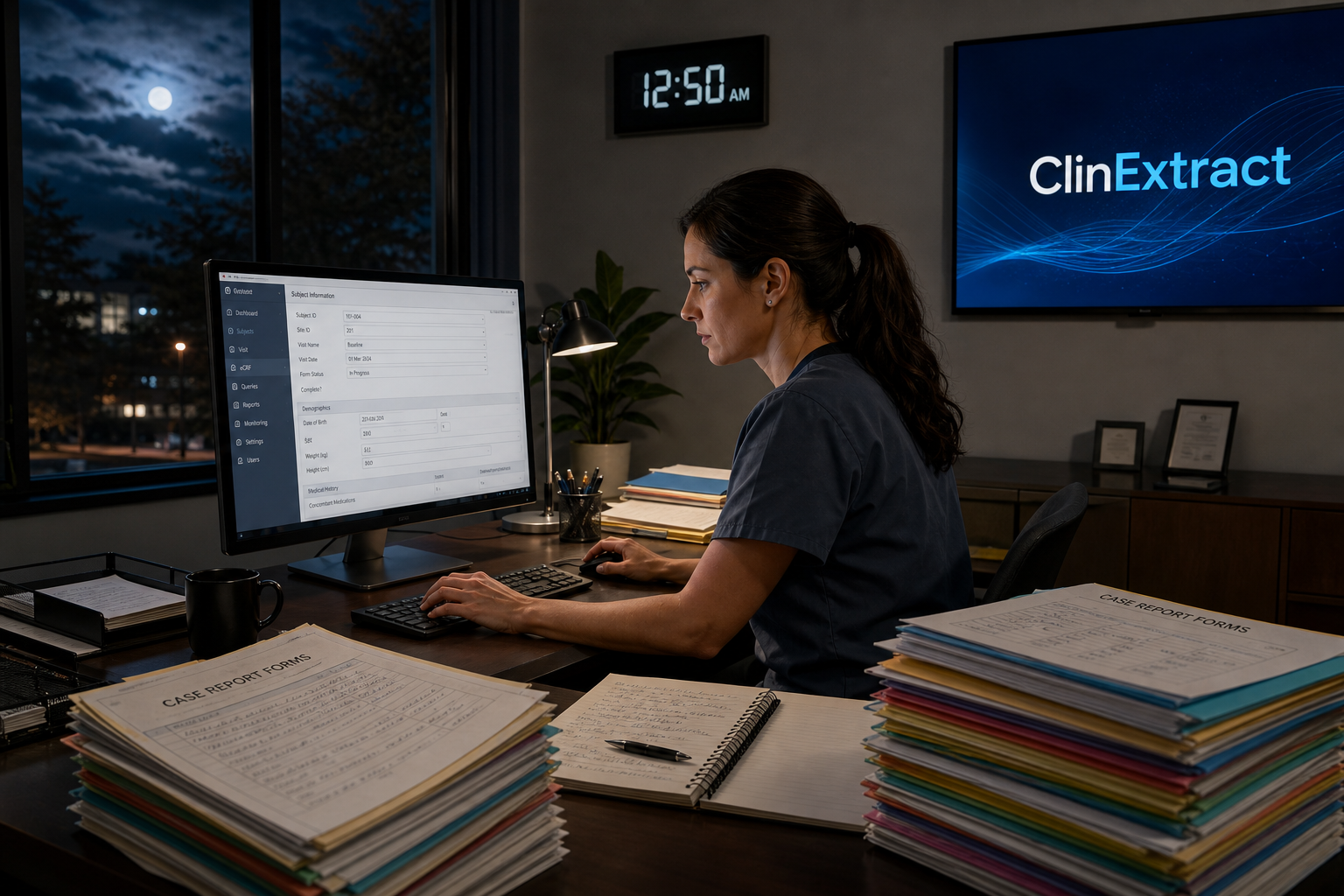
Anywhere paper case report forms are still part of a study and in real-world evidence studies, they often are someone has to get that data into the EDC eventually. In practice, that means a CRC reading a paper form and typing the same information into a screen, field by field, study after study. It's not glamorous work, but it's real work, and it's exactly the kind of task where double entry quietly becomes the single biggest drag on data availability: the visit happened weeks ago, and the data still isn't in the system because nobody's had the hours to transcribe it yet.
The cost isn't just staff time, either. Every manual transcription step is a chance for a transposed number or a misread field to slip through, and in an RWE study where the whole point is drawing conclusions from real clinical data that's not a small risk to carry.
What ClinExtract actually does
ClinExtract uses natural language processing and machine learning to read clinical documents CRFs among them and pull out the structured data points that matter: the fields a form actually contains, not just the words on the page. It works through the context and relationships in a document the way a person reading it would, so it can extract data even from forms that don't follow a rigid template. That extracted data then populates the EDC directly, instead of a person re-typing it there by hand. The manual double-entry step read the paper form, type it into the EDC becomes read the form once, let the extraction do the typing.
Where the time actually goes back
Real-World Evidence studies are a clear example of where this pays off dozens of subjects, each with a full set of CRFs, all captured in a tight window. When every form has to be manually re-keyed, that volume adds up fast; removing the retyping step cuts directly into that burden, and the time saved scales with volume.
Fewer errors, less rework downstream
A large share of EDC queries don't come from clinical data issues they come from transcription mistakes: a misread digit, a skipped field, a value entered in the wrong visit. When digitization handles the transcription consistently, those avoidable errors drop, and so does the query volume tied to them meaning less time spent chasing typos and more time spent on data that actually needs clinical judgment.
Faster path from paper to usable data
Instead of a lag between when a form is filled out and when it's finally entered into the EDC, extracted data can move through in a fraction of the time which matters when interim looks, safety reviews, or accelerated study timelines are on the line.
CRC time redirected to higher-value work
Every hour not spent retyping a CRF is an hour a CRC can spend on things that actually need a person patient engagement, resolving queries, monitoring site-level data quality. Reducing transcription load doesn't just save time, it shifts where that time goes.
Why this is worth getting right
The time saved by not retyping a CRF by hand is real, and it adds up across a study. But the reason to adopt a tool like this isn't just the hours back it's that the data gets into the system faster without the traceability, verification, and validation rigor getting weaker along the way. Removing manual effort and removing regulatory confidence shouldn't be the same trade.
See how ClinExtract moves data from paper CRFs into your EDC, with the audit trail intact. [Book a demo →]
Subscribe to our Newsletter
