

Request a demo specialized to your need.
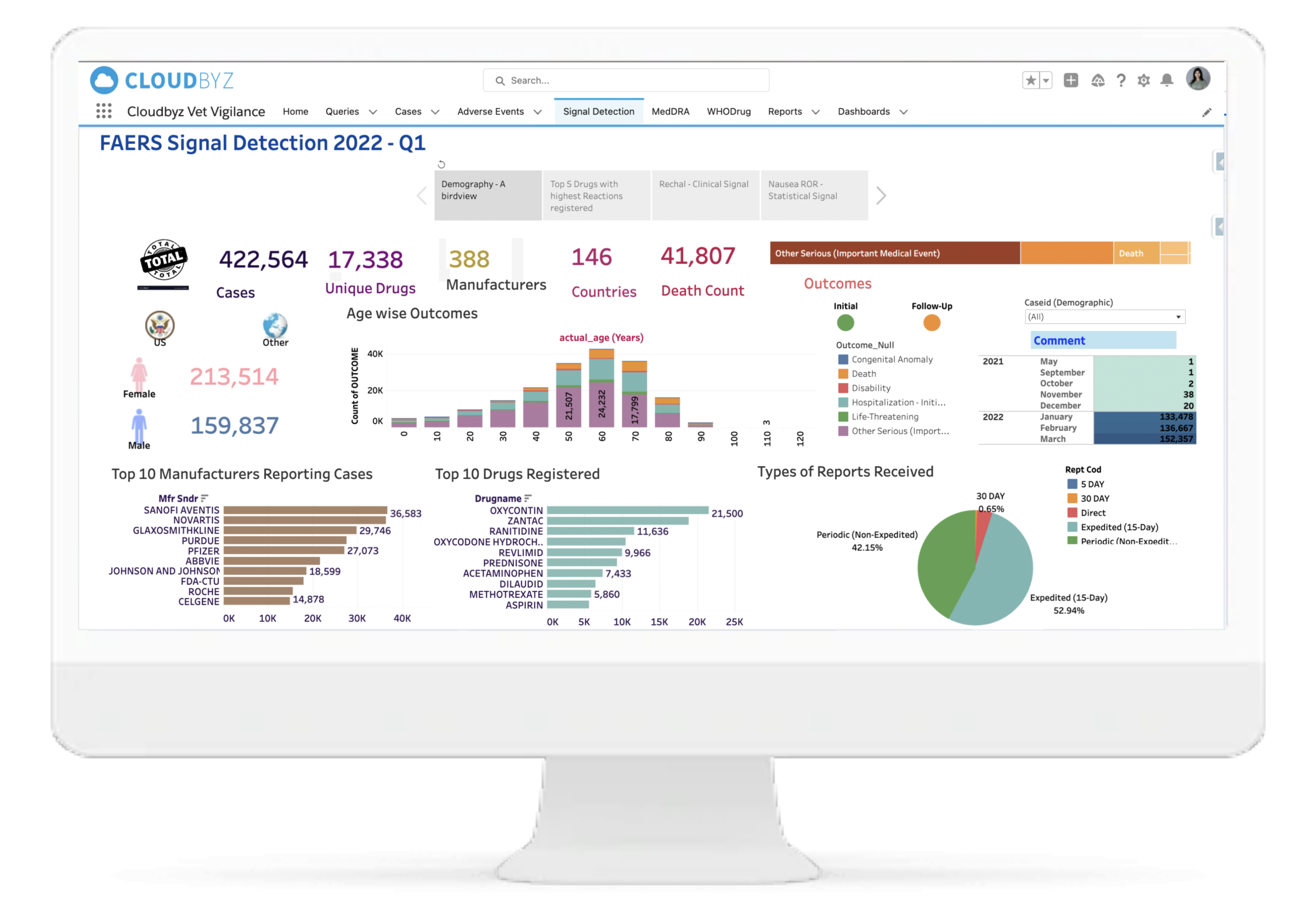
Moving Beyond the Noise: A New Era of Drug Safety Surveillance
Introduction: The Signal Detection Imperative
Every year, regulatory agencies around the world receive millions of Individual Case Safety Reports (ICSRs). The World Health Organization's VigiBase alone holds over 40 million adverse drug reaction reports, a number that grows by millions annually. Behind each data point is a patient. Behind each cluster of data points could be the next thalidomide, or alternatively, a false alarm that pulls a life-saving drug from the market prematurely.
Signal detection, the systematic process of identifying new or changing safety concerns from accumulated pharmacovigilance data, sits at the very heart of post-market drug safety. For decades, this has been the domain of statisticians armed with disproportionality analysis methods like the Proportional Reporting Ratio (PRR) and Bayesian Confidence Propagation Neural Networks (BCPNN). These tools have served the industry well, but they were built for a different data era.
Today, the volume, velocity, variety, and complexity of safety data have outpaced what traditional statistical methods can handle alone. Artificial intelligence is not merely augmenting pharmacovigilance. It is fundamentally reimagining what signal detection can look like.
The Limitations of Traditional Signal Detection
Before appreciating what AI brings to the table, it is worth understanding what legacy approaches struggle with.
Traditional disproportionality analysis methods compare the observed reporting frequency of a drug-event combination against what would be expected under statistical independence. They are computationally simple, interpretable, and well-validated by regulators. But they come with significant blind spots.
They are inherently reactive, requiring a sufficient volume of reports before a signal emerges above background noise. They are largely drug-event binary, incapable of capturing complex multi-drug interactions, patient-level risk factors, or temporal patterns that evolve over time. They are also data-silo dependent, typically applied to spontaneous reporting system databases in isolation, without integrating the rich ecosystem of real-world evidence that now exists: electronic health records (EHRs), claims data, social media, scientific literature, wearables, and genomic data.
Perhaps most critically, traditional approaches are hampered by unstructured data blindness. Up to 80% of medically relevant information in pharmacovigilance databases exists in narrative free-text fields, including case narratives, reporter comments, and clinical descriptions that tell the real story. Classical methods largely ignore this richness.
The AI Toolkit for Signal Detection
AI brings a diverse and layered set of capabilities to pharmacovigilance. The most impactful applications can be organized across three dimensions: data ingestion, signal generation, and signal evaluation.
1. Natural Language Processing: Unlocking Unstructured Data
Natural Language Processing (NLP) is arguably the single most transformative AI technology in pharmacovigilance today. Modern NLP models, particularly large language models (LLMs) and transformer-based architectures like BERT and its clinical variants (BioBERT, ClinicalBERT), can read and interpret free-text case narratives with a level of sophistication that approaches that of a trained safety scientist.
Key applications include:
Automated MedDRA Coding. Mapping adverse event descriptions to standardized Medical Dictionary for Regulatory Activities (MedDRA) terms is a high-volume, labor-intensive process. NLP models trained on pharmacovigilance datasets can automate this coding with accuracy rates that rival human coders, dramatically reducing turnaround time and freeing safety scientists for higher-value work.
Case Narrative Mining. NLP can extract clinically meaningful signals from narrative fields, identifying dose-response relationships, temporal associations, dechallenge/rechallenge information, and patient characteristics that structured fields never capture.
Literature Surveillance. The biomedical literature grows by more than a million new publications per year. AI-driven literature monitoring tools can continuously scan PubMed, Embase, and grey literature sources to identify published case reports and epidemiological findings that carry signal value, a task that would otherwise require entire teams working around the clock.
Social Media and Patient Forums. Platforms like Twitter/X, Reddit, and patient communities like PatientsLikeMe are increasingly recognized as early-warning systems. Patients report adverse events in these spaces, often before they file a formal report, using lay language, emotionally-inflected narratives, and real-time descriptions. NLP models trained on lay medical language can mine these sources to detect nascent signals, particularly for patient populations who are underrepresented in traditional spontaneous reporting.
2. Machine Learning for Disproportionality Enhancement
Classical disproportionality methods apply uniform statistical thresholds across all drug-event pairs. Machine learning allows for the development of models that are contextually aware and adaptive.
Supervised Learning Models trained on historical validated signals can learn the features that distinguish true signals from noise, incorporating not just reporting frequencies but case characteristics, reporter quality, temporal patterns, and biological plausibility. These models can generate probability scores that help prioritize signals for human review.
Unsupervised Clustering algorithms can identify unexpected groupings of adverse events, revealing previously unrecognized syndromes or drug-effect clusters that no single drug-event pair would surface on its own. This is particularly valuable for detecting complex, multisystem adverse drug reactions.
Temporal Pattern Analysis. Traditional disproportionality is largely time-agnostic. Machine learning models, particularly recurrent neural networks (RNNs) and Long Short-Term Memory (LSTM) architectures, can detect signals that emerge, evolve, or disappear over time. This is a critical capability for distinguishing post-marketing risk accumulation from reporting spikes driven by media attention or regulatory action.
3. Graph Neural Networks and Knowledge Graphs
One of the most exciting frontiers in AI-driven pharmacovigilance is the application of knowledge graphs and graph neural networks (GNNs).
A pharmacovigilance knowledge graph links drugs, targets, diseases, adverse events, biological pathways, and patient characteristics in a structured relational network. By reasoning over this graph, AI models can identify biologically plausible connections between a drug's mechanism of action and a reported adverse event, a capability that no traditional statistical method possesses.
For example, if a new drug shares a molecular target with an older compound known to cause cardiac arrhythmias, a GNN can surface this structural risk before sufficient spontaneous reports have accumulated. This enables prospective, mechanism-informed signal detection rather than purely retrospective, report-driven detection.
Knowledge graphs also enable drug-drug interaction signal detection at scale, a problem that disproportionality analysis handles poorly when three or more concomitant medications are involved.
4. AI-Powered Real-World Evidence Integration
The pharmacovigilance data ecosystem has expanded dramatically beyond spontaneous reporting systems. Electronic health records, insurance claims, patient registries, genomic databases, and wearable sensor data are all increasingly available. The challenge has been integration: these data sources exist in different formats, at different granularities, and with different biases.
AI, specifically federated learning and transfer learning approaches, is enabling multi-source signal detection without requiring the centralization of sensitive patient data. Federated models can be trained across multiple hospital networks or national data repositories, each contributing to a shared signal detection model while keeping patient records local and private.
This represents a fundamental shift: from signal detection that occurs after sufficient spontaneous reports have accumulated, to signal detection that is continuous, real-world, and prospective.
From Signal Detection to Signal Intelligence
The most forward-looking pharmacovigilance organizations are moving beyond detection toward what might be called signal intelligence, the ability to not just identify a safety signal but immediately contextualize it, assess its causality, quantify its public health impact, and recommend a regulatory response.
This requires AI to do several things simultaneously:
- Causality assessment support: LLMs trained on clinical pharmacology can evaluate the Bradford Hill criteria for a flagged signal, helping safety scientists make faster and more consistent causality assessments.
- Benefit-risk contextualization: AI models integrating efficacy data with safety signals can provide dynamic benefit-risk profiles, critical for determining whether a signal warrants label update, risk minimization measures, or market withdrawal.
- Regulatory intelligence: NLP-driven monitoring of regulatory agency websites, Dear Healthcare Professional letters, and public assessment reports worldwide enables pharmacovigilance teams to triangulate internal signals against global regulatory actions in near-real time.
The Human-AI Partnership: An Essential Balance
Despite the transformative potential of AI in signal detection, a critical principle must be stated clearly: AI in pharmacovigilance is a decision-support tool, not a decision-making tool.
The consequence of a false negative, missing a true safety signal, can be patient deaths. The consequence of a false positive, acting on a spurious signal, can deprive patients of effective medicines and impose enormous costs on healthcare systems. Both errors carry profound ethical weight.
Regulatory frameworks reflect this reality. The ICH E2E guideline, the FDA's Pharmacovigilance Framework, and the EMA's GVP Module IX all position signal detection as a process that requires qualified human oversight. AI outputs must be explainable, auditable, and interpretable by the safety scientists who act on them, a requirement that pushes back against the "black box" models that dominate other AI application domains.
The emerging best practice is a tiered system: AI handles high-volume, repetitive detection tasks (MedDRA coding, literature triage, initial disproportionality scoring), while experienced safety scientists apply clinical judgment to signal validation, causality assessment, and regulatory decision-making. This is not a diminishment of the human role. It is an elevation of it. AI removes the cognitive burden of data processing so that human expertise can be focused where it matters most.
Regulatory Posture and the Path to Validation
Regulators globally are actively engaging with AI in pharmacovigilance, though the validation landscape is still maturing.
The FDA's Emerging Technology Program and the EMA's Big Data Task Force have both issued frameworks encouraging innovation while emphasizing the need for algorithmic transparency, performance validation, and bias assessment. The key regulatory expectations for AI-driven signal detection tools include:
- Documented validation against historical confirmed signals and false positives
- Sensitivity and specificity benchmarks that are acceptable for the use case
- Bias assessment, particularly with respect to underrepresented populations who are systematically underreported in spontaneous reporting systems
- Explainability, meaning the ability to provide a human-understandable rationale for why a signal was surfaced
For the industry, this means that deploying AI in pharmacovigilance is not just a technical challenge but a regulatory strategy challenge. Organizations that invest in validation frameworks and regulatory engagement now will have a substantial competitive and compliance advantage as requirements formalize.
The Equity Dimension: AI and Underrepresented Populations
A dimension that deserves more attention in pharmacovigilance AI discourse is health equity. Spontaneous reporting systems systematically underrepresent women (particularly in reproductive health contexts), the elderly, pediatric populations, and patients in low- and middle-income countries. Training AI models on these biased datasets risks perpetuating, and potentially amplifying, those gaps.
Thoughtful pharmacovigilance AI must include deliberate strategies to address reporting bias: using real-world data from broader populations, explicitly weighting underrepresented groups in model training, and building signal detection frameworks that flag when data on vulnerable populations is insufficient to draw conclusions.
This is not just an ethical imperative. It is a scientific one. A drug safety profile that is accurate for a 45-year-old white male but misleading for a 70-year-old woman or a child is not an accurate drug safety profile.
Looking Ahead: The Next Five Years
Several developments will define the next phase of AI in pharmacovigilance signal detection:
Multimodal AI will integrate structured, unstructured, genomic, imaging, and wearable data into unified safety models, enabling pharmacovigilance that is truly patient-centric and biologically grounded.
Generative AI will move from text processing to reasoning, capable of drafting signal assessment reports, synthesizing evidence, and simulating regulatory scenarios to support decision-making.
Continuous learning systems will replace static, periodically retrained models with adaptive systems that update their signal detection capabilities in real time as new data flows in.
Global signal harmonization through federated AI networks will enable multi-regional signal detection that respects data sovereignty while generating insights that no single national database could produce alone.
Conclusion: A Responsibility as Much as an Opportunity
The application of AI to signal detection in pharmacovigilance is one of the most consequential deployments of this technology in healthcare. The stakes are not abstract. They are measured in adverse events prevented, product liabilities avoided, and patient lives protected.
Organizations that approach this space with scientific rigor, regulatory foresight, and a genuine commitment to patient safety will find that AI does not replace the discipline of pharmacovigilance. It expands what pharmacovigilance can know, how fast it can act, and how many lives it can protect.
That is the real signal worth detecting.
Subscribe to our Newsletter
