

Request a demo specialized to your need.
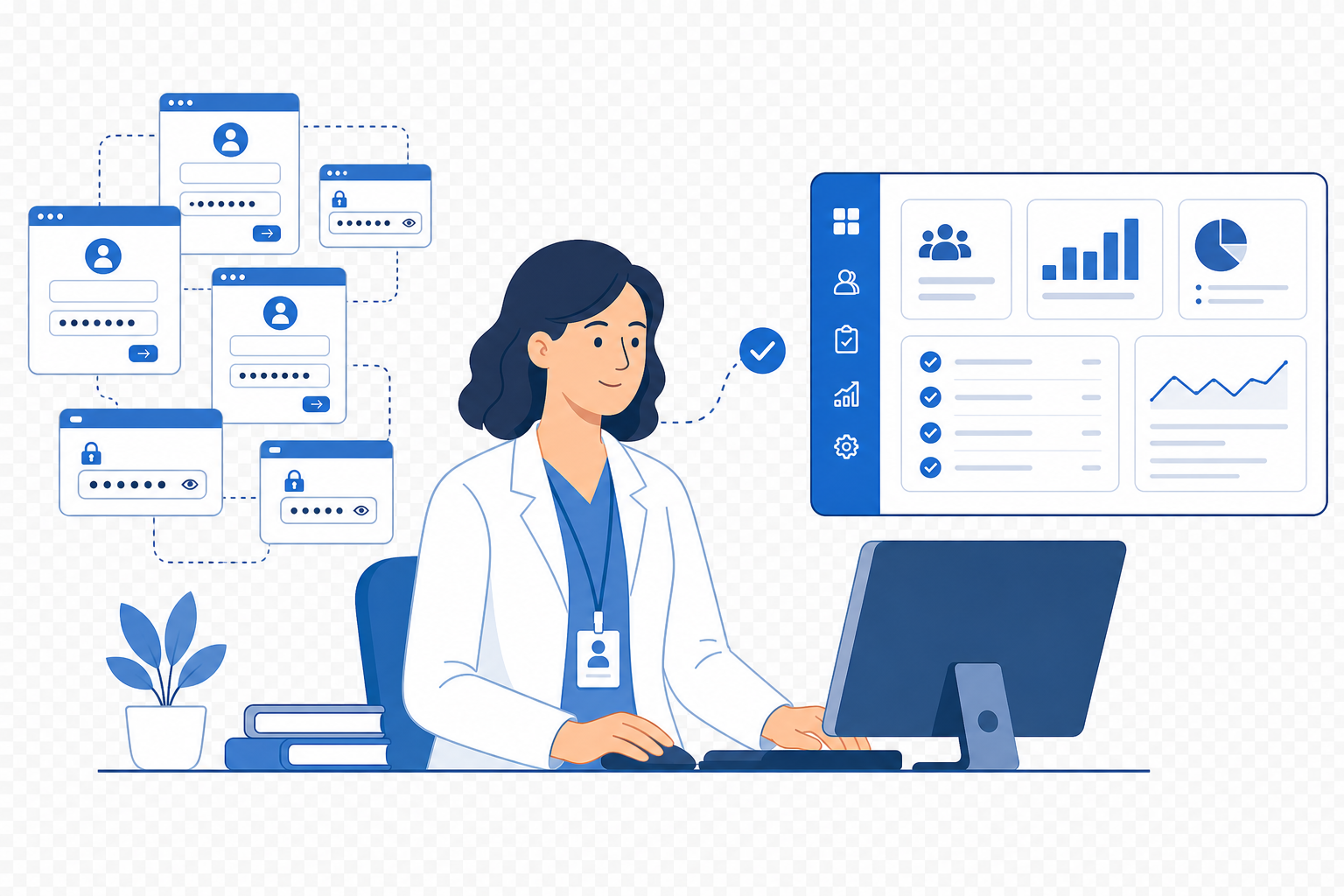
Take a modest early phase study a few dozen enrolled subjects at a given site and count the separate systems a coordinator needs credentials for just to run it: CTMS for visit and monitoring tracking, EDC for clinical data entry, a separate login for ePRO administration, another for the safety database, a sponsor portal for document exchange, and often a training or LMS platform to prove GCP and protocol training was completed before any of the above access gets granted.
That's six systems, six sets of credentials, six password policies for a site that might be actively managing fewer patients than logins. Run three studies for three different sponsors at once, which is normal for a busy site, and the math gets worse, not better, because every sponsor's technology stack is different.
Nobody designed this on purpose. It's what happens when every eClinical function gets procured separately, by different stakeholders, for different reasons, without anyone on the sponsor side ever asking what it's like to be the person at the site trying to keep track of all of it.
Why credential sprawl happens in the first place
CTMS access usually gets set up by clinical operations. EDC access comes from data management. eTMF and document access often route through regulatory. Safety database credentials come from pharmacovigilance. None of these teams are talking to each other about the cumulative experience they're creating for the person on the other end the coordinator who has to log into all of it, correctly, before they can do anything else that day.
Because every sponsor assembles its own version of this stack, a coordinator working across multiple studies doesn't even get the small mercy of a consistent set of logins. Every study is its own puzzle.
What this actually costs beyond the annoyance
-
Time, repeatedly, in small pieces. Every login, every password reset, every "which portal was this in again" moment adds up across a visit day, and it adds up again across a study, and again across every study a site runs concurrently.
-
Password fatigue creates its own compliance risk. When people manage six or more separate logins, workarounds appear written-down passwords, reused credentials across systems, shared logins during access delays. Every one of those workarounds is a 21 CFR Part 11 access control finding waiting to happen, and none of them started as carelessness. They started as six too many systems.
-
Deprovisioning becomes something that has to be remembered, six separate times. When a coordinator leaves a role or a study closes out, someone has to remember to revoke access in every system it was granted in. Orphaned accounts access that should have been removed but wasn't are a well documented audit finding category precisely because deprovisioning across a fragmented stack depends on someone's checklist discipline instead of the system enforcing it.
-
Site activation slows down waiting on training across every system. Before first login, most sites need documented training on each platform. Six systems can mean six separate training modules stacked before a coordinator can actually start working extending site activation timelines for reasons that have nothing to do with the study itself.
Where ICH E6(R3) points instead
ICH E6(R3) pushes toward processes that are fit-for-purpose and proportionate to actual risk not complexity for its own sake. A site coordinator managing six credential sets to run one study isn't a quality safeguard; it's administrative overhead that adds burden without adding oversight. The guidance's emphasis on appropriately supporting delegated tasks assumes the people doing that work can actually get to it efficiently not that getting logged in becomes its own daily task.
What changes with one connected platform
| Fragmented per-system access | Unified platform access | |
|---|---|---|
| Logins needed per study | One per system (often 5–6+) | One |
| Training curriculum before activation | Separate module per system | Single platform-wide training |
| Deprovisioning on staff change | Manual, per system | Centralized, single point of control |
| Risk of orphaned accounts | Compounds with every added system | Structurally reduced |
| Time from access request to first login | Sequential approvals across systems | Single role-based provisioning |
What this means for each stakeholder
-
Site coordinators get their time back for the work that actually requires a human patient care and data quality instead of system navigation.
-
CRAs verify access and delegation against one system during monitoring instead of cross checking credentials across several.
-
Clinical operations leadership sees faster site activation, because training and provisioning happen once instead of once per system.
Where a complete eClinical suite fits
A genuinely unified eClinical platform gives every stakeholder investigator, CRO, sponsor, and site staff role-based access through one connected environment instead of a separate login for every function. Cloudbyz brings CTMS, eTMF, EDC, ePRO/eCOA, CTFM, and Safety & Pharmacovigilance together on a single Salesforce-native platform with dedicated Investigator, CRO, and Sponsor portals so the people running the trial manage one set of credentials, not six.
See how a unified eClinical platform simplifies access for your sites and study teams book a demo with our team.
Subscribe to our Newsletter
