

Request a demo specialized to your need.
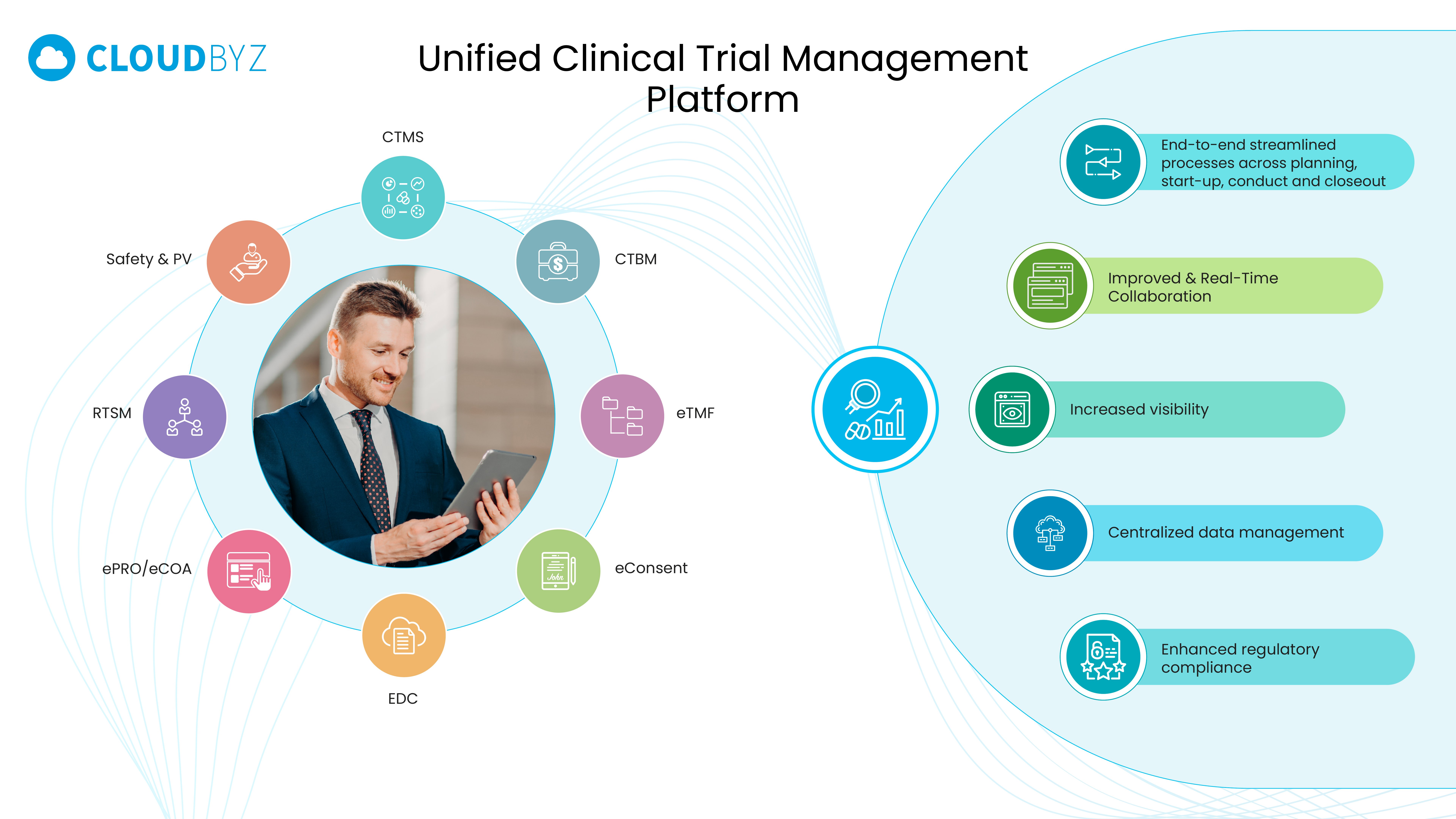
Unify CTMS, EDC, and eTMF so records reconcile cleanly and fast.
Designing a Unified Operating Model Aligned to E6(R3) and Data Ownership
And How Cloudbyz Makes Semantic Alignment the Default, Not a Manual Burden
As clinical trials grow more global, complex, and digitally mediated, sponsors and CROs continue to face a persistent challenge: keeping CTMS, EDC, and eTMF truly in sync. What begin as seemingly minor inconsistencies—a site code that differs by a character, visit names that drift after protocol amendments, or document versions that lag across systems—can quickly cascade into reconciliation backlogs, delayed payments, delayed database lock, and inspection findings.
The issue is rarely a lack of systems. It is the absence of a unified operating model that defines data ownership, alignment rules, and risk priorities from the outset. The solution lies in a shared semantic layer and governance model that makes alignment the default rather than an afterthought—one that is explicitly designed around modern quality principles such as those articulated in ICH E6(R3).
Establishing Design Foundations with Clear Data Ownership
A resilient integration strategy starts with first principles. Sponsors must define a canonical data model spanning CTMS, EDC, and eTMF, with explicit ownership for each domain object. In a best-practice model:
-
CTMS is the operational spine, owning studies, countries, sites, visit plans, milestones, monitoring activities, and issues.
-
EDC is the system of record for subject-level activity, visit and procedure completion, and data quality signals such as queries.
-
eTMF is the authoritative source for essential document completeness, status, and versioned artifacts.
Where these domains intersect, ownership and publishing responsibilities must be unambiguous. Each system publishes what it owns—under defined conditions and timing—rather than duplicating or inferring state from downstream systems.
This design should be explicitly grounded in a risk-based mindset aligned to ICH E6(R3). Sponsors should identify critical-to-quality (CTQ) intersections—points where misalignment directly threatens participant safety or data reliability. Examples include site activation readiness, informed consent documentation, and endpoint-defining visits. CTQ intersections should trigger prioritized workflows, predefined playbooks, and heightened visibility rather than manual reconciliation after the fact.
Equally important is planning for change. Protocol amendments inevitably introduce new visit names, schedule windows, and document templates. Identifier dictionaries must be updated centrally and cascade to all systems with effective dates. Superseded values should be archived—not overwritten—so historical records remain explainable during audits.
These foundations eliminate the most common sources of reconciliation friction and prepare the environment for automation at scale.
How Cloudbyz Unified eClinical Achieves This by Design
What distinguishes Cloudbyz is that this unified operating model is not an integration overlay—it is native to the platform architecture.
Cloudbyz delivers CTMS, EDC, eTMF, Clinical Trial Financials, and Safety on a single, Salesforce-native data model with a shared semantic layer. This means identifiers, hierarchies, and relationships are defined once and reused consistently across all modules.
A Single Canonical Data Model Across CTMS, EDC, and eTMF
In Cloudbyz, studies, countries, sites, visit definitions, milestones, document requirements, and financial triggers are not replicated across systems—they are shared objects with explicit ownership:
-
The Cloudbyz CTMS module owns study structure, visit plans, milestones, monitoring activities, and readiness states.
-
The Cloudbyz EDC module extends the same visit and subject objects with subject-level execution, timestamps, and query states.
-
The Cloudbyz eTMF module links essential documents directly to the same study, country, site, and milestone objects, with version control and completeness status embedded in the operational workflow.
Because all modules operate on the same underlying model, semantic drift is structurally prevented. A visit name cannot silently diverge between CTMS and EDC, and a site cannot be marked “active” unless required eTMF documents tied to that site and country are complete and current.
Built-In CTQ Awareness Aligned to E6(R3)
Cloudbyz operationalizes ICH E6(R3) by embedding CTQ awareness directly into workflows. Sponsors can declaratively tag CTQ data intersections—such as informed consent readiness, endpoint visits, or site activation dependencies—and the platform automatically enforces heightened controls at those points.
For example:
-
Site activation milestones in CTMS are automatically blocked unless required essential documents in eTMF are present, approved, and version-current.
-
Endpoint-defining visits cannot trigger downstream actions (such as payments or database milestones) unless EDC data quality conditions are met.
-
CTQ discrepancies surface in prioritized worklists and dashboards, rather than being discovered during reconciliation or inspection preparation.
This ensures that quality is designed in, not inspected in later.
Event-Driven Synchronization Without Fragile Interfaces
Because Cloudbyz is unified, changes propagate as native events rather than brittle integrations. When a protocol amendment updates visit schedules or document templates, those changes cascade across CTMS, EDC, and eTMF with effective dating and preserved historical context.
There is no need to reconcile nightly flat files or debug mismatched identifiers. Referential integrity is enforced at the platform level, and any exceptions are surfaced with context, ownership, and resolution guidance.
Inspection-Ready Evidence Across Systems
Cloudbyz also simplifies inspection readiness by maintaining end-to-end traceability across operational, clinical, and document workflows. Inspectors can easily trace:
-
A site activation decision to the underlying eTMF documents and CTMS readiness milestones
-
A subject visit in EDC to the corresponding CTMS visit definition and monitoring status
-
A protocol amendment to its effective dates, impacted visits, and document versions
All actions are time-stamped, user-attributed, and retained in immutable audit trails, aligning with regulatory expectations outlined by the FDA for computerized systems used in clinical trials.
Sustaining Harmony Through Governance and Continuous Improvement
Cloudbyz further supports sustained alignment through configurable governance constructs. Cross-functional data councils can manage identifier dictionaries, mapping rules, and change control centrally within the platform. Built-in dashboards track reconciliation health indicators such as exception aging, readiness blocks, and CTQ compliance.
When protocols amend, Cloudbyz automatically re-baselines plans and dashboards, eliminating the manual rework that often follows change events in fragmented environments.
Over time, this unified, E6(R3)-aligned operating model reduces reconciliation effort, accelerates payments and database lock, and strengthens confidence across sponsors, CROs, and sites.
In practice, Cloudbyz demonstrates that semantic alignment is not an integration problem to be managed—it is a platform capability to be designed.
Subscribe to our Newsletter
