

Request a demo specialized to your need.
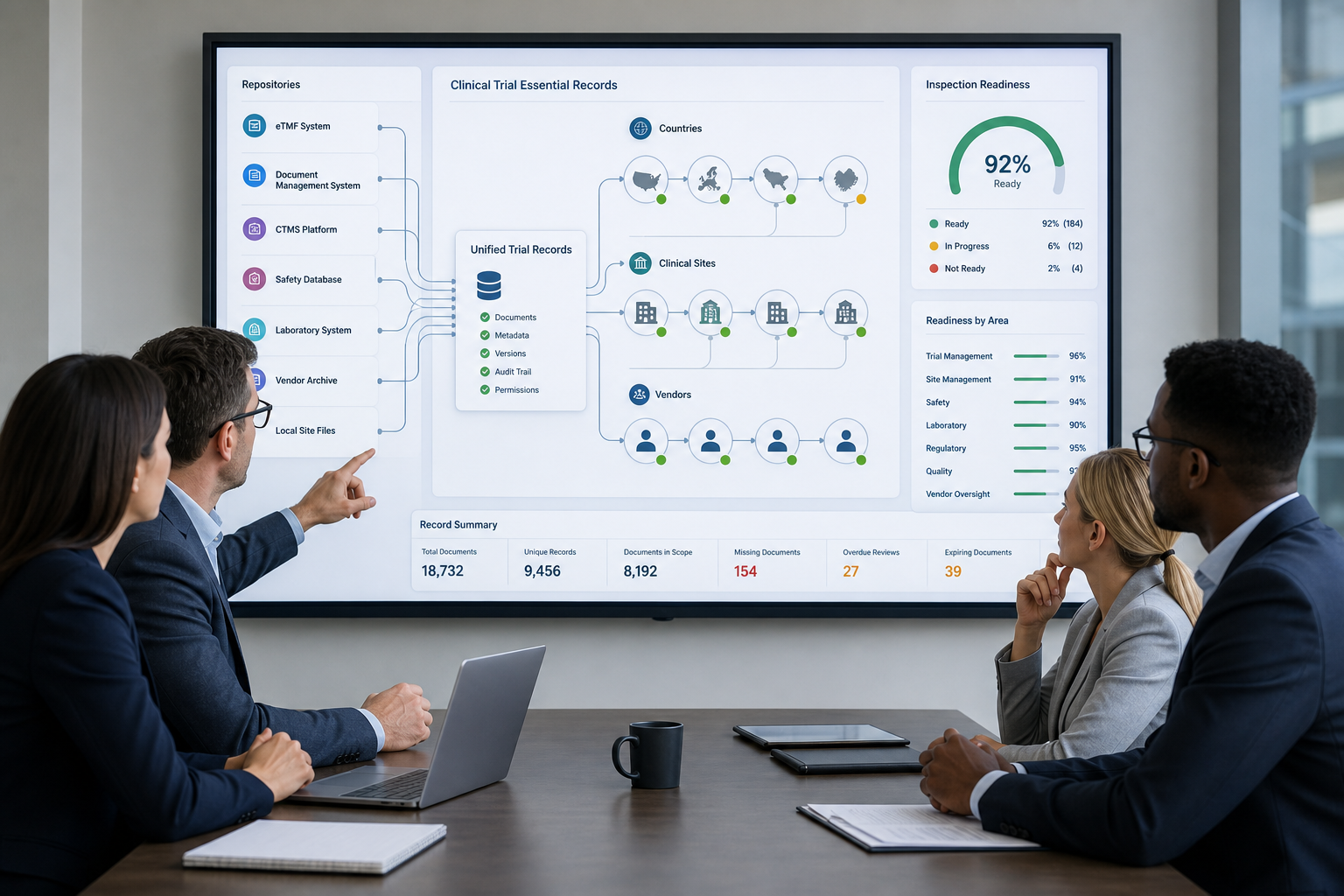
How Cloudbyz AI eTMF Agent and CTMS↔eTMF on Salesforce turn TMF documents into ALCOA+-aligned evidence trails under ICH E6(R3).
Version control and metadata traceability are no longer hygiene factors in the Trial Master File. Under ICH E6(R3), they are central to whether your records qualify as evidence. This paper explains why that shift matters, what it demands of your eTMF platform, and how Cloudbyz delivers ALCOA+-aligned evidence behaviour as a native property of its Salesforce-native unified eClinical platform.
1. The Inspection Question That Changed Everything
Every TMF inspection eventually arrives at a question that starts with: "Which version was in force when...?" When was the subject consented? When did the country begin enrolling? When was the DMC recommendation implemented? When did the protocol amendment take effect?
Under ICH E6(R2), sponsors and CROs could often answer those questions with effort: trawling through filenames, local trackers, and CRO exports until a plausible timeline emerged. That reconstruction work was painful, but it was survivable.
Under E6(R3), that reconstruction work becomes the expected standard, not the exception -- unless your platform changes. The final guideline, adopted on 06 January 2025, reframes the TMF through the lens of essential records and makes version chains, metadata integrity, and audit behaviour primary inspection artefacts. Regulatory Affairs, Clinical Operations, and Quality leaders at Biotech sponsors and mid-size CROs need to understand what that shift demands -- and why most legacy eTMFs cannot meet it.
2. What ICH E6(R3) Actually Requires
The E6(R3) Step 4 text introduces three provisions that directly govern how TMF platforms must behave.
Appendix C and Section C.2: Essential Records as Evidence Nodes
Appendix C defines essential records as documents, metadata, and data that "facilitate the ongoing management of the trial" and collectively allow evaluation of methods, influencing factors, and actions taken. The file is not the record; the record is the file plus its context.
Section C.2 -- Management of Essential Records -- goes further: records must be identifiable and, where appropriate, version-controlled; they must capture authors, reviewers, and approvers as part of the record; and they must protect blinding and privacy when shared. Some record types (SOPs, validation documentation, MSAs) may appropriately live outside the TMF, but only if they are governed and readily available.
Section 4.2.3: Planned, Risk-Based Metadata Review
Section 4.2.3 makes review of trial-specific data and metadata -- including audit trails -- a planned, risk-based, documented activity. Regulators are not simply asking whether documents exist; they are asking how those documents, with their versions and metadata, behave over time, and how that behaviour is reviewed on purpose. Version chains, metadata changes, and audit log behaviour are no longer back-office curiosities; they are primary inspection artefacts.
The Broader Regulatory Frame
E6(R3) does not operate in isolation. The converging requirements from:
- EU Clinical Trials Regulation (Regulation (EU) 536/2014): transparency and documentation discipline
- EMA TMF content, management and archiving guideline: timely filing, completeness, and audit-ready systems
- 21 CFR Part 11 (US): criteria for trustworthy electronic records and signatures
...all point toward the same operational shorthand: ALCOA+. Attributable, Legible, Contemporaneous, Original, Accurate, Complete, Consistent, Enduring, and Available. Under current inspection practice, these are not aspirational adjectives; they are concrete tests applied to every record and every version chain in your TMF.
3. Why Legacy eTMFs Cannot Meet R3-Era Expectations
Most eTMF pain points trace back to one foundational design decision: treating documents as static files rather than as nodes in a versioned, metadata-rich evidence graph.
The structural consequences are familiar to anyone who has prepared for an inspection:
- File naming conventions and folder structures stand in for controlled version chains, creating ambiguity when two documents share a name pattern but different effective dates.
- Metadata fields vary from study to study, driven by local habits rather than a deliberate evidence model, making cross-study governance impossible.
- Audit logs, when technically present, are practically unreadable -- exported as dense tables that only a handful of specialists can interpret and that inspectors increasingly reject as evidence.
- Sample-based QC processes provided defensible coverage under E6(R2); under E6(R3), planned and documented metadata review is required, not just plausible.
Asking teams to bridge that design gap with manual QC, spreadsheet trackers, and hero projects is neither sustainable nor inspection-credible. The E6(R3) framework demands a TMF platform that treats each document as a living record with lineage, relationships, and auditable behaviour -- and that can surface that behaviour clearly, without a data-science project, whenever an inspector or internal leader asks: "What really happened here?"
4. How Cloudbyz Addresses the R3-Era Evidence Standard
Cloudbyz is the only 100% Salesforce-native unified eClinical platform in this space, with CTMS and eTMF sharing a single data, security, and audit model. On that spine, the AI eTMF Agent operates as an in-workflow capability that turns static documents into ALCOA+-aligned evidence trails.
A Structured Record, Not a Static File
Every TMF artifact in Cloudbyz is represented as a structured record. The file is one attribute of that record. Core fields include programme, protocol, country, site, TMF zone and artifact type (aligned with the TMF Reference Model), risk tier, originating system, and associations to CTMS milestones and subject journeys.
Versioning is modelled explicitly: each new iteration is a node in a version chain, with effective date ranges and supersession logic captured as data, not inferred from filenames. There is no ambiguity about which version was in force when.
The AI eTMF Agent: Continuous ALCOA+ Enforcement
When new documents arrive from CROs, internal teams, or integrated systems, the AI eTMF Agent:
- Auto-classifies them to the correct TMF zone and artifact type, based on content and context.
- Applies and validates metadata using live CTMS data: which study, country, site, investigator, and milestone the document belongs to.
- Attaches the document to the correct version chain, checking for overlaps, regressions, or inconsistent tags.
- Runs risk-tiered QC rules: low-risk records may be auto-corrected for predictable gaps; medium- and high-risk records trigger human review when anomalies appear (late filing relative to a milestone, improbable effective dates, missing approvals, or unexplained reversion to an older version).
Because CTMS and eTMF are native to the same Salesforce platform, these operations are not guesswork. When the agent links an updated PIS/ICF to a specific set of countries and sites, or ties a safety letter to certain enrolment windows, it uses the same objects that drive site activation, subject visits, and monitoring plans. Evidence is literally anchored to how the trial runs.
Readiness Views That Speak the Language of R3 and ALCOA+
Instead of a generic completeness percentage, Regulatory Affairs and Clinical Operations leaders can see:
- Version integrity: where chains are clean and where overlaps or gaps exist, by artifact family and country.
- Metadata quality: how often the AI eTMF Agent or humans have had to correct tags, and in which zones or providers those corrections concentrate.
- Timeliness: filing latency against key CTMS milestones for high-risk record families.
A Single, Coherent Audit Story
Every classification, metadata change, version link, approval, escalation, and resolution -- whether initiated by a user or proposed by the AI eTMF Agent -- is logged via Salesforce-native Audit Trail and e-Signature, with a timestamp, actor, and context. From an ALCOA+ standpoint, every evidence trail is Attributable, Contemporaneous, and traceable across its lifecycle. From an E6(R3), EU CTR, and Part 11 perspective, it provides a single, coherent story of how the TMF supported trial conduct and oversight.
5. Capability-to-Requirement Alignment
The table below maps key R3 and ALCOA+ requirements to Cloudbyz platform capabilities.
|
Requirement (R3 / ALCOA+) |
Legacy eTMF Gap |
Cloudbyz Capability |
|---|---|---|
|
Version-controlled essential records (C.2) |
Filenames as version proxies; no supersession logic |
Explicit version chains with effective dates; AI-enforced supersession |
|
Authors, reviewers, approvers as part of the record (C.2) |
Manual sign-off outside the document store |
Salesforce-native e-Signature and role capture per version node |
|
Planned, documented metadata review (4.2.3) |
Ad-hoc sampling; no structured cadence |
Risk-tiered AI QC; escalation workflow with documented resolution |
|
ALCOA+ Attributable |
Audit logs technically present but unreadable |
Per-event log with actor, timestamp, and context; human-readable views |
|
ALCOA+ Contemporaneous |
Filing often lags milestone; no structured latency measure |
AI monitors filing latency against CTMS milestones; alerts on high-risk delays |
|
21 CFR Part 11 / EU CTR trustworthiness |
Separate systems for CTMS and eTMF; gap risk at integration points |
Single Salesforce data model; no integration gap between trial conduct and TMF |
6. The Practical Stakes for Biotech Sponsors and Mid-Size CROs
For organisations operating under post-2024 funding constraints, the cost of maintaining the status quo is not abstract. It shows up in:
- Weeks of pre-inspection reconstruction effort per study, consuming Clinical Operations and Quality bandwidth that cannot be recovered.
- Inspection findings on metadata quality or version traceability that trigger remediation programmes with cascading costs.
- Submission delays when regulators request version-specific evidence packages that cannot be assembled quickly from fragmented stores.
- M&A and partnership diligence risk, as acquirers and co-development partners increasingly scrutinise TMF governance maturity alongside clinical data integrity.
The difference between burning weeks reconstructing version histories ahead of each inspection and being able to walk an inspector through live, ALCOA+-aligned evidence trails on demand is not a feature comparison; it is an operational risk exposure. Cloudbyz's CTMS-eTMF spine, amplified by the AI eTMF Agent, gives sponsors and CROs the latter.
Conclusion
ICH E6(R3) does not ask for better folder organisation; it asks for a different category of platform -- one where every document is a structured record with lineage, every version chain is explicit, and every evidence trail is auditable on demand. ALCOA+ is no longer a post-hoc description of what your records should be; it is a real-time property of how your system must behave.
Cloudbyz was built for exactly this environment. The Salesforce-native CTMS-eTMF data model, combined with the AI eTMF Agent's continuous classification, versioning, and QC enforcement, makes ALCOA+-aligned evidence behaviour a property of the platform itself -- maintained automatically, visible continuously, and defensible under inspection without reconstruction.
Subscribe to our Newsletter
