
Request a demo specialized to your need.
A thought leadership perspective on unified eClinical platforms, agentic AI, and the next decade of clinical trial execution
The Industry Has a Speed Problem — And It Isn't a Technology Shortage
Clinical development has never had more software. Sponsors and CROs today run an average of a dozen or more point solutions across trial management, financial management, document management, data capture, and safety. And yet cycle times have barely moved. Study startup still takes months. Site payments still lag by quarters. TMF completeness is still chased in the final weeks before an inspection. Safety case processing still consumes armies of manual reviewers.
The paradox is easy to explain: the industry digitized its documents and workflows, but it never unified its data — and it never automated its decisions. Every integration between a standalone CTMS, a separate eTMF, a third-party EDC, a bolt-on CTFM tool, and an isolated safety database is a seam. Every seam is a place where data is re-entered, reconciled, delayed, or lost. And every seam is a place where a human being becomes the integration layer.
Artificial intelligence was supposed to fix this. But AI layered on top of fragmented systems inherits the fragmentation. An AI copilot that can only see the CTMS cannot reason about the budget. An agent trained on the eTMF cannot connect a missing document to the monitoring visit where it should have been collected. The lesson of the last three years of enterprise AI is unambiguous: agentic AI is only as powerful as the data foundation beneath it.
This is precisely where Cloudbyz has made a decade-long architectural bet that is now paying off.
The Cloudbyz Difference: One Platform, One Data Model, One Source of Truth
Cloudbyz built its entire eClinical suite — CTMS, CTFM (Clinical Trial Financial Management), eTMF, EDC, and Safety & Pharmacovigilance — natively on the Salesforce platform. Not integrated with Salesforce. Not connected via APIs. Built natively on a single, unified data model.
This is a distinction that matters enormously in practice:
A study, a site, a subject, an investigator, a contract, a budget line, a monitoring visit, a TMF document, a data query, and an adverse event are not records in five different databases stitched together by middleware. They are related objects in one platform, governed by one security model, visible in one reporting layer, and — critically — reasoned over by one AI layer.
When the site activation date changes in CTMS, the financial forecast in CTFM updates from the same record. When a monitoring visit is completed, the expected TMF documents are known instantly because the visit and the TMF live on the same data model. When an adverse event is captured in EDC, safety case intake doesn't require an export, a transform, and a load — it requires a workflow.
For a decade, this unified architecture delivered efficiency. With Agentforce, it delivers something categorically different: a substrate on which autonomous AI agents can actually operate end-to-end.
Why Agentforce Changes the Equation
Salesforce Agentforce represents the shift from generative AI (answering questions, drafting text) to agentic AI — autonomous digital workers that perceive context, reason across data, take actions within governed guardrails, and escalate to humans when judgment is required. Agentforce agents are grounded in the Salesforce Data Cloud and trust layer, meaning they operate with enterprise-grade security, auditability, and data governance from day one.
Here is the strategic insight most of the industry has not yet internalized: Agentforce agents can only act on what lives on the platform. For a company running a fragmented eClinical stack, Agentforce can automate the CRM edges of clinical operations — but not the core. For Cloudbyz customers, because CTMS, CTFM, eTMF, EDC, and Safety all live natively on Salesforce, Agentforce agents can operate across the entire clinical operations value chain — with full context, full lineage, and full compliance controls.
This is the unique differentiation. Competitors must choose between (a) building AI inside one silo, or (b) building fragile orchestration across silos. Cloudbyz doesn't face that trade-off. The unified data model and the agentic AI layer were made for each other.
Agentic AI Across the Cloudbyz eClinical Suite: What Future-Ready Actually Looks Like
CTMS: From Tracking Trials to Orchestrating Them
Traditional CTMS is a system of record — it tells you what happened. Agentforce-enabled Cloudbyz CTMS becomes a system of action.
AI agents continuously monitor enrollment velocity against plan and proactively flag sites trending toward under-enrollment weeks before a human dashboard review would catch it — then recommend corrective actions, from targeted site engagement to enrollment reallocation. Site monitoring agents assemble pre-visit packages automatically: open action items, protocol deviations, outstanding queries, and expected documents, drawn live from across the unified platform. Post-visit, agents draft monitoring visit reports from structured visit data, cutting report turnaround from weeks to hours while keeping the CRA firmly in the review-and-approve loop.
The result is a shift in the CRA and CTM role itself — away from data assembly and status chasing, toward judgment, site relationships, and risk-based decision-making. That is what ICH E6(R3)'s emphasis on risk-proportionate, quality-by-design trial conduct actually demands.
CTFM: Financial Intelligence at the Speed of the Trial
Clinical trial financial management is where fragmentation hurts most — because finance data traditionally lives far from operational data. Accruals are estimated from stale spreadsheets. Site payments lag activity by months. Budget variances surface at quarter-end, when it's too late to act.
Because Cloudbyz CTFM shares a data model with CTMS and EDC, Agentforce agents can compute activity-based accruals from actual trial activity — visits completed, procedures performed, milestones achieved — in near real time. Financial navigator agents monitor burn rate against enrollment progress and forecast study-level financial outcomes under multiple scenarios, including multi-country trials with currency, tax, and fair-market-value complexity. Site payment agents validate triggered payments against source activity, flag anomalies, and prepare payment runs for human approval — compressing the payment cycle that consistently ranks among sites' top grievances with sponsors.
For CFOs and heads of R&D finance, this is the difference between financial reporting and financial steering. Recent industry events — including high-profile revenue restatements tied to clinical trial accounting — have shown how costly the gap between operational reality and financial visibility can be. A unified, agent-monitored financial layer closes that gap structurally.
eTMF: From Inspection Anxiety to Continuous Inspection Readiness
The TMF is where the industry's manual burden is most visible: classifying documents, checking metadata, chasing expected documents, and reconciling completeness before an inspection. Agentforce-enabled Cloudbyz eTMF turns this from a periodic fire drill into a continuous, autonomous process.
AI agents auto-classify incoming documents against the TMF Reference Model, extract and validate metadata, and detect quality issues — missing signatures, wrong versions, incorrect study associations — at the point of filing. Because the eTMF shares a data model with CTMS, agents know what documents should exist: a completed monitoring visit generates an expected-document footprint, and the agent reconciles actuals against expectations automatically. Completeness, timeliness, and quality metrics are computed continuously, and gaps are routed to the right owner before they age.
The strategic outcome is continuous inspection readiness — a TMF that is always current, always complete, always defensible — with dramatically less human effort. Under ICH E6(R3), where the TMF is expected to demonstrate the story of the trial's conduct and oversight, this is no longer a nice-to-have.
EDC: Cleaner Data, Faster Databases, Earlier Insight
In data management, the bottleneck has never been data capture — it's data cleaning. Agentforce agents in Cloudbyz EDC monitor incoming data for anomalies, inconsistencies, and protocol-logic violations, generating intelligent queries with context rather than blunt edit-check firing. Medical coding assistant agents propose MedDRA and WHODrug codes with confidence scoring, letting human coders focus on the ambiguous minority rather than the routine majority. Agents track query aging and site responsiveness, prioritizing data cleaning effort where it most affects database lock.
Because EDC lives on the same platform as CTMS and Safety, clean data flows downstream without transformation loss — enrollment data informs financial forecasting, and safety-relevant data reaches pharmacovigilance workflows without batch exports. Database lock stops being a heroic end-of-study event and becomes the natural conclusion of a continuously clean dataset.
Safety & Pharmacovigilance: Scaling Vigilance Without Scaling Headcount
Pharmacovigilance faces a structural crisis: case volumes grow every year, regulatory expectations tighten, and skilled case processors are scarce. Agentic AI is the only credible answer — but only if it is deployed with the rigor PV demands.
Agentforce-enabled Cloudbyz Safety applies agents across the case lifecycle: intake agents extract structured data from unstructured source documents and validate E2B(R3) conformance; triage agents assess seriousness, expectedness, and causality signals to prioritize workload; quality agents check case narratives for consistency and completeness before medical review; and reporting agents track regulatory submission clocks across jurisdictions so no expedited report deadline is ever silently missed. Aggregate reporting workloads — PSURs, PBRERs, DSURs — are accelerated by agents that assemble data tabulations and draft sections for medical writer refinement.
Crucially, every agent action is logged, attributable, and reversible — human-in-the-loop by design, with medical judgment always retained by qualified professionals. That is what regulators expect, and it is what a governed platform like Salesforce, with its trust layer and audit infrastructure, makes practical at scale.
The Compounding Advantage: Cross-Suite Agentic Workflows
The deepest differentiation isn't any single agent — it's what becomes possible when agents operate across the suite, on one data model:
Study startup orchestration. A startup agent coordinates feasibility data, site contracts and budgets (CTFM), regulatory document collection (eTMF), and system readiness (EDC) as one workflow — collapsing the handoffs that make startup the slowest phase of every trial.
Risk-based quality management. An RBQM-oriented agent synthesizes signals no siloed system can see together: enrollment anomalies from CTMS, data quality patterns from EDC, TMF timeliness from eTMF, payment irregularities from CTFM, and safety signal trends from PV — surfacing site- and study-level risk with a completeness that fragmented stacks simply cannot achieve.
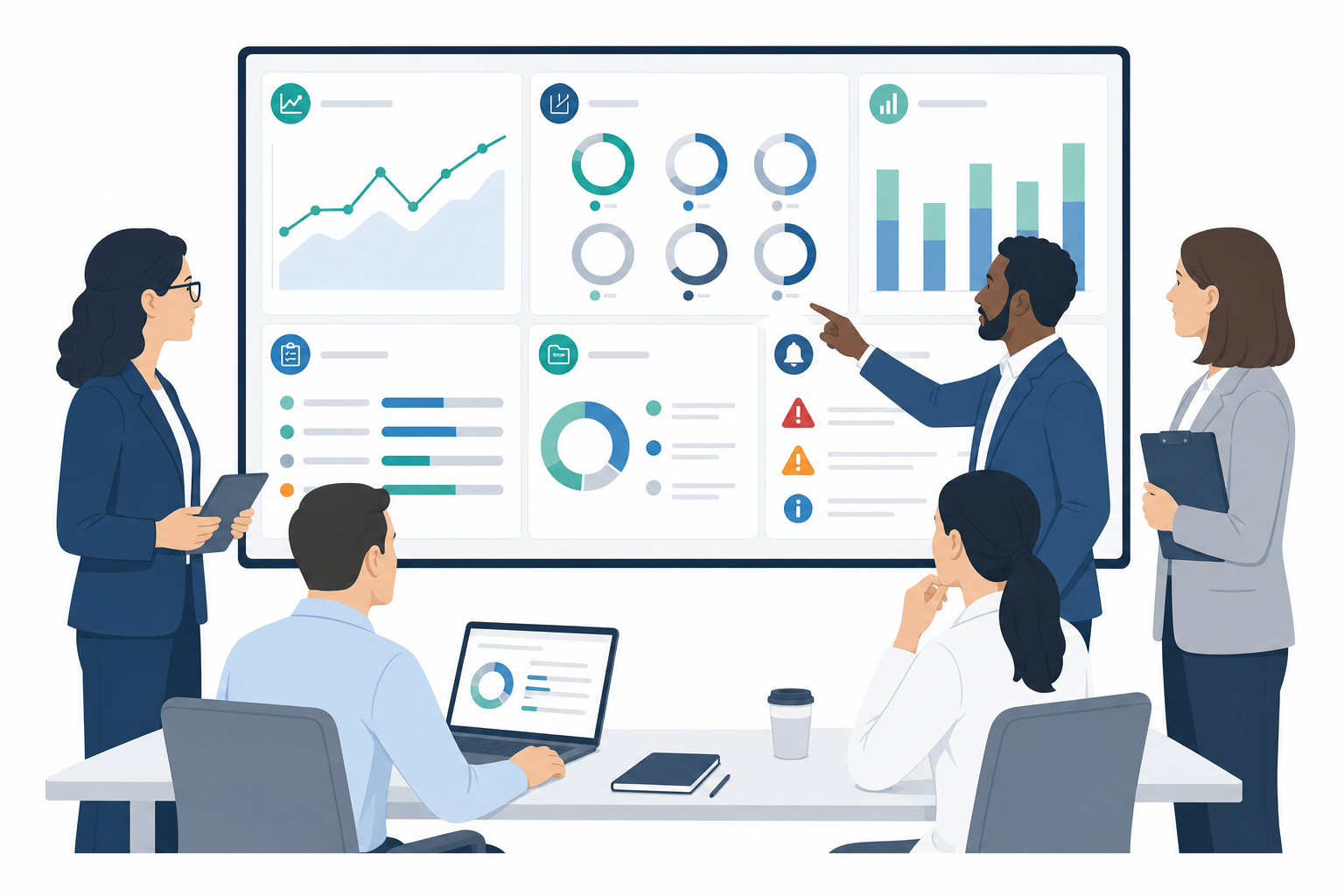
Executive intelligence. Portfolio leaders ask questions in natural language — "Which studies are at risk of missing database lock this quarter, and what's the financial exposure?" — and get answers grounded in live, unified operational and financial data, not last month's reconciled spreadsheet.
This is the compounding effect of architecture: every agent added to the platform makes every other agent smarter, because they share context. Fragmented stacks get linear value from AI. Unified platforms get exponential value.
Governance, Compliance, and Trust: Future-Ready Means Regulator-Ready
Speed without compliance is not future-ready — it's a liability. The Cloudbyz-on-Salesforce architecture embeds the controls life sciences demands:
Agent actions inherit the platform's role-based security, audit trails, and data residency controls, supporting 21 CFR Part 11, GxP, and ALCOA+ expectations by design rather than by bolt-on validation. Human-in-the-loop checkpoints are configurable per workflow, so organizations can dial autonomy up or down by risk level — full automation for document classification, mandatory human approval for site payments or regulatory submissions. The Salesforce trust layer ensures customer data is not used to train shared models, addressing the data governance questions every quality and IT organization rightly asks. And because agents operate on validated platform objects rather than screen-scraping or brittle RPA, the validation burden of agentic automation is dramatically more tractable under GAMP 5 principles.
This is a critical and underappreciated differentiator: agentic AI on a governed, unified platform is validatable. Agentic AI stitched across a fragmented stack often is not.
What This Means for Clinical Operations Leaders
The strategic question facing sponsors and CROs is no longer "should we adopt AI?" It is "does our architecture allow AI to actually deliver?" Leaders evaluating their eClinical roadmap should ask three questions:
First, can our AI see the whole trial? If your CTMS, CTFM, eTMF, EDC, and safety systems live in separate databases, no amount of AI investment will produce agents that reason end-to-end. The integration tax will be paid forever, in latency, cost, and blind spots.
Second, can our AI act, not just answer? Copilots that summarize are useful. Agents that reconcile TMF completeness, compute accruals, draft visit reports, and manage submission clocks — under governed human oversight — are transformational. The difference is architectural.
Third, can our AI be validated and inspected? In a GxP world, autonomy without auditability is unusable. The platform's trust, security, and audit infrastructure is not a footnote — it is the foundation.
Cloudbyz's answer to all three is structural, not aspirational: a unified eClinical suite, built natively on Salesforce, now activated by Agentforce agents that operate across the full clinical value chain with enterprise governance built in.
The Road Ahead
The next decade of clinical development will be defined by organizations that treat trials not as a sequence of departmental handoffs but as a single, continuously optimized operation — where enrollment, finance, documents, data, and safety are one connected fabric, monitored and advanced by AI agents around the clock, with humans elevated to the work only humans can do.
That future is not a roadmap slide. For Cloudbyz customers, it is the current release.
The industry spent twenty years buying systems of record. The winners of the next twenty will run systems of action. Unified data was the prerequisite. Agentic AI is the activation. Cloudbyz, uniquely, built both on the same foundation — and that is what makes clinical operations truly future-ready for efficiency and speed.
Cloudbyz delivers a unified eClinical suite — CTMS, CTFM, eTMF, EDC, and Safety & Pharmacovigilance — built natively on the Salesforce platform and enabled with Agentforce AI agents. To see agentic clinical operations in action, request a demo at cloudbyz.com.
Subscribe to our Newsletter
