

Request a demo specialized to your need.
ICH E6(R3) replaces a document written for a paper-and-fax era with a framework built for decentralized visits, electronic records, and risk-based oversight. For sponsors and CROs still running trials on spreadsheets, shared drives, and after-the-fact monitoring reports, the gap between how E6(R3) expects trials to be managed and how many are actually managed today is significant.
The Principles document and Annex 1 of ICH E6(R3) became effective on 23 July 2025, while Annex 2, addressing pragmatic trials and real-world data, was adopted on 3 June 2026 for implementation on 15 January 2027. This guideline represents a current regulatory requirement for trial planning and documentation, rather than a future consideration. Read the full ICH E6(R3) guideline for further details. This post breaks down what actually changed in E6(R3), what it demands operationally, and how Cloudbyz CTMS helps sponsors and CROs close the gap between the new standard and day-to-day trial execution.
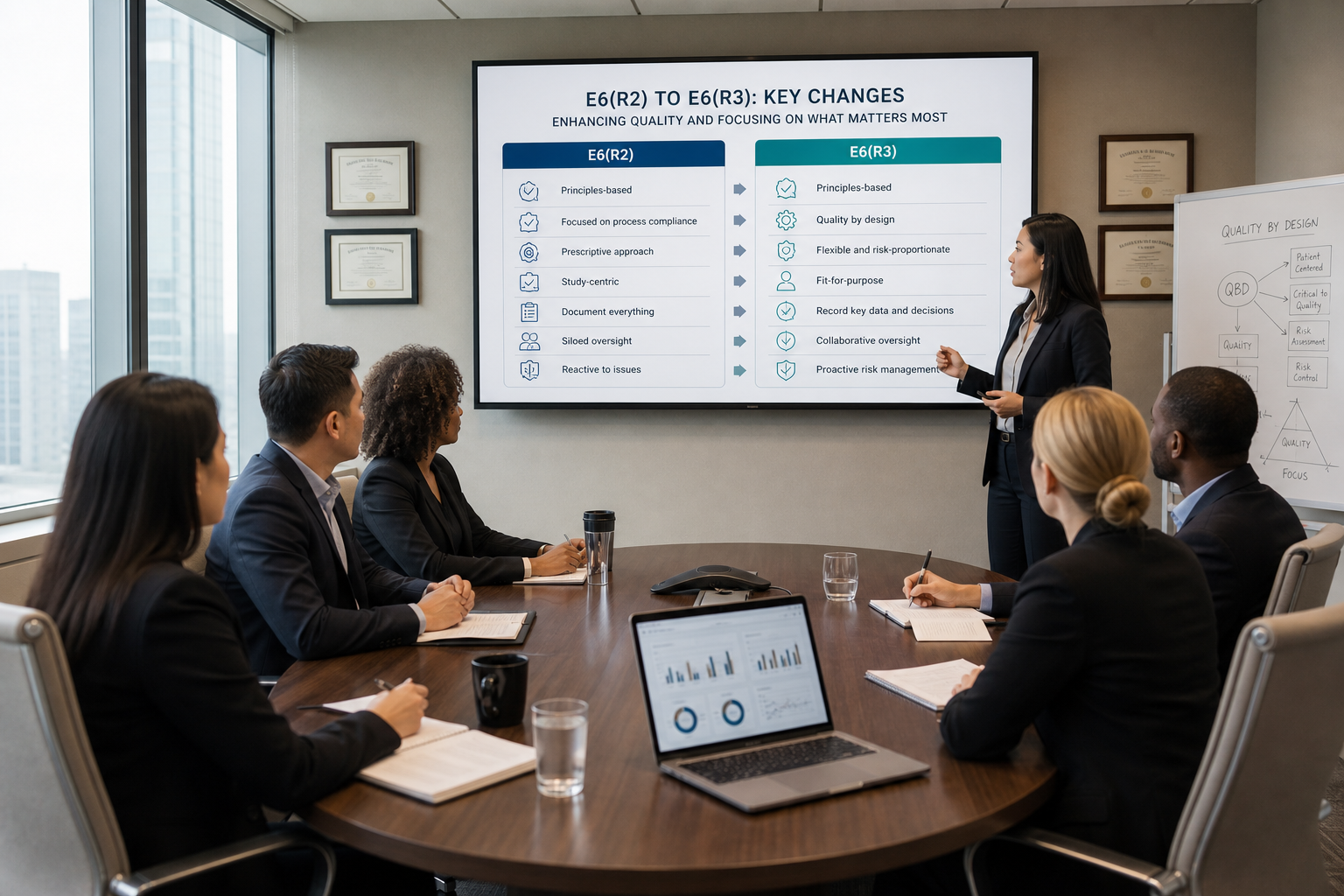
What Actually Changed from E6(R2) to E6(R3)
1. Risk-based, proportionate quality management is now the expectation, not an option. E6(R3) formalizes the concept of Critical-to-Quality (CtQ) factors the idea that the level of monitoring, documentation, and statistical oversight applied to any given process should match how critical that data or process actually is to patient safety and trial reliability. Blanket, one-size-fits-all monitoring plans no longer satisfy the guideline's intent. Sponsors need to identify what truly matters to trial integrity and direct resources there.
2. The definition of a trial "record" has expanded and so has the burden of traceability. Where E6(R2) largely assumed paper-based documentation, E6(R3) explicitly recognizes electronic files, communication logs, and operational evidence as part of the trial record. That's a welcome modernization, but it raises the bar: everything from an email decision trail to an eTMF entry now needs to be traceable, attributable, and audit-ready in a way informal systems were never designed to support.
3. Sponsor oversight must be proactive and evidenced, not reactive. E6(R3) is explicit that sponsors including when they outsource to CROs must maintain thorough, contemporaneous records of decisions, the reasoning behind them, and the actions taken in response to risk signals. Oversight can no longer be demonstrated after the fact through a end-of-study summary; it has to be built into how the trial runs, with evidence generated along the way.
4. Training and competency documentation is now a defined requirement. For sponsor staff, CRO personnel, site teams, and other external partners, E6(R3) expects documented evidence of role-appropriate training a new, explicit obligation that many organizations previously handled informally.
Taken together, these changes push the industry toward exactly the kind of centralized, real-time, systems-based trial management that many organizations have been slow to fully adopt.
Where This Creates Pressure for Sponsors and CROs
If your trial oversight currently lives across monitoring visit reports, email threads, and disconnected spreadsheets, E6(R3) creates three practical problems:
You can't demonstrate a risk-based approach if you don't have real-time visibility into which sites, processes, or data points are actually higher risk. You can't produce the "thorough records of decisions, reasoning, and actions" inspectors will look for if that reasoning was never captured in a structured, retrievable system. And you can't prove training compliance across a distributed CRO and site network if training records sit in separate systems that don't talk to your trial management system at all. This is where the right CTMS stops being a nice-to-have and becomes the backbone of E6(R3) compliance.
How Cloudbyz CTMS Helps You Meet ICH E6(R3)
Cloudbyz CTMS was built as a centralized, real-time trial management platform which maps directly onto what E6(R3) now expects.
Risk-based oversight, operationalized. Cloudbyz CTMS gives study teams real-time dashboards and customizable KPI monitoring across sites, enrollment, and site visit activity, so risk signals surface as they emerge rather than at the next scheduled monitoring visit. That's the practical infrastructure a CtQ-driven, risk-proportionate oversight plan actually requires not just a policy on paper, but a system that can act on it.
One centralized, traceable record not a patchwork of systems. Because Cloudbyz CTMS manages sites, documents, events, milestones, finances, and inventory in a single trial database, and integrates with eTMF, EDC, RTSM, and safety/pharmacovigilance systems, the "electronic files, communication logs, and operational evidence" E6(R3) now recognizes as part of the trial record live in one traceable environment rather than scattered across disconnected tools.
Built-in audit trail and e-signature for evidenced decision-making. Every action, update, and approval in Cloudbyz CTMS is captured with a full audit trail and e-signature support, so the "thorough records of decisions, reasoning, and actions" that E6(R3) demands of sponsor oversight are generated as a byproduct of normal system use not reconstructed under pressure ahead of an inspection.
Compliance and data integrity built into the foundation. Cloudbyz CTMS is built with regulatory validation, data privacy and security controls, and is backed by ISO 9001:2015 and ISO 27001:2013 certification giving sponsors and CROs a validated, GxP-aligned foundation to build their oversight processes on, rather than trying to retrofit compliance onto a generic system.
Vendor and CRO oversight in one place. With centralized visibility into site performance, milestones, and study status, sponsors can systematically evaluate CRO and vendor performance directly addressing E6(R3)'s heightened expectations around sponsor accountability when trial responsibilities are outsourced.
Getting Ahead of E6(R3)
The organizations that will struggle most with E6(R3) aren't the ones with the most complex trials they're the ones still relying on fragmented, manual processes to demonstrate oversight that regulators now expect to see evidenced continuously. The organizations that will move fastest are the ones already running on a unified platform where risk-based monitoring, documentation, and oversight are simply how the system works.
If your team is reassessing your clinical operating model and technology stack in light of E6(R3) as ICH itself recommends that's the right moment to evaluate whether your current CTMS can actually produce the real-time, risk-based, evidenced oversight the new guideline requires.
Ready to see how Cloudbyz CTMS can help your organization operationalize ICH E6(R3) compliance? Request a demo to see the platform in action.
Subscribe to our Newsletter
