
Request a demo specialized to your need.
If you've run a feasibility assessment before, you know the drill. You draft a set of questions, send them out to fifty or sixty potential sites by email, and then the real work starts: waiting. Checking your inbox to see who's responded. Copying answers into a spreadsheet, one row per site, one column per question. Chasing the sites that went quiet. Sending a reminder, then another. And somewhere around week three, squinting at a spreadsheet with sixty rows, trying to work out which sites actually said they could deliver the patient numbers you need.
None of that is really feasibility work. It's tracking. And tracking a feasibility survey by hand, outside the system that's supposed to be running your trial, is exactly the kind of gap that turns a two-week feasibility window into a six-week one.
What's actually built into CTMS
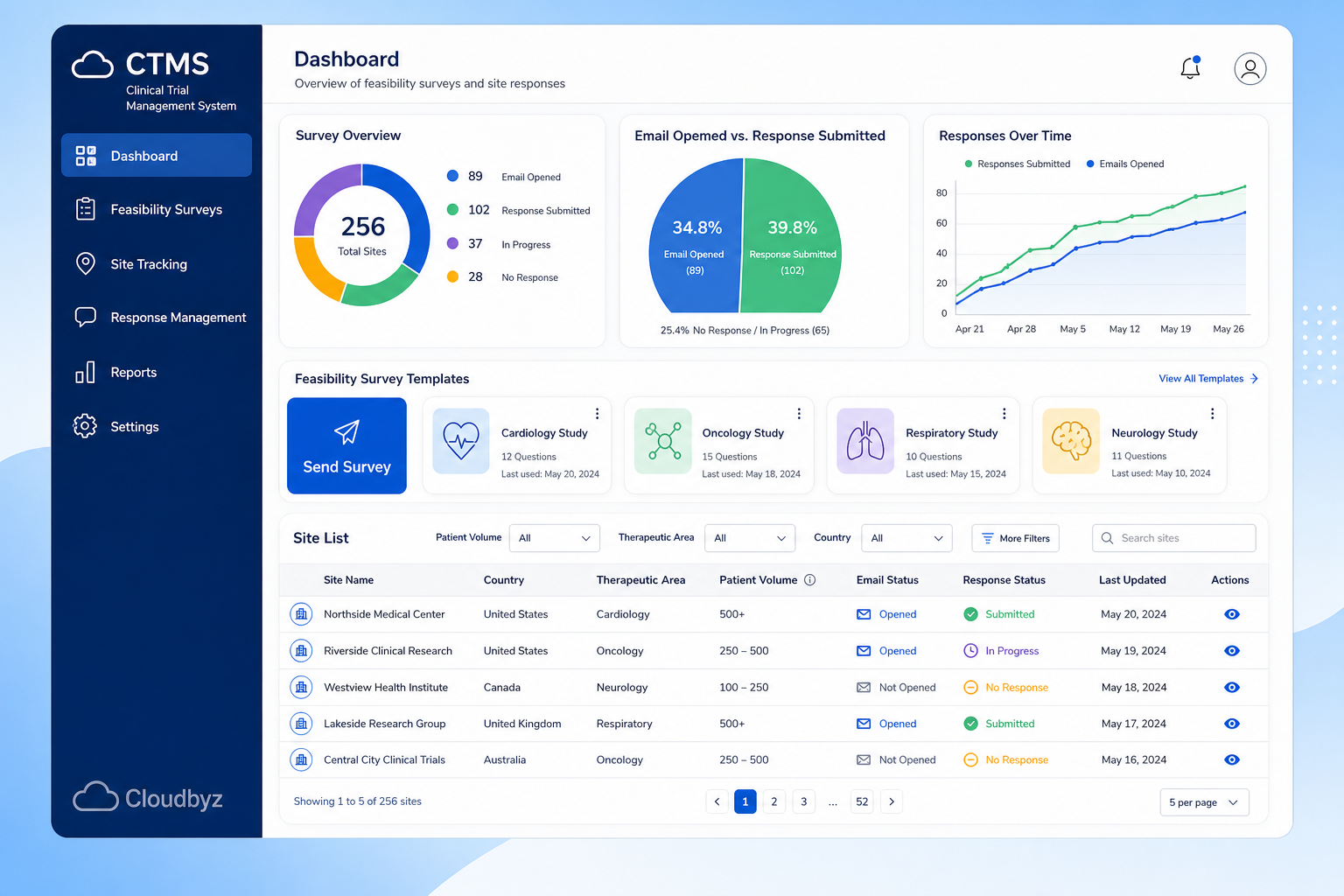
Feasibility Survey is its own module inside Cloudbyz CTMS, not a form you build from scratch or a survey tool bolted on from outside. You build the questionnaire once, using templates you can customize per study and per site, and send it to one contact or a hundred, directly from the system.
From there, everything that used to live in a spreadsheet lives in the record instead:
- The questions are yours to define. Standard fields, plus whatever's specific to this protocol expected number of eligible patients per month, prior experience with a comparable therapy, cold-chain storage capacity, whatever actually matters for this trial.
- Every send is tracked automatically. Sent, opened, responded, and for the ones who've gone quiet flagged for a reminder. You're not maintaining a "who's replied" column by hand; the system already knows.
- Responses come back inside CTMS, not as an email attachment. Sites get a link, fill out the form, and the response lands directly in the record. The link stays open for 24 hours after submission, so a site can go back and correct something without emailing you a revised copy.
- You can pull every response as a clean, downloadable PDF the moment you need to share it with a steering committee or file it for the record — no manual copy-paste into a deck.
And here's the part that actually saves the time: you can filter the responses themselves, not just the send list. Sort every site by therapeutic area, by location, by phase — or by the custom question you actually care about, like expected patient volume — and the system hands you a ranked list. Not a spreadsheet you built. A live filter, on data that's already there.
What that looks like on an actual trial
Picture a Phase 2 study for a rare autoimmune condition, feasibility going out to sites across the US, India, Poland, and Brazil — sixty-some contacts in total, because rare disease trials live or die on finding enough eligible patients, and nobody knows yet which of those sixty will actually deliver.
The questionnaire goes out from CTMS in one send, customized with the two or three questions that actually matter for this protocol — expected eligible patients per month, experience with the required biologic infusion protocol, and current caseload for the target condition. Over the next ten days, the system tracks all of it on its own: which sites opened the email, which responded, and which needed a nudge. Sites in India and Brazil that hadn't opened the email by day five get an automatic reminder — nobody on the study team had to notice that themselves.
By day twelve, forty-four of sixty have responded. Instead of building a tracker to figure out who's promising, the study lead filters directly on the "expected eligible patients per month" field and sets the bar at three or more. Nineteen sites clear it, spread across all four countries. That's the shortlist built in about thirty seconds, from data that was already sitting in the system, not reconstructed from a spreadsheet somebody has to keep updating by hand.
The other forty-one responses aren't lost or ignored, either. They're sitting in the same record, filterable the same way, in case the bar needs to move or a second-tier list is needed later.
Why this actually matters
The real win here isn't the survey tool by itself. It's that feasibility responses live in the same place as everything else about the sit the same record that will later hold its budget, its documents, its activation status. Nothing about the shortlist has to be re-entered anywhere. The site that clears feasibility today is the same record that moves into contracting next month, in the same system, with the same history attached.
That's the actual difference between a feasibility process and a feasibility spreadsheet: one of them remembers what it learned. The other one gets closed and forgotten the moment site selection is done.
See how Cloudbyz CTMS runs your next feasibility round end to end.
Subscribe to our Newsletter
