
Request a demo specialized to your need.
By Cloudbyz AI Innovation Lab · Pharmacovigilance Intelligence · 2026
Pharmacovigilance teams are under more pressure than ever. Regulatory authorities are tightening submission timelines, expanding their expectations around data quality, and applying greater scrutiny to Individual Case Safety Report (ICSR) submissions. At the same time, the volume of ICSRs — from spontaneous reports, clinical trials, literature, and digital health sources — continues to grow faster than teams can scale.
The result is a predictable tension: speed versus accuracy. Submit too slowly and you face regulatory action. Submit with errors and you invite rejection, queries, and reputational risk.
AI Vigicheck Agent is Cloudbyz's answer to that tension. It is an AI-powered ICSR validation platform that automatically reviews every case against E2B(R3) standards, MedDRA coding requirements, and the specific submission rules of EudraVigilance, FDA FAERS, and WHO VigiBase — in under two seconds per report.
This article explains what AI Vigicheck Agent does, why it matters, and how it fits into the modern pharmacovigilance workflow.
The Problem With Manual ICSR Quality Control
Before diving into the solution, it is worth being precise about the problem.
An ICSR is not a simple document. A complete E2B(R3) case contains more than 200 data elements spanning patient information, suspect and concomitant drugs, adverse event terms, reporter details, narrative text, and administrative metadata. Each field has its own validation rules — some mandatory, some conditional, some dependent on the values of other fields. A case for a suspected serious unexpected adverse reaction (SUSAR) has a different regulatory clock and a different completeness threshold than a non-serious spontaneous report.
When a PV scientist manually QCs a case before submission, they are doing all of this in their head — checking field by field against an internal mental model of E2B(R3), ICH E2B implementation guides, EMA validation rules, and FDA business rules simultaneously.
Several failure modes are common in this process:
Conditional field gaps. E2B(R3) has dozens of fields that are mandatory only when other conditions are met — for example, the dose per administration field becomes required if the drug is listed as a suspect. These conditional relationships are difficult to track manually across a queue of 50 cases.
MedDRA coding errors. MedDRA releases a new version twice per year. Authorities require the current version at the time of submission. Coding to a retired PT, submitting a term at the wrong hierarchy level, or leaving adverse events coded only at the LLT level without a valid PT are common errors that trigger queries.
Duplicate submissions. The same adverse event may be reported by multiple sources — a patient, a healthcare professional, a hospital, and a published case report — all describing the same underlying case. Identifying duplicates before submission avoids inflating signal counts and regulatory queries from EudraVigilance.
Narrative inconsistencies. The case narrative is the human-readable account of the case. Authorities expect it to be internally consistent — that the dates in the narrative match the structured data fields, that the suspect drug is named correctly, and that the outcome described in the narrative matches the coded outcome field. Mismatches are a common source of follow-up queries.
Agency-specific rule deviations. EudraVigilance, FDA FAERS, and WHO VigiBase each have their own implementation guides layered on top of the base E2B(R3) standard. A case that is structurally valid per ICH E2B(R3) may still fail EudraVigilance validation because of an authority-specific business rule.
Manual QC catches many of these issues. It also misses many, especially under time pressure. And it cannot scale.
What AI Vigicheck Agent Does
AI Vigicheck Agent is a purpose-built validation engine that runs every ICSR through a structured, rule-based AI analysis before submission. It operates across six capability layers.
1. E2B(R3) Field Validation
The foundation of the agent is a complete implementation of the ICH E2B(R3) message structure. Every case submitted to AI Vigicheck Agent is parsed against this structure and validated at three levels:
- Structural validation confirms that the XML or data payload is well-formed and that all required message-level elements are present.
- Field-level validation checks each data element for type conformance, permissible values, and format — for example, that date fields follow ISO 8601 format and that coded fields contain valid code values from the correct controlled vocabulary.
- Conditional validation applies the full matrix of conditional field requirements from the ICH E2B(R3) implementation guide — more than 80 distinct conditional rules — and flags every instance where a conditionally required field is absent.
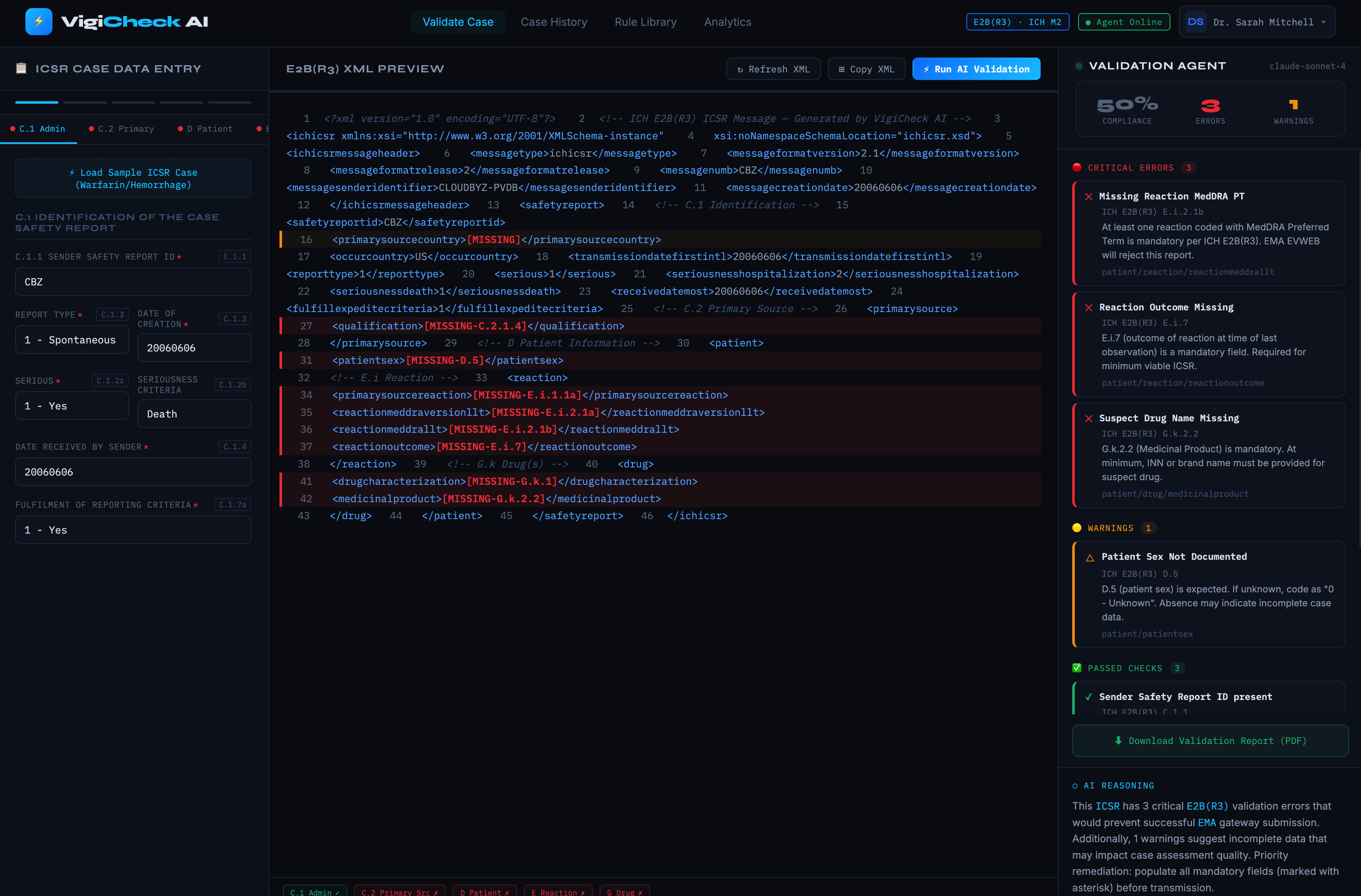
Each finding is returned with the exact E2B(R3) element path, the rule that was violated, the current field value (if any), and a clear remediation instruction.
2. MedDRA Coding Verification
AI Vigicheck Agent integrates with the current MedDRA release and performs a multi-dimensional coding check on every adverse event term in the case:
- Version currency check confirms that all coded terms exist in the version of MedDRA specified in the submission. Retired PTs, deleted LLTs, and terms that moved hierarchy position between versions are flagged.
- Hierarchy completeness verifies that every adverse event coded at any level has a valid, current path from LLT through PT, HLT, HLGT, to SOC.
- PT-level requirement flags cases where adverse events are coded only at LLT without a corresponding valid PT, which is a common submission error.
- Uncoded term detection identifies adverse event fields that contain free-text descriptions without a corresponding MedDRA code, which will fail authority validation.
3. Duplicate Detection
Duplicate ICSRs are a well-recognised quality problem in pharmacovigilance databases. Authorities including EMA have issued guidance requiring MAHs to conduct duplicate searches before submission. AI Vigicheck Agent performs automated duplicate detection using a configurable matching algorithm that evaluates:
- Patient demographics: age, sex, weight, and country of occurrence
- Suspect and concomitant drug names, active substances, and dosing information
- Adverse event MedDRA PT terms and onset dates
- Reporter type, report type, and source reference numbers
Matches are scored and returned as probable duplicates, possible duplicates, or flagged for human review. The agent does not suppress or auto-merge cases — it surfaces candidates and documents the assessment for the auditable QC record.
4. Regulatory Authority Business Rules
ICH E2B(R3) defines the data standard. Each regulatory authority then publishes its own implementation guide that adds authority-specific business rules on top of the standard. These rules are not always obvious from the base specification, and they evolve with each new version of the authority's validation criteria file (VCF).
AI Vigicheck Agent maintains a continuously updated rule library for:
- EudraVigilance — applying the EMA EVWEB and ICSR Processing Regulation business rules, including the latest EV VCF validation criteria
- FDA FAERS — applying FDA E2B(R3) Technical Specification requirements, including FDA-specific field requirements and submission format rules
- WHO VigiBase — applying WHO-UMC reporting criteria and VigiBase submission requirements
Cases are checked against the rule set for the intended destination authority before submission. A case destined for both EudraVigilance and FDA FAERS is checked against both rule sets, and deviations are reported per authority.
5. Narrative Quality Assessment
The case narrative is the only free-text element in an ICSR, and it is often where the most important clinical context resides. AI Vigicheck Agent evaluates narratives across three dimensions:
Completeness. The narrative should describe, at minimum: the patient's relevant medical history, the suspect drug and indication, the adverse event onset and course, any treatment for the adverse event, and the outcome. The agent checks for the presence of each of these elements and flags narratives that omit clinically essential information.
Internal consistency. Structured data fields and the narrative must agree. The agent performs cross-field validation between the narrative and structured elements — comparing suspect drug names, onset dates, outcome codes, and seriousness criteria between the narrative text and the corresponding E2B(R3) fields.
Causality and seriousness alignment. The narrative should be consistent with the reporter's causality assessment and the coded seriousness criteria. The agent flags cases where the narrative describes a fatal outcome but the outcome field is coded as recovered, or where the narrative asserts no causal relationship while the reporter's causality field indicates probable.
6. Workflow Integration and Audit Trail
AI Vigicheck Agent is not a standalone tool — it is designed to integrate into the pharmacovigilance workflow at the point of case QC, before submission.
Every validation run generates a structured QC report that includes:
- Case identifier, submission destination, and MedDRA version used
- Complete list of findings by severity: Error (submission-blocking), Warning (requires review), and Information (advisory)
- For each finding: the E2B(R3) element path, the rule violated, the current value, and a recommended remediation action
- Timestamp, user, and rule version for every finding — providing a complete, GVP-compliant audit trail
Findings can be assigned to case owners, tracked through resolution, and documented for inspection readiness. The resolved QC record becomes part of the permanent case file.
Why This Matters for GVP Compliance
The EU Good Pharmacovigilance Practices (GVP) Module VI on management and reporting of adverse reactions sets clear expectations for ICSR quality. MAHs are expected to have systems and processes in place that ensure the accuracy, completeness, and consistency of submitted ICSRs.
In practice, inspectors look for evidence that:
- A defined QC process exists before submission
- The process is consistently applied
- Findings are documented and resolved
- The system produces an auditable record
AI Vigicheck Agent is designed to satisfy all four requirements. The validation engine applies the same rule set to every case, every time — there is no variability based on the individual reviewer's knowledge or workload. Every finding is documented with a timestamp and a rule reference. Every resolution is tracked. The QC record is exportable for inspection.
For SUSAR reporting with 7-day and 15-day clocks, this matters enormously. A case that fails EudraVigilance validation after submission wastes irreplaceable time in the reporting window. AI Vigicheck Agent catches those failures before submission.
The Technical Architecture
AI Vigicheck Agent is built on a Python backend with a PostgreSQL data layer and is deployed on AWS. Key architectural decisions were made to support the specific requirements of pharmacovigilance data processing:
Rule engine architecture. Validation rules are stored as structured data, not hard-coded logic. This means the rule library can be updated when authorities publish new validation criteria files without requiring a code release. When EMA publishes a new VCF version, the corresponding business rules are updated in the rule library and immediately applied to all subsequent validations.
MedDRA integration. The agent integrates with MedDRA on-demand via a licensed interface. The currently loaded MedDRA version is recorded in every QC report, ensuring traceability of the coding version used for each validation run.
E2B(R3) XML parsing. Cases submitted in E2B(R3) XML format are parsed using a schema-validated parser that supports both the full ICSR XML format and the batch wrapper format used for multi-case submissions. Cases stored in internal database formats are mapped to the E2B(R3) schema before validation.
Performance. The validation engine is designed to process a single ICSR in under two seconds, including all six validation layers. Batch validation of up to 500 cases runs in parallel worker threads, enabling a queue of 500 cases to be validated in under five minutes.
Security and data residency. All case data is processed within the customer's AWS tenancy. No patient data is transmitted to external services or used for model training.
Who Is AI Vigicheck Agent For?
AI Vigicheck Agent is designed for three primary user groups in the pharmacovigilance function:
PV Scientists and Case Processors use the agent as a final check before promoting a case to submission-ready status. Instead of manually running through a QC checklist, the scientist reviews the agent's structured findings, makes any necessary corrections in the safety database, and re-runs the validation until the case is clean.
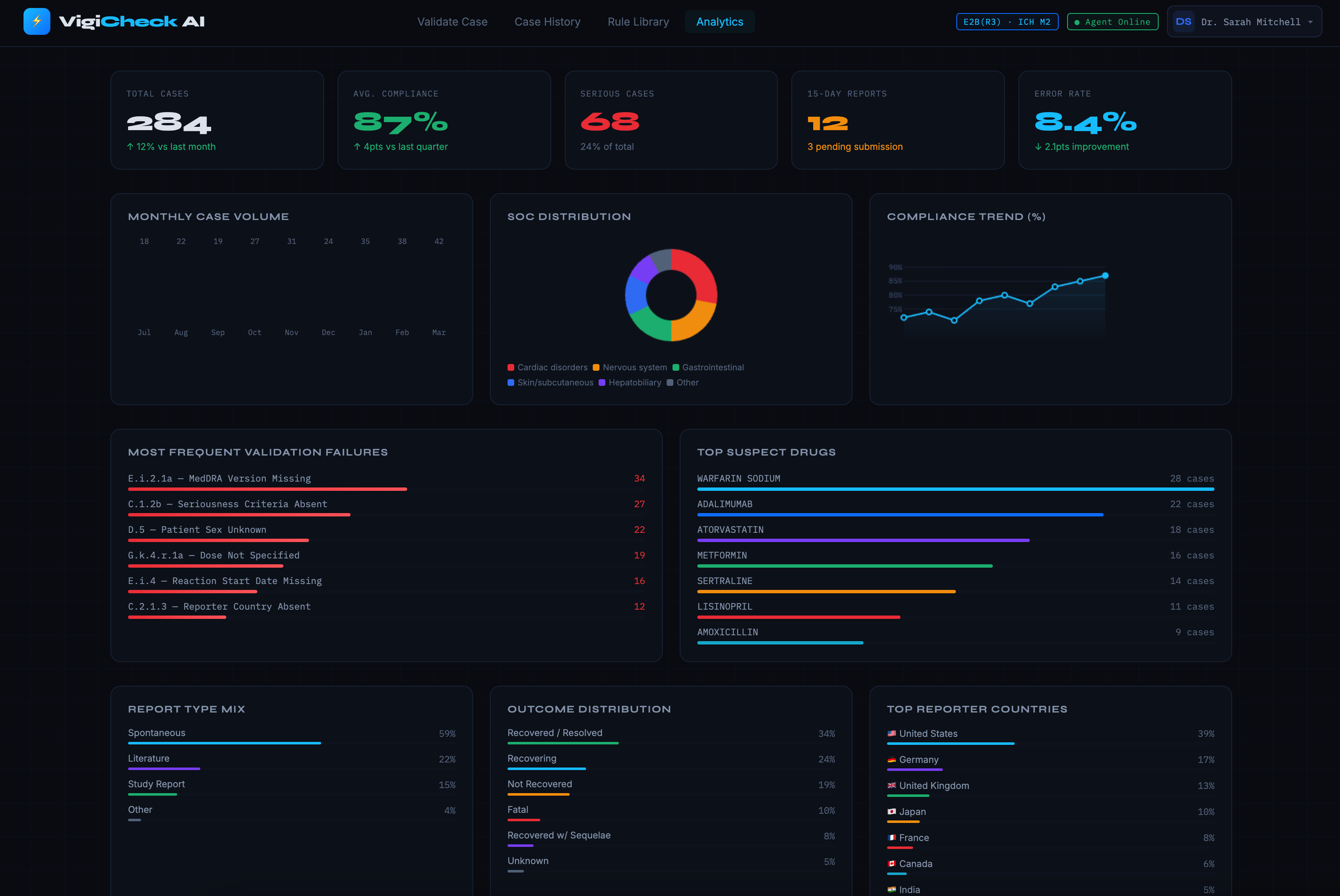
PV QC Managers use the agent's analytics dashboard to track case quality metrics across the portfolio — by product, by reporter type, by submission destination, and over time. Recurring finding patterns are surfaced as quality trends, enabling targeted process improvement.
Regulatory Affairs and PV Leadership use the audit trail and QC documentation to demonstrate GVP compliance during inspections and to provide evidence of systematic quality control in responses to regulatory queries.
Positioning in the Cloudbyz Pharmacovigilance Suite
AI Vigicheck Agent is part of the Cloudbyz pharmacovigilance product portfolio, which covers the full spectrum of PV operations:
|
Product |
Function |
|
AI Vigicheck Agent |
ICSR validation and QC before submission |
|
AI VigiAggr Agent |
Aggregate report generation (PSUR, PBRER, DSUR) |
|
Literature Search Agent |
PV literature surveillance and signal detection |
Together, these products cover case processing quality, aggregate reporting, literature surveillance, and signal management — a complete pharmacovigilance intelligence layer on top of any safety database.
Looking Ahead: What's Coming in AI Vigicheck Agent
The 2026 roadmap for AI Vigicheck Agent includes several capability expansions:
Signal detection integration. The agent will expand beyond individual case validation to support cumulative analysis — flagging patterns across a case series that may represent an emerging signal, integrating with disproportionality analysis outputs from VigiAggr.
Automatic E2B(R3) correction suggestions. For a subset of common, deterministic errors — such as date format corrections, missing mandatory fields with inferable values, and MedDRA version upgrades — the agent will offer one-click correction proposals that the case processor can accept or reject with a documented rationale.
Real-time validation during data entry. Integration with Cloudbyz safety database interfaces will enable field-level validation at the point of data entry, surfacing errors as they are created rather than at the end of the QC cycle.
Expanded authority coverage. Rule libraries for Health Canada, PMDA (Japan), and TGA (Australia) are in development, extending multi-authority validation to key markets beyond the current EU/US/WHO coverage.
Conclusion
Pharmacovigilance is a patient safety function. The quality of ICSR submissions directly affects the completeness of global safety databases, the accuracy of signal detection, and ultimately the decisions that regulatory authorities make about the benefit-risk profiles of medicines in use by millions of patients.
AI Vigicheck Agent brings systematic, scalable, auditable quality control to the ICSR submission process. It does not replace the pharmacovigilance scientist — it removes the mechanical burden of rule-checking from their workflow so they can focus on the clinical judgement that no algorithm can replicate.
Every ICSR that leaves your team, validated.
About Cloudbyz
Cloudbyz is a life sciences software company building AI-powered platforms for pharmacovigilance, regulatory affairs, clinical operations, and eClinical data management. The Cloudbyz AI Innovation Lab develops intelligent agents that automate the high-volume, rule-intensive workflows across the drug development lifecycle.
© 2026 Cloudbyz Inc. All rights reserved. This article is for informational purposes. MedDRA is a registered trademark of the International Federation of Pharmaceutical Manufacturers & Associations (IFPMA). EudraVigilance is a trademark of the European Medicines Agency.
Subscribe to our Newsletter
