

Request a demo specialized to your need.
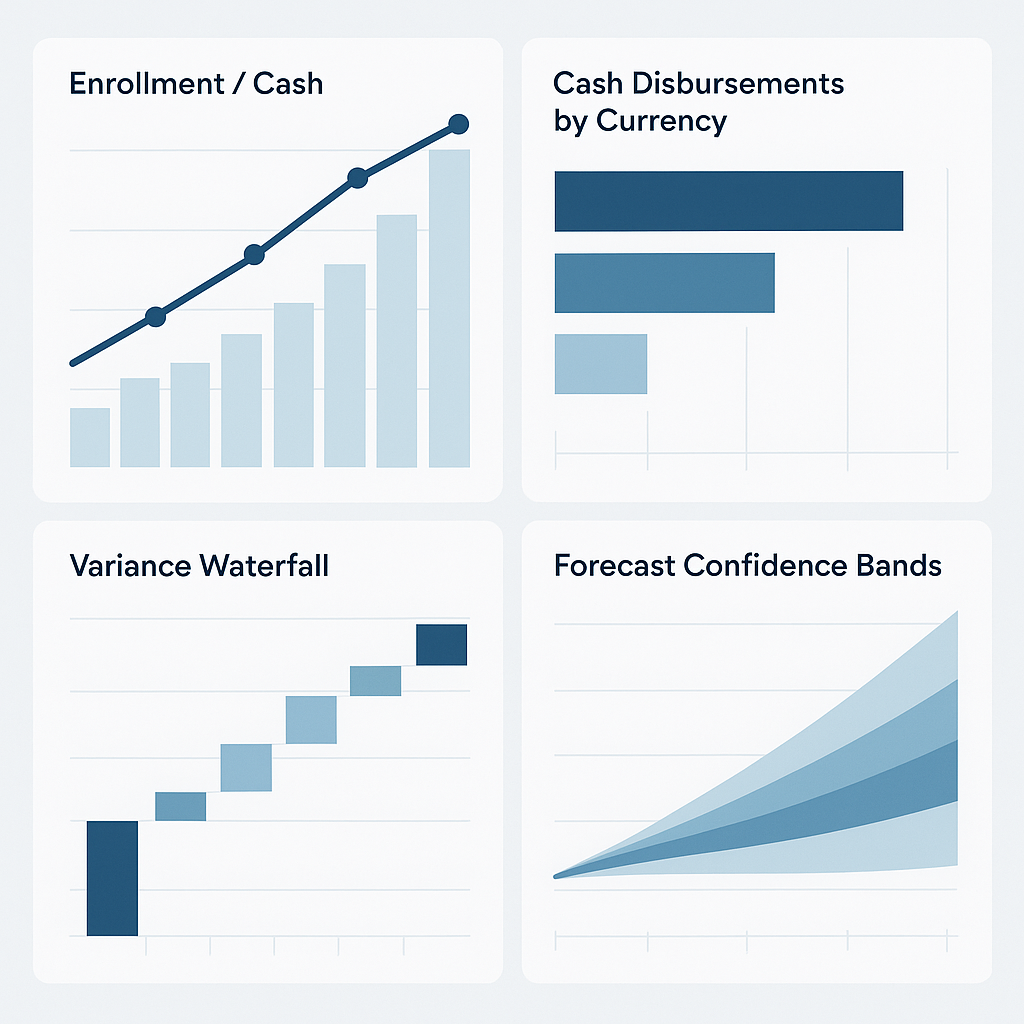
Tie enrollment to cash with explainable forecasts leaders trust.
Executive Perspective
Clinical trials operate at the intersection of scientific uncertainty and financial accountability. While protocols, sites, and patients evolve in real time, financial forecasts in many organizations remain static, assumption-driven, and backward-looking. This disconnect has become increasingly visible as trials grow more complex, global, and capital-intensive.
Enrollment-linked cash forecasting represents a fundamental rethinking of Clinical Trial Financial Management (CTFM). It aligns financial projections directly with patient enrollment behavior, transforming CTFM from a system of record into a system of financial foresight. Instead of asking, “What did we spend?” organizations can now ask, “Given how enrollment is unfolding, what will we spend, when, and why?”
The Structural Problem with Traditional Forecasting Models
Legacy CTFM approaches were designed for an era of simpler trials and predictable accrual. They typically rely on static budgets and periodic reforecasts that lag behind operational reality. While these methods may satisfy accounting requirements, they fail to support timely decision-making.
Milestone-based forecasting assumes that contractual events occur on predictable timelines, even though milestones such as first-patient-in or last-patient-out are entirely dependent on enrollment performance. Linear accrual models further compound the issue by spreading costs evenly across months, masking the true volatility of site activation delays, recruitment surges, and patient dropouts. By the time forecasts are updated, the financial impact has already occurred.
The consequence is chronic misalignment between finance and clinical operations. Finance teams are forced to explain unexpected cash burn, while clinical leaders lack visibility into the downstream financial impact of enrollment decisions.
Reframing Enrollment as the Primary Financial Driver
Enrollment-linked cash forecasting in CTFM starts from a different premise: patients, not budgets, drive trial economics. Every enrolled subject initiates a cascade of financial obligations—procedures, visits, pass-throughs, investigator fees, vendor services, and CRO activities. When enrollment changes, cash flow changes.
This approach treats enrollment as a living input, continuously feeding financial models that adapt in near real time. Forecasts are no longer snapshots based on outdated assumptions; they become dynamic representations of how a trial is actually unfolding.
Core Components of Enrollment-Linked Cash Forecasting
Patient-Level Cost Attribution
At the foundation is patient-level financial modeling. Instead of aggregating costs at the study or site level, modern CTFM platforms attribute costs to individual subjects, visits, and events. This granular structure enables precise forecasting of downstream obligations as patients progress through the protocol. When a subject enrolls, the system automatically anticipates future visits and their associated costs, creating a forward-looking accrual profile.
Enrollment Velocity Modeling
Enrollment is rarely linear. Sites ramp up at different speeds, countries activate asynchronously, and recruitment momentum fluctuates over time. Enrollment-linked forecasting incorporates velocity curves that reflect real site performance, historical enrollment patterns, and probabilistic assumptions around screen failures and dropouts. As actual enrollment data arrives, these curves are recalibrated, improving forecast accuracy without manual intervention.
Contractual Trigger Mapping
Financial obligations only materialize when contractual conditions are met. Enrollment-linked CTFM explicitly maps operational events—such as patient enrollment, visit completion, or milestone achievement—to payment triggers defined in site and vendor contracts. This ensures that forecasts reflect not just expected costs, but the timing of cash outflows, which is critical for treasury and cash-flow planning.
From Data Integration to Continuous Reforecasting
Enrollment-linked forecasting relies on tight integration between operational and financial systems. Enrollment data flows from CTMS, EDC, or RTSM into CTFM, where it immediately recalculates projected accruals, payment schedules, and cash burn. Forecasts update continuously, not quarterly, enabling rolling visibility into trial economics.
This real-time feedback loop allows teams to run scenarios instantly: assessing the financial impact of accelerating enrollment at high-performing sites, delaying underperforming regions, or introducing protocol amendments. Decisions that once required weeks of spreadsheet modeling can now be evaluated in minutes.
Organizational Impact Across Stakeholders
For finance leaders, enrollment-linked forecasting delivers predictability and control. Cash burn becomes explainable, variance analysis becomes proactive, and capital planning is grounded in operational reality rather than optimistic assumptions.
For clinical operations, the model provides financial transparency tied directly to enrollment strategy. Leaders can see how site activation decisions, recruitment investments, or enrollment pauses translate into real cash consequences.
For portfolio and executive leadership, the value compounds at scale. Aggregating enrollment-linked forecasts across studies enables portfolio-level cash planning, funding runway analysis, and more informed investment decisions across therapeutic areas.
Elevating CTFM from Reporting to Decision Support
The true value of enrollment-linked cash forecasting is not accuracy alone—it is decision enablement. When financial forecasts reflect enrollment reality, organizations can intervene earlier, reallocate resources more intelligently, and align clinical ambition with financial discipline.
Advanced CTFM platforms increasingly augment this capability with analytics and AI, identifying enrollment anomalies, predicting cost overruns before they occur, and recommending corrective actions. Forecasts evolve from passive reports into active guidance systems.
Strategic Implications for Modern Sponsors and CROs
As funding environments tighten and trial complexity increases, financial agility becomes a competitive advantage. Organizations that adopt enrollment-linked cash forecasting gain tighter control over burn rates, stronger credibility with investors and boards, and faster response times when enrollment deviates from plan.
Those that rely on static, milestone-based forecasting remain reactive—explaining financial outcomes after the fact rather than shaping them in advance.
Conclusion: Financial Foresight Starts with Enrollment
Enrollment-linked cash forecasting redefines the role of CTFM in clinical development. By anchoring financial projections to the most volatile and consequential operational variable—patient enrollment—it transforms financial management from retrospective accounting into predictive control.
In an environment where every enrolled patient carries both scientific promise and financial consequence, this approach enables organizations to move forward with confidence, clarity, and control—turning uncertainty into informed action and CTFM into a strategic asset rather than a compliance necessity.
Subscribe to our Newsletter
