

Request a demo specialized to your need.
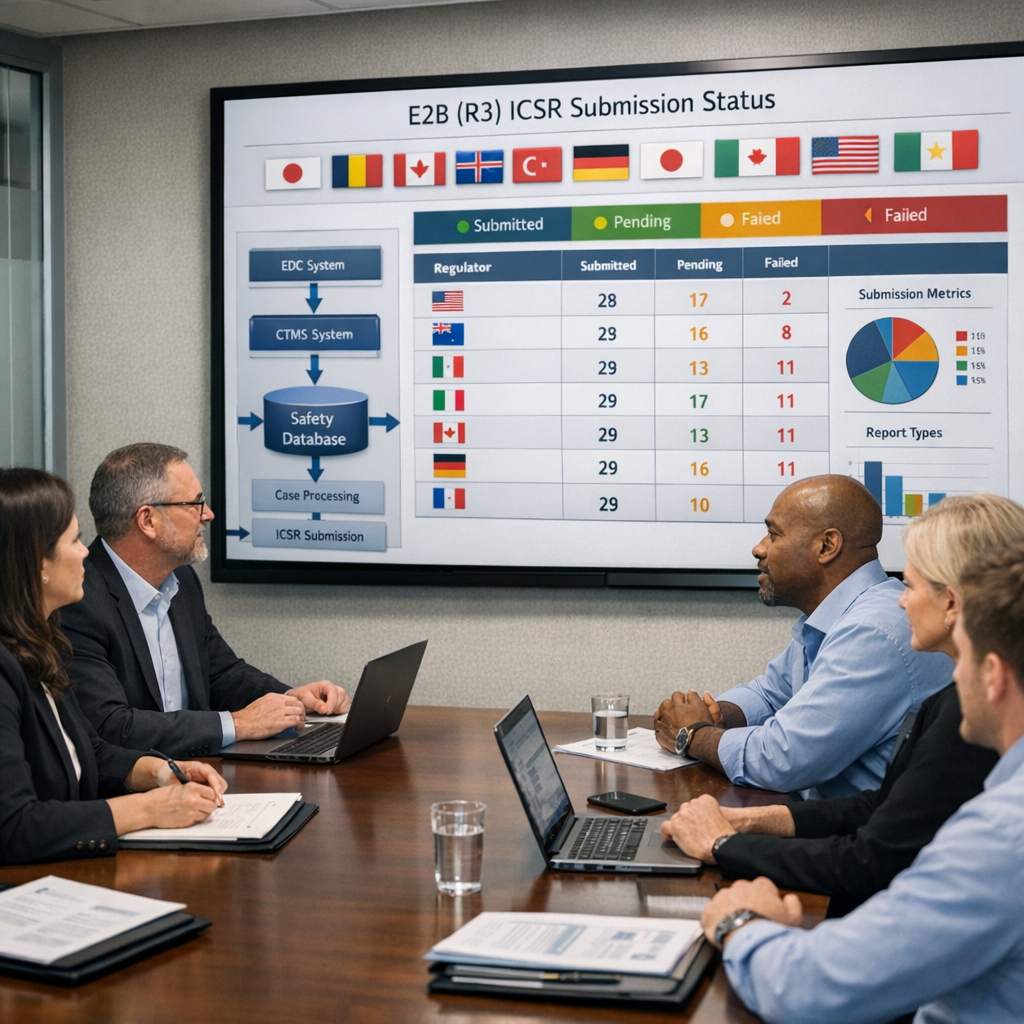
How designing E2B(R3)-aligned data structures at capture on a unified Safety–EDC–CTMS spine stabilises ICSR quality across human and multivigilance portfolios.
Why Technically Complete E2B(R3) ICSRs Still Get Rejected — and How a Unified Platform Fixes It
Drug Safety Officers and Regulatory Affairs Directors know the frustration: a case clears internal quality checks, maps all required data elements, and still bounces at validation. The problem is almost never the ICH E2B(R3) standard itself. The specification is clear, well-documented, and consistently interpreted across the EMA and FDA implementation guides. The problem is architectural.
The Real Source of ICSR Failures
In most sponsor and CRO environments, a single ICSR is assembled from data living in three or four disconnected systems. EDC holds adverse events, labs, concomitant medications, and narrative fragments. CTMS carries protocol, site, country, and monitoring context. The safety database maintains its own copy of core case fields, typically optimized around post-marketing workflows. A separate submission tool then transforms those safety records into E2B(R3) messages.
Each handoff between systems is a failure point. ETL jobs drop mandatory elements. Spreadsheet-based enrichment introduces transcription errors. Sender case identifiers become inconsistent between initial and follow-up messages. Seriousness criteria get applied correctly inside the safety database but translate poorly into message-level flags. Product details fail to map cleanly because therapeutic, vaccine, device, cosmetic, nutrition, or veterinary attributes were never structured with E2B(R3) in mind at the point of capture.
Every new portfolio — biologics, vaccines, devices, cosmetics, animal health — adds another layer of one-off mapping. The cumulative result is ICSR quality that depends on heroic reconciliation at the edge of transmission rather than on the integrity of the underlying data.
The Regulatory Accountability That Fragmentation Ignores
The governance expectations here are unambiguous. GVP Module VI makes clear that sponsors remain responsible for the collection, management, and submission of ICSRs even when pharmacovigilance services are outsourced. EMA's EU ICSR Implementation Guide specifies how cases must behave within the EU regulatory network; brittle mapping failures still manifest as sponsor findings, regardless of which vendor assembled the submission pipeline.
ICH E6(R3), adopted at Step 4 on 6 January 2025, raises the bar further. Sponsors are now explicitly accountable for data origination, transformation, and transcription across systems. Section 4.2.3 calls for planned review of data and audit trails as a routine quality activity, not a retrospective response to inspection findings.
The compliance burden of fragmented systems is not just operational. It is increasingly a regulatory exposure.
Treating E2B(R3) as a Design Principle, Not a Downstream Obligation
The architectural alternative is to treat E2B(R3) alignment as a property of how data is captured and structured, not as a formatting step applied at submission time.
Cloudbyz takes this approach as the only 100% Salesforce-native unified eClinical platform in this space. Safety, EDC, and CTMS run on a single backbone. Adverse events, drugs, vaccines, biologics, devices, cosmetics, nutrition products, and animal-health products are all represented as structured records on that spine, with attributes aligned to the data elements defined in ICH E2B(R3). Mapping to the authoritative field list in the EMA-hosted E2B(R3) implementation guide becomes a configuration exercise rather than a custom development project per portfolio.
Because there are no inter-system translations, there is no translation layer where mandatory elements can be lost, seriousness flags can drift, or case identifiers can diverge.
Extending That Discipline Across a Multivigilance Portfolio
Once cases are E2B(R3)-ready at capture, the same structural integrity extends naturally across all vigilance domains.
In vaccine vigilance, batch and campaign context are as critical as subject attributes. On the unified Cloudbyz spine, vaccine-specific fields — batch and lot numbers, campaign identifiers, administration site characteristics — are captured at source in EDC and CTMS. When serious events cluster, Safety teams can stratify cases by batch or campaign and generate ICSRs using the same E2B(R3)-aligned structures, without reconstructing context from external registries.
Biovigilance and transfusion-related vigilance introduce donor-recipient chains and procedure metadata. Cloudbyz represents donors, recipients, products, and procedures as linked records, giving Safety specialists full chain-of-custody visibility on the same object graph that underpins ICSR generation for drugs and vaccines.
Device vigilance adds implant, explant, procedural, and device-identifier fields. While regulatory frameworks differ from pharmaceutical reporting, the underlying requirement — complete, structured data that maps cleanly into incident-report formats — is identical. The same backbone supports both human-drug ICSRs and device incident workflows without forcing PV teams onto separate siloed platforms.
Cosmetovigilance and nutrivigilance generate high-volume event streams, often from consumer channels. Most cases will never become ICSRs, but the ones that do require consistent structuring, coding, and follow-up tracking. Representing those events on the Cloudbyz Safety-EDC-CTMS spine means that when individual cases or clusters rise to regulatory attention, they can be promoted into E2B(R3)-aligned workflows without manual re-entry or data reconstruction.
Veterinary vigilance and animal health add species, owner, and husbandry context. Even where downstream reporting formats diverge from human-drug requirements, the same disciplined capture model applies.
The Outcome: ICSR Quality as a Platform Property
Across all of these domains, Cloudbyz's Salesforce-native audit and e-signature framework records how case data moved from capture through assessment to submission — directly supporting ICH E6(R3) expectations for data-integrity oversight.
For Drug Safety Officers, PV leads, and Regulatory Affairs Directors, the practical result is measurable: fewer E2B(R3) validation failures, fewer last-minute investigations into missing fields, and a multivigilance portfolio where ICSR quality is built into the platform rather than assembled under pressure at transmission.
The E2B(R3) standard is not the problem. The architecture is. And the architecture is fixable.
Subscribe to our Newsletter
