

Request a demo specialized to your need.
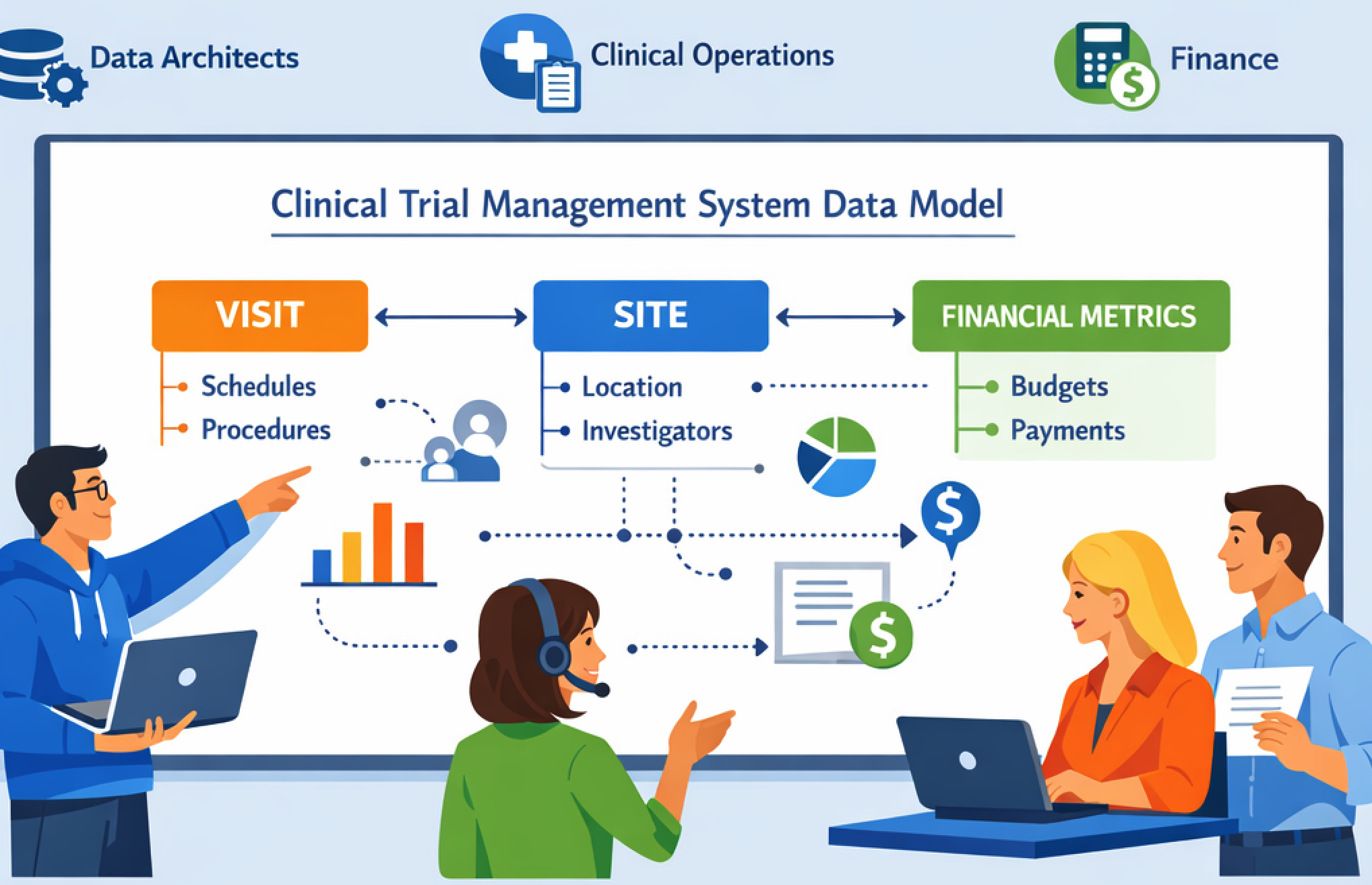
Shows how to design CTMS data and integration architectures that clinical and finance teams can trust for decisions.
Making CTMS the Operational Backbone for Financial Truth
Clinical operations and finance often look at the same clinical trial and see different systems. For study teams, the Clinical Trial Management System (CTMS) is the source of truth for countries, sites, subjects, visits, milestones, and monitoring activity. For finance, the systems of record are budgeting tools, Clinical Trial Financial Management (CTFM) platforms, and ERP.
When the data models behind those worlds do not line up, month-end close turns into detective work, dashboards show conflicting numbers, and audit questions are hard to answer.
Designing a CTMS architecture that finance can trust starts with aligning those models from the beginning.
CTMS as the Operational Spine
CTMS should be treated as the operational backbone for how work is planned and executed. Every subject visit, monitoring trip, and milestone needs a clear, consistent representation. CTFM and ERP then interpret that operational history through the lens of cost, revenue, and cash.
Cloudbyz CTMS implementation best practices emphasize building this backbone carefully:
- Defining master data for studies, countries, and sites
- Standardizing visit and milestone templates
- Setting up clean interfaces with eTMF, EDC, RTSM, and safety systems
A strong architecture makes those relationships explicit. Study, site, and subject identifiers must be stable and shared across CTMS, CTFM, and ERP so financial transactions can be traced back to specific operational events. Visit and milestone types need clear, normalized definitions so that a "complex oncology visit" or "site startup completion" means the same thing in operational, financial, and compliance reports.
When CTMS events drive budgets, payments, and forecasts directly, finance teams no longer have to reverse-engineer intent from spreadsheets or CRO reports.
A Data Model Finance, Ops, and Quality Can Share
A trustworthy CTMS architecture has to reflect the realities of clinical finance and compliance without turning every screen into an accounting tool. Finance teams care about subjects, visits, milestones, and sites because they drive budgets, payments, and accruals. Quality and audit teams care because those same events show whether obligations were met and whether data is inspection-ready.
A good data model lets each function see what it needs without duplicating records or inventing parallel hierarchies.
The CTMS-CTFM separation of concerns. One practical pattern is to treat CTMS as the operational spine and CTFM as the financial brain that sits alongside it:
- Operational entities — studies, countries, sites, subjects, visits, monitoring visits, deviations — live in CTMS with clear identifiers and status models
- Financial entities — budgets, contracts, rate cards, payment runs, accrual snapshots — live in CTFM but always reference CTMS IDs and statuses
This coupling works in practice: visit and milestone events in CTMS drive budgets, forecasts, and site payments in CTFM, while consolidated financial views roll back into dashboards that clinical and finance leaders share.
Structured financial relationships, not free-form fields. Financial concepts should not be bolted directly onto subject or visit records as free-form fields. Instead, use structured relationships or dedicated objects that link operational events to financial logic:
- A visit-to-fee mapping table that defines which visit types and statuses trigger which financial events
- A contract-to-event matrix that specifies which milestones and event counts satisfy each obligation
This makes it easier to evolve payment rules or rate structures as portfolios grow, without rewriting CTMS core objects. Tools that separate operational truth from valuation logic are more adaptable and auditable over time.
Integration design as a first-class concern. CTMS must exchange data cleanly with EDC, eTMF, safety, ERP, and sometimes third-party site payment tools or eSource platforms. Using standard APIs and interoperability formats ensures that operational, regulatory, and financial data can move without manual rework.
A well-architected integration layer enforces consistent identifiers and timing rules. For example, visits should only change financial status after meeting specific data-entry or query-resolution conditions, rather than letting each system interpret events differently.
Building for Adaptability
Even a strong initial design will fail if it cannot adapt as portfolios, partners, and regulations change. CTMS architectures that finance can trust are deliberately built to evolve.
Governance. Cross-functional councils that oversee CTMS workflows and KPIs should explicitly own the data model and integration roadmap. Without a forum where clinical operations, finance, quality, and IT agree on definitions and priorities, data structures drift and trust in dashboards erodes.
Configuration over custom code. Cloudbyz CTMS, built natively on Salesforce, uses configurable objects, page layouts, and automation to capture new attributes or workflows without rewriting the underlying platform. Best practice is to prioritize configuration, keep "minimum viable" models at go-live, and iterate based on user feedback rather than over-building on day one.
When finance needs a new way to classify costs, or quality needs an extra status for deviation review, those changes should be achievable through configuration and properly versioned metadata, not fragile one-off code.
Data stewardship and training. Clean data does not happen by accident; it comes from clear ownership, validation rules, and user education:
- CTMS data stewards own subject, site, and visit integrity
- Finance stewards own budgets, payments, and accrual definitions
- Integration stewards own how external data flows in and out
Organizations that embed CTMS usage into daily stand-ups and clinical-finance reviews see higher data quality and faster issue detection. When everyone knows that key decisions — portfolio funding, vendor negotiations, audit preparation — depend on CTMS data, they have a tangible reason to keep the architecture healthy.
The Compounding Value of a Coherent Architecture
Over time, an adaptable data model pays off in ways that go beyond individual studies. Historical CTMS and CTFM data becomes a library of reference designs and cost patterns that can be reused when planning new programs or evaluating new partners. Instead of rebuilding logic, teams can clone proven structures, adjust for new science, and trust that finance, quality, and operations will all see the same story.
That is what it means to have a CTMS architecture that finance can trust: not just accurate numbers today, but a platform that can absorb change without losing coherence.
Subscribe to our Newsletter
