

Request a demo specialized to your need.
How to use a CTMS-powered portal to give sites and sponsors a shared, real-time view of visit status, payment readiness, and cash flow.
From Visit to Cash: Building a CTMS-Powered Site Payment Portal
For site coordinators, predictable cash flow is rarely a luxury. It is a baseline requirement for running a stable clinical operation. They need to know which activities will be paid, when payment will arrive, and what they can do to unblock delays. Sponsors and clinical finance teams have a complementary need: a real-time view of how much work sites have completed, which portions have become payable, and how all of that translates into forward-looking cash forecasts.
When payment status is buried in email threads, siloed spreadsheets, and vendor portals with inconsistent logic, both sides spend an outsized share of their time reconciling numbers and chasing updates. A CTMS-powered site portal offers a more sustainable path forward.
Making the Portal the Single Source of Truth
Because a modern CTMS already records the operational events that matter for site economics (subjects enrolled, visits performed and verified, startup and closeout milestones, protocol amendments), it is the natural place to derive payment readiness. When CTMS is tightly integrated with a clinical trial financial management system (CTFM), those events can drive payables automatically and surface the resulting states in a shared, role-based portal that both sites and sponsors can access. The portal becomes a living map of "visit to cash," not a static statement that arrives weeks after the fact.
Designing such a portal starts with the questions each stakeholder actually needs answered:
For sites:
- Which visits and milestones are still waiting on my action before they become payment-eligible?
- Which eligible items are pending sponsor review, and which have already been approved and scheduled for payment?
- What is my expected cash inflow over the next 30, 60, and 90 days by study?
For sponsors and CROs:
- How much eligible but unpaid work is accumulating by site and country?
- Where are we falling short of our payment SLAs?
- How do site-payment dynamics affect overall trial cash curves?
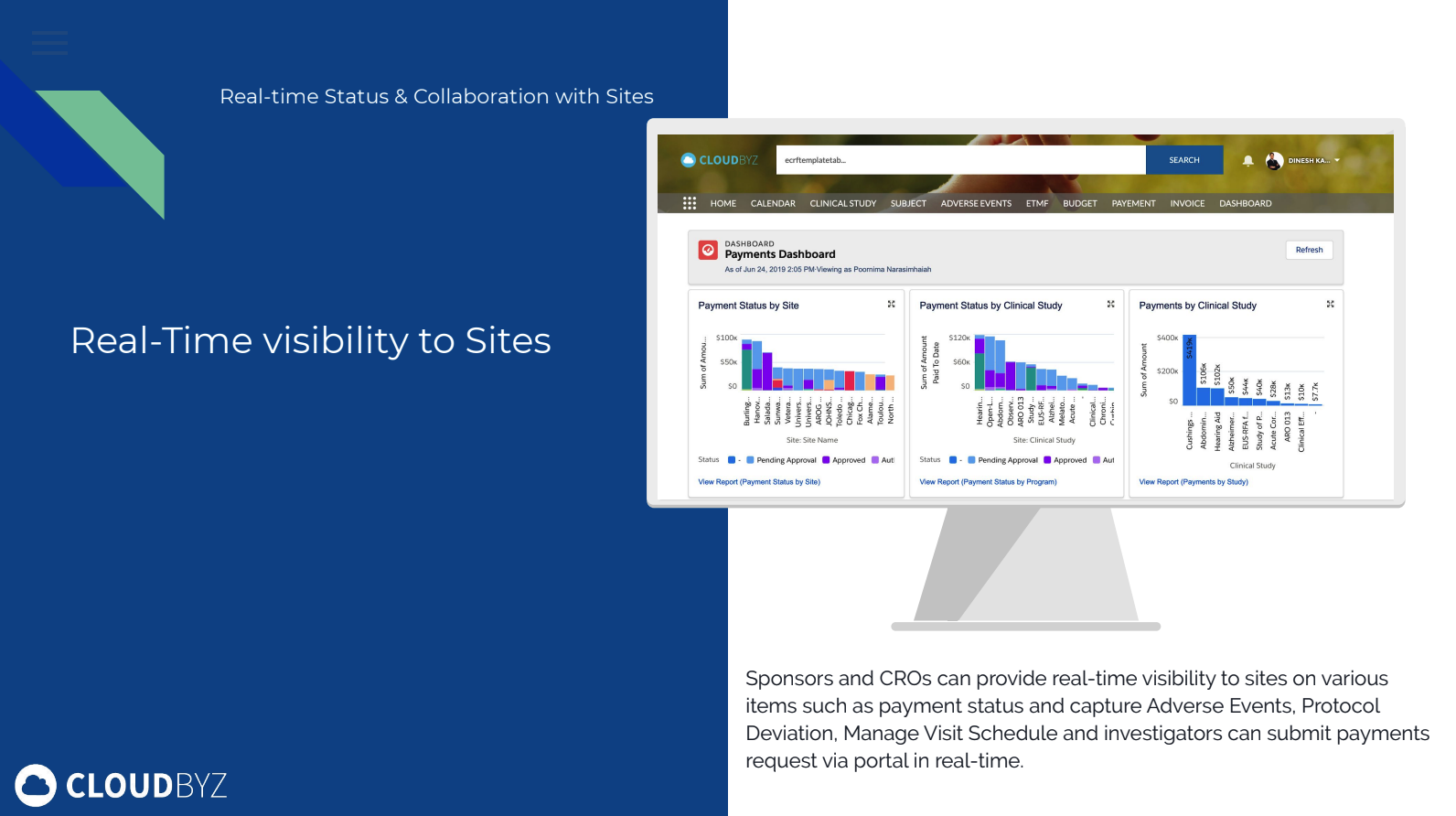
These questions translate into a relatively small set of portal views. A site-facing home page can display tiles for "Action needed," "Eligible and pending approval," and "Approved and scheduled," each drillable down to individual visit and milestone details. Sponsor and CRO users can see the same underlying items grouped by region, study, and site tier, with filters for vendor and payment run. Crucially, both sides draw on the same data model, so arguments about who is "right" give way to conversations about how to fix the underlying drivers.
Keeping Visit and Milestone Data Payment-Ready
A clear portal design is only as good as the data behind it. The next step is ensuring that underlying workflows keep data current and reliable enough to drive payments. This means treating CTMS not just as a tracker of visits and milestones, but as the primary system for determining when work crosses the threshold from "done" to "finance-eligible." When that threshold is encoded as configuration rather than as a spreadsheet rule, CTFM can generate site payables and cash forecasts automatically, and the portal can present those states without manual intervention.
Eligibility rules should be defined explicitly within CTMS and related systems. For example:
- A completed visit should not become finance-eligible until all required data have been captured in EDC or eCOA, an authorized monitor has verified the visit in CTMS, and no critical queries remain open.
- A startup pack might become eligible only when ethics approvals, contracts, training, banking and tax documentation, and system provisioning are all present and current.
- A closeout pack could require last-patient-last-visit confirmation, query resolution, and eTMF health scores above a defined threshold.
Each of these eligibility states should live in CTMS and feed CTFM, not in hidden logic inside external spreadsheets.
To keep these workflows healthy, validations and alerts should nudge teams before problems reach a payment run. If a visit sits in "completed but unverified" status for too long, CTMS should surface it on a monitor's dashboard and, if necessary, escalate. If a startup pack is stalled because one document is missing, the portal should show both site and sponsor the exact blocker rather than a generic "pending" label. Much of the delay and frustration in site payments stems from misaligned terminology and mismatched systems; by making CTMS the shared source of truth for eligibility, you give both sides a realistic picture of what needs to happen next.
Measuring and Improving Site Cash Flow Over Time
With workflows and portals in place, the real opportunity is to use CTMS and CTFM data to improve cash flow performance continuously. Rather than treating payment SLAs as static contract clauses, you can monitor them in real time and adjust processes where they are falling short.
A well-designed dashboard can show, for each study and geography, how long it typically takes for visits to move through each stage of the payment lifecycle:
- Completed to Finance-eligible
- Eligible to Approved
- Approved to Paid
It can also highlight where bottlenecks sit: at the site (slow data entry or query resolution), at the sponsor or CRO (slow review or exception handling), or in external dependencies such as banking or tax clearances.
These insights enable focused improvement cycles rather than blanket interventions. If eligibility lags are common at certain sites, offer targeted training and template adjustments. If approvals are slow because reviewers encounter too many exceptions, revisit rate-card and rule design so that common scenarios flow straight through while genuine edge cases still receive attention. If cash disbursement is the bottleneck, collaborate with finance and treasury teams to streamline integrations with ERP or payment providers.
Over time, publish comparative metrics back to internal teams and, where appropriate, to the sites themselves. Sharing how a site's event-to-payable cycle times compare to study or regional medians, and publicly recognizing improvements, reinforces the behaviors that make the system work.
Cloudbyz CTMS: A Site Portal Built In From the Start
One of the practical advantages of working within the Cloudbyz ecosystem is that you do not need to build a site portal from scratch. Cloudbyz CTMS comes with a site portal included as a native capability, meaning the foundation for visit-to-cash visibility is already in place the moment your team goes live.
Rather than stitching together a custom solution or relying on a disconnected third-party tool, site coordinators and investigators can log into a portal that is directly connected to the same CTMS data driving your study operations. Visit statuses, milestone completions, and eligibility states are not copied or exported into a separate system; they are surfaced in real time from the source. When CTMS is also integrated with CTFM, that same portal extends naturally into payment tracking, giving sites a single place to monitor both their operational and financial standing on a study.
This out-of-the-box availability also shortens the time to value. Study teams do not need to wait for a lengthy implementation project before sites can start seeing payment status and upcoming cash flow. Configuration and role-based access can be tailored to sponsor and site requirements, but the underlying infrastructure is already there. For sponsors and CROs looking to improve site relationships quickly, the Cloudbyz site portal offers a ready starting point rather than a build-from-zero undertaking.
The Competitive Advantage of Financial Predictability
Research consistently underlines how strongly site satisfaction and sponsor-site relationships depend on financial predictability. In a competitive enrollment environment, a reputation for timely and explainable payments can matter as much as protocol design when it comes to securing the attention of the best centers.
By turning CTMS- and CTFM-driven transparency into a core part of your operating model, you do more than reduce friction on individual payment runs. You build a structural advantage: sites trust the numbers, staff spend less time chasing updates, and both parties can focus their energy on the work that actually advances the trial. That shift, from reactive reconciliation to proactive visibility, is what a well-designed visit-to-cash portal ultimately delivers.
Subscribe to our Newsletter
