

Request a demo specialized to your need.
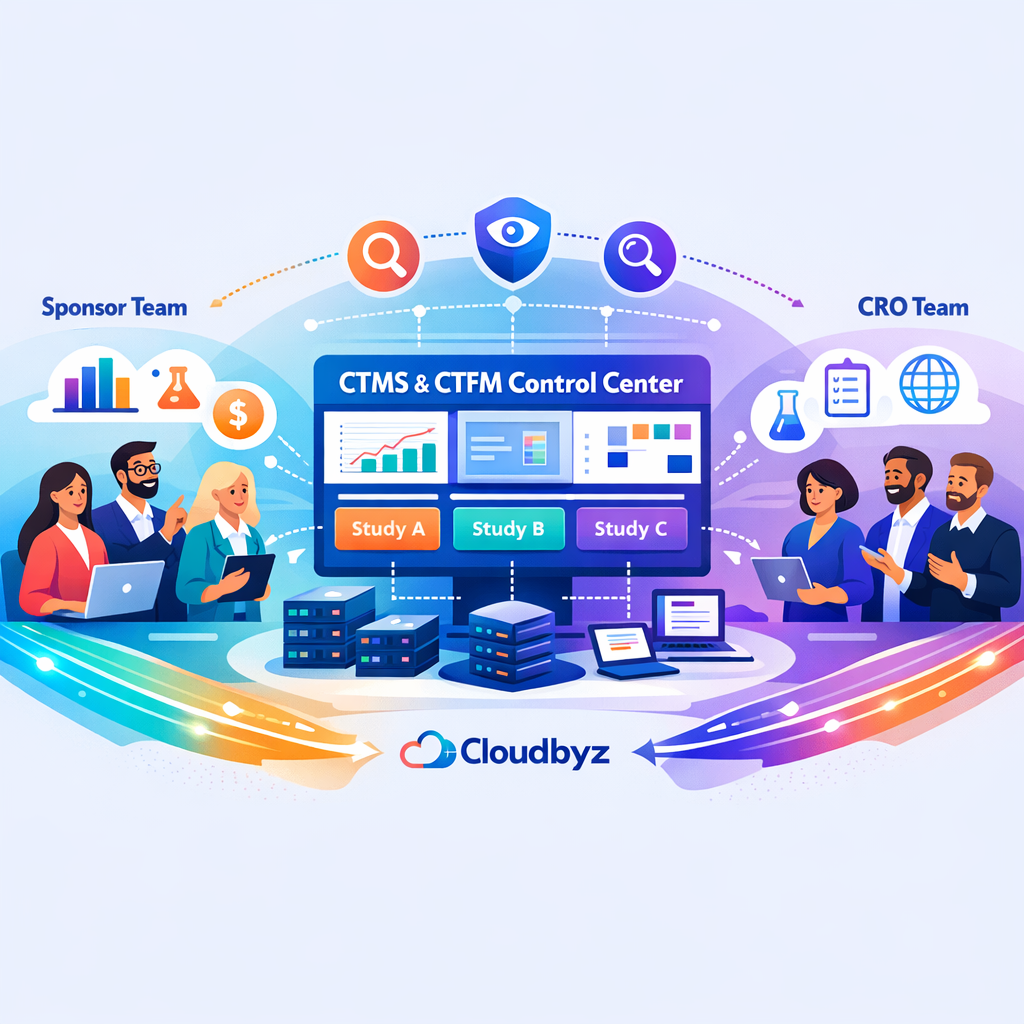
Define CTMS operating models that give sponsors and CROs shared visibility into operational and financial performance.
Defining Transparency in Sponsor and CRO CTMS Relationships
Sponsors and CROs speak often about partnership, alignment, and shared goals. Yet the data that govern those relationships frequently live in separate systems and tell slightly different stories. Sponsors assemble a portfolio view from their own CTMS, ERP platforms, and spreadsheets. CROs manage daily operations in their internal tools and provide periodic status decks or reconciled reports. When timelines slip or budgets shift, conversations can quickly turn into reconciliation exercises about whose numbers are correct instead of focused discussions about what must change.
For organizations operating on Cloudbyz CTMS and Clinical Trial Financial Management CTFM, there is an opportunity to redefine how transparency works. Rather than accepting fragmented reporting cycles, sponsors and CROs can design operating models in which operational and financial evidence is shared by default. Transparency then becomes a deliberate design choice, not an afterthought.
The first step is to define what transparency actually means in the sponsor and CRO relationship. At a basic level, it may involve milestone reporting that covers activation, enrollment, monitoring, and closeout, along with high level spend curves. At a more advanced level, transparency may include near real time visibility into study dashboards that display country and site readiness, verified visits, data quality indicators, budget burn, and site payment status. Most organizations seek a practical middle ground. They want enough shared detail to detect risk early without forcing either side to reveal sensitive internal cost structures or proprietary methods.
A CTMS driven operating model makes this balance achievable. Instead of relying on slide decks and periodic reconciliations, both parties agree on a standard set of study dashboards, shared KPIs, and event driven data flows. When designed properly, updates flow within hours rather than weeks. The emphasis shifts from retrospective explanations to proactive course correction.
A practical starting point is to define which entities and events must be aligned between sponsor and CRO systems. These typically include study identifiers and versions, country and site codes, startup and closeout milestone packs, subject and visit identifiers, critical to quality visit flags, and finance eligibility states. These elements form the spine of the operating model. Once they are aligned, reporting templates, variance analyses, and site payment service levels can sit on top of that structure without constant renegotiation.
Designing CTMS Workflows and Data Flows for Shared Visibility
True shared visibility requires more than data sharing. It requires rethinking CTMS as the orchestration layer for sponsor and CRO collaboration rather than as a local tracking tool on each side.
In a Cloudbyz environment, the foundation is a shared dictionary. Studies, countries, sites, subjects, visits, procedures, milestones, rate card codes, and cost buckets must mean the same thing in both sponsor and CRO dashboards. When both organizations operate on Cloudbyz CTMS and CTFM, that dictionary can reside natively in the platform. In mixed system environments, it can live in a governed integration layer that maps codes in a controlled and auditable way.
Once the shared dictionary is in place, workflows can be redesigned around shared states instead of isolated ones. A startup milestone pack, for example, may move through planned, in progress, and ready states in both organizations’ CTMS views. Evidence from feasibility assessments, regulatory approvals, contracting, and system provisioning is captured once and visible to both parties. This reduces duplication and ensures that readiness is defined consistently.
Enrollment and visit workflows can extend beyond counting randomized subjects. Shared metrics can include which visits are verified, which are finance eligible, which protocol deviations have been resolved, and how these signals feed into site payment and accrual logic. Closeout workflows can similarly coordinate database lock, TMF reconciliation, and financial reconciliation across sponsor and CRO teams. The result is not just shared reporting but shared operational understanding.
Data flows must also evolve from ad hoc extracts to predictable event driven streams. When a country becomes ready, a site is activated, a visit is verified, or a significant risk is logged, both sponsor and CRO systems should recognize that change quickly enough to influence decisions. Whether enabled through APIs, secure feeds, or controlled exports, the goal is immediacy that supports action rather than retrospective justification.
In such a model, CTMS dashboards surface near real time study progress, milestone states, monitoring outcomes, and quality indicators. CTFM overlays budget burn, accrual coverage, and payment status in the same context. When operational and financial signals appear side by side, leadership conversations become sharper and more fact based.
Governance, KPIs, and the Evolution of Transparency
Even the best designed transparency model will drift without governance and disciplined metrics. Sponsors and CROs that want CTMS driven transparency to endure must establish a joint governance forum with real decision authority and a compact KPI set that both sides commit to use.
Governance should oversee the shared dictionary, workflow templates, integration contracts, and role based access to sensitive data. It should also define how to handle corrections and exceptions. If data must be amended, the process should be transparent and auditable. If rate card exceptions are approved, they should be documented within the shared system rather than buried in email. As new trial designs, hybrid visit models, or emerging technologies are introduced, governance should determine how they are incorporated into the common framework.
On the metrics side, a concise set of transparency KPIs can anchor collaboration. These may include time from protocol finalization to first country ready, from country ready to first site ready, and from first site ready to first patient in. Enrollment versus plan by country, verification timeliness for critical visit types, event to payable cycle time, and forecast accuracy by cost bucket are also powerful indicators. When these KPIs are defined and calculated identically for both sponsor and CRO views, they become a shared language for performance.
Importantly, transparency models should be expected to evolve. Early pilots may focus on selected studies or regions, with closer manual oversight of data quality and exceptions. As patterns stabilize, templates can be standardized, service levels tightened, and legacy trackers retired. Each iteration strengthens trust and reduces friction.
When disputes arise over timelines, budgets, or quality signals, the most constructive response is to ask what CTMS and CTFM showed and how those signals can be improved. Over time, this habit transforms CTMS from a reporting obligation into neutral ground. Sponsors and CROs can see the same evidence, interpret it through shared KPIs, and make faster, better decisions together. Transparency then becomes not a compliance requirement but a strategic asset for predictable and scalable clinical portfolios.
Subscribe to our Newsletter
