

Request a demo specialized to your need.
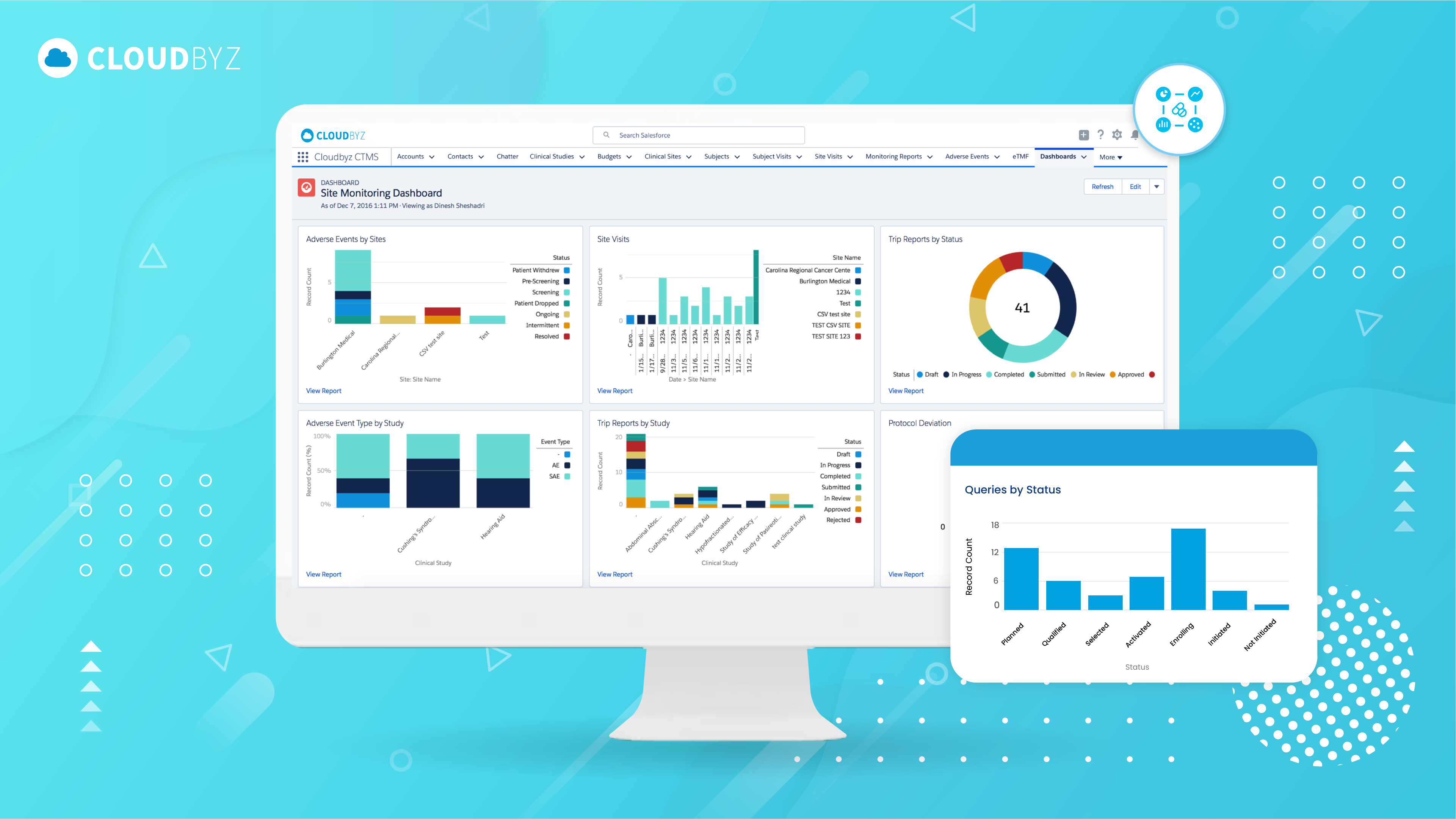 A practical roadmap for mid-size sponsors to implement CTMS without disruption.
CTMS Business Case, Architecture, and Adoption: A Pragmatic Guide for Mid-Size Sponsors
Many mid-size biotechs and device sponsors know they have outgrown spreadsheets, shared drives, and legacy trackers, but they hesitate to commit to a Clinical Trial Management System (CTMS). They worry about overwhelming lean study teams, wrestling with integrations, or getting locked into multi-year IT programs that never quite deliver. Yet the same organizations are under pressure to run more complex, geographically dispersed trials, respond to regulators faster, and give investors clearer visibility into portfolio performance. A pragmatic CTMS implementation roadmap can resolve that tension, especially when it is built around a modern, cloud-based platform like Cloudbyz CTMS.
Part 1: Defining the Business Case and Phased Roadmap
Why CTMS Matters Now
The starting point is clarity on why CTMS has become a strategic priority rather than a nice-to-have. A centralized platform replaces fragmented tools by unifying study planning, site management, enrollment tracking, monitoring, document oversight, and elements of financial governance in one place. That consolidation improves operational efficiency and supports compliance with evolving guidance like ICH E6(R3), which raises the bar for data governance and computerized systems validation.
Mid-size sponsors should translate these external pressures into concrete internal goals: reducing study start-up time by a measurable percentage, eliminating duplicate trackers, shortening time-to-visibility on enrollment and site performance, or enabling risk-based monitoring and financial forecasting directly from CTMS data. Grounding the business case in specific, measurable outcomes makes it far easier to secure stakeholder alignment and funding before implementation begins.
Building a Phased Roadmap
With goals defined, sponsors can outline a roadmap that starts small but builds meaningful momentum.
Phase 1 should focus on a single pivotal or registrational study and a minimal feature set: core study and site management, subject and visit tracking, monitoring visit planning, and basic reporting. Even this foundational slice can deliver real-time insight into study health across sites and countries. The goal is to generate early wins, build internal confidence, and establish the habits that will carry forward.
Phase 2 extends CTMS to additional trials and introduces more advanced capabilities such as risk-based monitoring metrics, issue and action management, and deeper integration with eTMF and financial tools.
Later phases tackle portfolio analytics and AI-assisted forecasting, taking full advantage of the broader eClinical ecosystem. Throughout all phases, clear success measures, such as user adoption rates, reduction in manual reconciliations, or faster response to audit requests, keep the roadmap grounded in business value rather than technical checklists.
Part 2: Designing for Scalability: Architecture, Integrations, and Data
Treating CTMS as the Operational Hub
With a clear business case in place, the next step is designing a CTMS architecture that scales with the portfolio rather than with a single flagship trial. Modern GCP guidance encourages sponsors to think in terms of data life cycles, risk-based quality management, and integrated systems rather than isolated tools. For Cloudbyz customers, this means treating CTMS as the operational hub in a connected eClinical ecosystem, linked to EDC, eTMF, RTSM, safety, and financial tools through a hub-and-spoke model that orchestrates site management, visit tracking, monitoring, budgeting, and payments.
Starting with a Minimum Viable Integration Set
Most mid-size sponsors should aim for a minimum viable integration set at go-live rather than a "connect everything" vision. In practical terms, that often means three core connections to begin:
- One-way or bidirectional integration between CTMS and EDC for enrollment and visit status
- Automated document links between CTMS and eTMF
- A simple feed to financial tools for site payment triggers and study budgets
This incremental approach matters because legacy systems were expensive, brittle, and difficult to integrate, whereas a modern, Salesforce-native CTMS can start small and expand as governance and usage mature. A pragmatic roadmap defines which integrations must be live for the first wave of studies and which can wait, avoiding the analysis paralysis that stalls many programs before they start.
Investing Early in Data Governance
Data design is just as important as system wiring. Mid-size sponsors often discover they lack consistent definitions for basic concepts: study phase, program, indication, or even what counts as a "screened" versus "enrolled" subject. Before configuring CTMS, implementation teams should run short data-definition workshops to align on key fields, picklists, and hierarchies.
That foundational work pays off when executives start using CTMS dashboards to compare trials and portfolios. Real-time reporting and centralized oversight only deliver their full value when the underlying data model reflects how the sponsor actually runs development. Sponsors that invest early in lightweight data governance, including simple field dictionaries, clear data stewardship roles, and rules about who owns which records, find that onboarding new trials and integrating new partners becomes a configuration exercise rather than a reinvention each time.
Part 3: Change Management, Training, and Continuous Improvement
Positioning CTMS as a Shared Platform
Even the best-designed architecture will fail if people do not adopt it, or if it ossifies after the first wave of projects. For mid-size sponsors, change management and continuous improvement are where modern CTMS platforms differentiate themselves from legacy tools. Instead of treating CTMS as an IT system to be "rolled out," leading teams position it as a shared platform for clinical operations, data management, finance, and quality, backed by explicit expectations about how and when it should be used.
Cross-functional governance councils that own templates, KPIs, and configuration standards are particularly effective. They ensure that each new study reuses proven patterns rather than building from scratch and that the system evolves in a coordinated, intentional way.
Role-Based Training and Embedded Support
On the ground, change management starts with role-based training and continues with embedded support throughout execution. Study managers need to see how CTMS replaces their enrollment and site-health spreadsheets. CRAs need hands-on practice with visit verification workflows. Finance partners should understand how CTMS events drive site payments and accrual logic in downstream tools.
Lightweight office hours, study team champions, and quick-reference dashboards help sustain adoption after go-live. The goal is to make CTMS the path of least resistance for everyday work, not a system people consult only when required.
Closing the Loop with Continuous Improvement
Continuous improvement is what separates a living platform from an underused system. After each major milestone, including first patient in on a new study, the first portfolio dashboard review, or the first inspection, governance teams should hold structured retrospectives. Key questions to address: Did CTMS data answer leadership's questions? Which workflows felt heavy or unclear? Where did sites or CROs fall back to email and manual trackers?
Feedback from these sessions feeds a prioritized backlog of enhancements to fields, layouts, training content, and integrations. Sponsors who treat CTMS as a living product iterate their way into a powerful, low-friction backbone for clinical operations. For mid-size sponsors in particular, that mindset is the difference between another underused system and a strategic asset that scales alongside the pipeline.
Conclusion
A successful CTMS implementation is not primarily a technology challenge. It is a program management and organizational discipline challenge. Mid-size sponsors that define a clear business case, adopt a phased roadmap, design for scalability from the start, and invest in change management and continuous improvement are the ones that realize the full value of a modern CTMS. Cloudbyz CTMS, built natively on Salesforce and embedded in a broader eClinical ecosystem, provides the platform foundation. The roadmap, governance model, and adoption culture are what transform that foundation into competitive advantage.
Subscribe to our Newsletter
