

Request a demo specialized to your need.
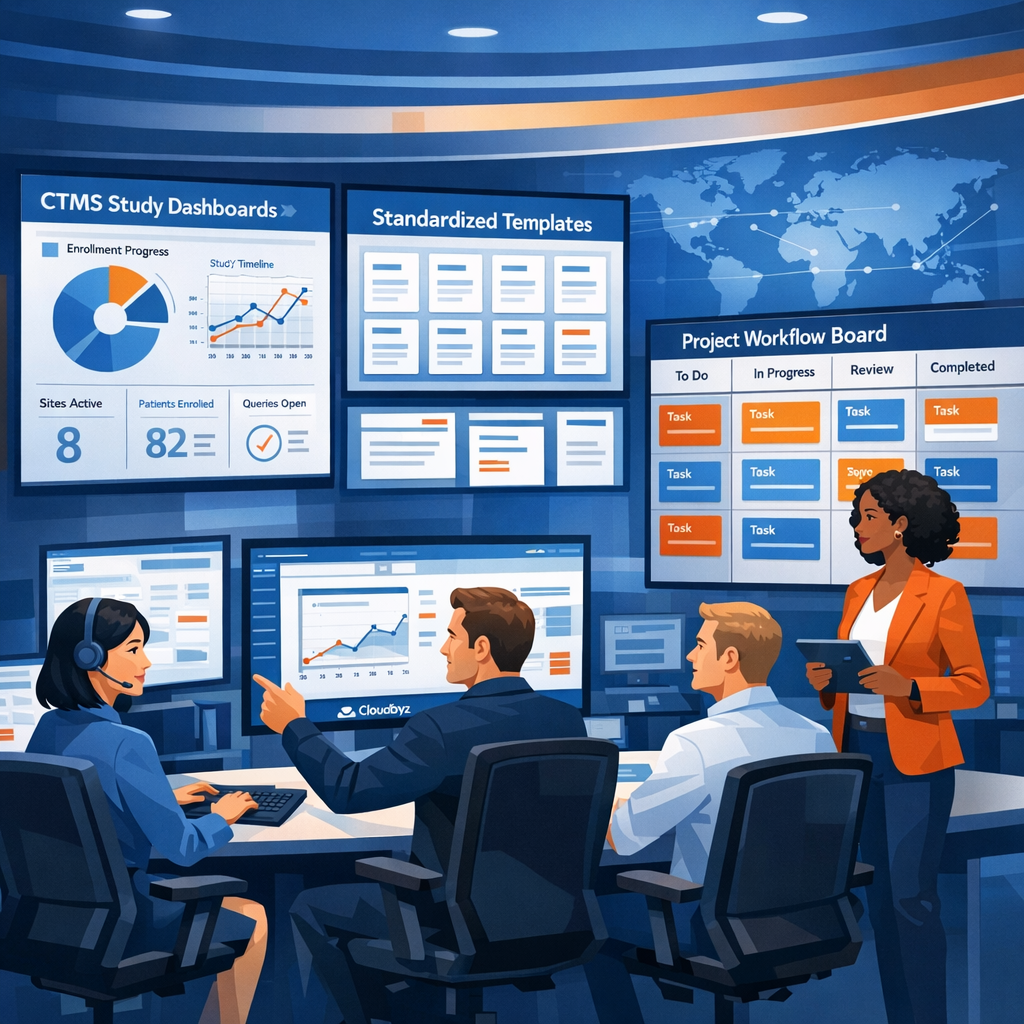
A playbook for mid‑size CROs to design CTMS templates, metrics, and governance that scale without enterprise overhead.
Introduction: The CTMS Paradox
For mid-size contract research organizations, the Clinical Trial Management System represents a curious paradox. The same platform promised as a solution for unified oversight, operational efficiency, and portfolio scalability can paradoxically become the very source of fragmentation it was meant to eliminate. Walk into many growing CROs today, and you'll find a CTMS that has quietly morphed into a patchwork of sponsor-specific configurations, parallel spreadsheet systems, and one-off reporting mechanisms—each well-intentioned, each solving an immediate problem, but collectively undermining the strategic value the platform should deliver.
This isn't a technology problem. The platforms available to mid-size CROs today—particularly Salesforce-native solutions like Cloudbyz CTMS with deep eClinical integrations—are more capable than ever. Rather, it's a design problem, and more fundamentally, a strategic clarity problem. As these organizations scale from managing a handful of studies to coordinating dozens of concurrent global trials across multiple sponsors, the critical question shifts from "Do we have a CTMS?" to "Have we designed our CTMS to reflect how we actually want to operate as an organization?"
This article presents a strategic framework for mid-size CROs ready to treat CTMS design not as a one-time IT implementation project, but as an ongoing organizational capability that defines their competitive positioning, operational excellence, and ultimately their ability to deliver "big pharma-grade" oversight without big pharma IT infrastructure and headcount.
The Hidden Cost of Configuration Sprawl
Before exploring solutions, it's worth understanding how mid-size CROs typically arrive at CTMS chaos—because the path is incremental, reasonable at each step, and ultimately unsustainable.
It often begins with the best of intentions. A new sponsor comes on board with specific requirements: particular visit naming conventions, unique site coding schemes, custom country pack structures. The project team, eager to demonstrate flexibility and client service, configures the CTMS to match these specifications exactly. The study launches successfully. Everyone is satisfied.
Then the second sponsor arrives with different conventions. And the third. And the fourth. Each configuration decision is locally optimal—it serves that sponsor, that study, that moment. But the cumulative effect is fragmentation. Within eighteen months, the CRO finds itself managing what is effectively multiple different CTMS instances under a single platform umbrella.
The consequences manifest across multiple dimensions:
Portfolio Analysis Becomes Artisanal: Every cross-study report becomes a custom project. Visit names vary by protocol, site codes follow inconsistent patterns, milestone definitions shift study to study. The data exists, but synthesizing it requires constant translation and reconciliation. The promise of portfolio-level insights—which therapeutic areas perform best, which countries deliver most reliably, where operational bottlenecks consistently emerge—remains frustratingly out of reach.
Knowledge Transfer Stalls: When team members rotate between projects, they face steep learning curves navigating each study's unique CTMS configuration. The institutional knowledge that should accumulate with each completed trial instead remains siloed within project teams. New hires struggle to become productive quickly because there's no consistent operational pattern to learn.
Scalability Plateaus: As the organization attempts to grow, it discovers that operational capacity doesn't scale linearly with headcount. Each new study requires not just execution effort but also design and configuration effort. The CTMS, which should enable scaling, instead becomes a constraint.
Quality Becomes Variable: When every study operates slightly differently, quality standards become difficult to enforce consistently. What constitutes "visit verified" or "site ready" may vary subtly between studies, making cross-portfolio quality management nearly impossible. Inspection readiness becomes a study-by-study challenge rather than an organizational competency.
Vendor Relationships Lack Clarity: Without a consistent operational model, CROs struggle to articulate their value proposition beyond generic flexibility. Sponsors receive different operational experiences across programs, making it difficult for the CRO to build a distinctive brand associated with specific quality attributes or operational excellence.
The irony is profound: organizations invest in sophisticated CTMS platforms to gain efficiency and insight, only to configure themselves back into the fragmentation that manual systems created.
Foundation First: Governed Data Structures as Strategic Assets
The path from configuration chaos to competitive advantage begins with the least glamorous but most foundational work: establishing governed core data structures that reflect how the CRO genuinely wants to operate, independent of any single sponsor's preferences.
The Core Dictionary Principle
Mid-size CROs must recognize that sponsor-provided study dictionaries—with their varied visit names, inconsistent site codes, and loose use of country-specific structures—represent vendor requirements, not operational truth. The strategic move is to maintain a governed internal dictionary within the CTMS and systematically map sponsor-specific labels onto it.
This means establishing clear, consistent internal conventions for the fundamental entities every clinical trial shares:
Study Taxonomy: Define standard study phase classifications, therapeutic area categories, and design archetypes (single-center vs. multi-center, single-country vs. global, early-phase vs. confirmatory) that reflect meaningful operational differences in how the CRO manages work.
Geographic Hierarchy: Establish consistent country and region codes that align with how the organization actually deploys resources and manages operations, regardless of how sponsors label their country packs.
Site Identification: Implement systematic site coding that enables tracking site performance and relationships across programs, even when sponsors assign different identifiers to the same investigational sites.
Visit and Procedure Structure: Create standardized visit-type classifications (screening, baseline, treatment, safety follow-up, early termination) and procedure categories (efficacy assessments, safety procedures, PK sampling) that enable meaningful cross-study comparisons.
Subject Lifecycle States: Define consistent subject status codes that reflect genuine operational states rather than sponsor-specific terminology.
Critically, this doesn't mean ignoring sponsor requirements. Instead, it means implementing a two-layer approach: the internal dictionary serves as the operational backbone for CTMS workflows, reporting, and analytics, while sponsor-specific terminology lives in descriptive fields and documentation that satisfies contractual requirements. A visit the sponsor calls "Week 12 Efficacy Assessment" might map internally to "Treatment Visit 4" in the core dictionary, enabling the CRO to analyze all Treatment Visit 4 patterns across its portfolio while still presenting sponsor-preferred nomenclature in client-facing reports.
Platforms like Cloudbyz CTMS, with their Salesforce-native flexibility, make this dual-layer approach architecturally straightforward. The challenge isn't technical—it's organizational: deciding which conventions matter enough to standardize and maintaining discipline against the perpetual temptation to create "just this one" sponsor-specific variation.
Why Governance Matters More Than Flexibility
Many mid-size CROs pride themselves on flexibility, treating sponsor-specific configuration as a service differentiator. But there's a crucial distinction between strategic flexibility—adapting how you deliver value to meet genuine client needs—and structural flexibility that fragments your operational model.
Governed data structures don't reduce the CRO's ability to serve diverse sponsors; they create the foundation for serving them consistently well. When core entities follow standard patterns, the organization can:
- Build once, deploy repeatedly: Workflows, validations, and integrations developed for one study can be reused across the portfolio with minimal rework.
- Learn systematically: Performance data becomes comparable across studies, enabling genuine evidence-based process improvement rather than anecdotal adjustments.
- Scale expertise efficiently: Staff can rotate between projects without complete retraining, and new hires can become productive faster by learning one consistent model.
- Demonstrate competence: Sponsors increasingly value operational maturity and predictability. A CRO that can articulate its standardized approach to study management, backed by portfolio-level performance data, differentiates itself from competitors offering undifferentiated "flexibility."
Workflow Standardization: The Primary Operational Lever
With governed data structures established, the next strategic priority is workflow standardization—moving from project team-designed, study-specific processes to a small set of configurable process archetypes that reflect the CRO's operational excellence model.
The Archetype Approach
Rather than allowing each project team to design its approach to feasibility, site selection, startup, monitoring, and closeout, mid-size CROs should define standard process archetypes within their CTMS that accommodate genuine study variation while maintaining operational consistency.
Startup Workflows: A standard startup archetype might universally progress through defined states—feasibility assessment, site pre-selection, contract negotiation, regulatory approval, initiation readiness, and activation—regardless of sponsor. However, the specific tasks, evidence requirements, and approval criteria within each state can vary by configuration parameters: study phase, therapeutic area, geographic region, and regulatory complexity.
For example, a Phase III multi-country cardiovascular study might trigger comprehensive country-specific regulatory checklists and central ethics review tracking, while a Phase I single-center oncology study activates a streamlined regulatory pack focused on investigator qualifications and safety committee setup. The workflow states remain consistent; the tasks and criteria adapt based on study characteristics captured in the core CTMS dictionary.
Resources like How to Accelerate Site Activation: Best Practices provide evidence-based guidance on which startup activities deliver the most impact on first-patient-in timelines and which are frequently over-engineered. CROs can use such evidence to design startup archetypes that eliminate low-value activities while rigorously enforcing critical quality gates.
Monitoring Workflows: Rather than implementing sponsor-specific monitoring approaches study by study, CROs can define standard risk-based monitoring patterns whose intensity and frequency are driven by key risk indicators calculated within the CTMS itself.
A baseline monitoring archetype might include central data review cycles every two weeks, remote site contacts every four weeks, and targeted on-site visits triggered by specific risk thresholds (enrollment deviation, high query rates, protocol deviation patterns, safety signal emergence). The fundamental workflow remains constant across studies, but the risk thresholds, visit intensity, and escalation triggers can be tuned based on study risk profile and sponsor requirements without fragmenting the underlying process.
This approach eliminates the proliferation of monitoring spreadsheets and one-off tracking mechanisms that typically emerge when each study implements monitoring differently. Instead, monitoring execution, metrics, and oversight all operate through standard CTMS workflows with study-appropriate parameterization.
Closeout Workflows: Study closeout often receives insufficient process attention until teams discover gaps during database lock or final monitoring visits. Standardized closeout archetypes can ensure that data cleaning milestones, eTMF reconciliation, financial closeout activities, and site de-activation all progress in coordinated lockstep rather than as disconnected parallel activities.
For instance, a standard closeout workflow might enforce dependencies: site-level closeout cannot complete until all queries are resolved, all monitoring findings are closed, all essential eTMF documents are filed, and all payment reconciliation is complete. By defining these dependencies once in the CTMS archetype rather than managing them manually study by study, CROs reduce closeout surprises and accelerate the path to final database lock.
Integration as Workflow Extension
For mid-size CROs, workflow standardization's full value emerges when CTMS workflows extend beyond task lists into integrated system ecosystems. This is where platforms like Cloudbyz CTMS, with native integration to CTFM (Clinical Trial Financial Management), eTMF, EDC, and RTSM systems, create operational leverage unavailable to organizations managing systems in silos.
Consider startup workflows: when a site's regulatory approval transitions from "pending" to "approved" in CTMS, this event can automatically trigger eTMF placeholder updates, activation of EDC site access, RTSM inventory allocation, and creation of initial site payment eligibility records—all without manual coordination across systems. What was previously a multi-day coordination exercise involving emails, spreadsheets, and system checks becomes an instantaneous automated cascade.
Similarly, when visits are verified in CTMS following monitoring review, this event can simultaneously update monitoring dashboards, refresh site payment candidate lists in CTFM, and mark relevant eTMF sections for document filing—ensuring that monitoring, finance, and quality activities remain synchronized through system integration rather than manual processes.
When protocol amendments modify visit structures or safety-critical procedure definitions, integrated platforms allow these changes to propagate automatically across visit schedule templates, monitoring plans, payment schedules, and EDC expectations—rather than requiring manual updates in each disconnected system.
For mid-size CROs under constant pressure to deliver sophisticated operational oversight without proportional IT and administrative staffing, this kind of opinionated, integration-enabled workflow design represents the only sustainable path to competitive operations.
Templates as Organizational Knowledge Codification
Standardized workflows remain abstract until they're codified in reusable templates that project teams can deploy with confidence. For mid-size CROs, templates serve a dual purpose: they accelerate study startup by eliminating repeated design work, and they capture and propagate organizational knowledge about what actually works.
Study Archetype Template Libraries
Rather than building each study from blank templates, CROs should maintain a curated library of study archetype templates that reflect their accumulated expertise. These might include:
- Phase I Healthy Volunteer Studies: Streamlined site selection focused on experienced early-phase units, intensive safety monitoring protocols, standardized PK visit schedules, and simplified regulatory requirements appropriate for first-in-human work.
- Phase II Proof-of-Concept Studies: Mid-sized site networks, balanced focus on efficacy endpoints and safety, flexible enrollment strategies to accommodate adaptive designs, and monitoring intensity calibrated to exploratory objectives.
- Phase III Confirmatory Studies: Large multi-country site portfolios, rigorous endpoint standardization and adjudication processes, comprehensive regulatory oversight appropriate for registration trials, and intensive quality control focused on data integrity for primary endpoints.
- Rare Disease Programs: Concentrated networks of specialized centers, patient advocacy coordination protocols, compassionate use and expanded access provisions, and monitoring approaches adapted to low enrollment velocity.
Each template would define country- and site-level tasks, evidence requirements, readiness criteria, and success metrics that reflect both regulatory requirements and the CRO's operational experience in that archetype. Rather than inventing these structures anew for each study, project managers select the most appropriate archetype, adjust configurable parameters, and launch with a battle-tested foundation.
Guidance resources such as Understanding Clinical Trial Budget Structure: A Comprehensive Guide help CROs determine which cost and resource allocation patterns should be embedded into archetype templates versus remaining study-specific adjustments.
Configuration, Not Customization
The strategic discipline templates enforce is the distinction between configuration and customization. Configuration means selecting from pre-defined options within an archetype: which visits are critical-to-quality, which KRIs drive RBQM intensity, which country regulatory packs apply, which payment milestone definitions are active. These choices adapt the archetype to study-specific requirements without breaking the underlying operational model.
Customization, by contrast, means creating study-specific workflow logic, inventing new data fields, or implementing processes that deviate from standard archetypes. While occasionally necessary, customization should be the exception requiring explicit justification and governance approval.
When templates are properly designed with rich configuration options, the vast majority of sponsor requirements can be accommodated through configuration alone. A sponsor wanting more intensive monitoring for a high-risk oncology trial doesn't need a custom monitoring workflow; they need the standard risk-based monitoring archetype configured with more stringent KRI thresholds and higher visit frequency. A sponsor requiring unique site payment terms doesn't need customized financial tracking; they need the standard payment template configured with sponsor-specific milestone definitions and payment schedules.
This configuration-over-customization principle keeps the CRO's operational model coherent while still delivering sponsor-specific adaptations where genuinely required.
Metrics That Tell the Truth: Portfolio-Level Intelligence
Templates and workflows deliver operational consistency, but without meaningful metrics, the organization remains operationally blind—unable to learn from its collective experience or identify improvement opportunities. Mid-size CROs don't need dashboards full of metrics; they need a disciplined set of KPIs that reveal truth about site performance, quality, financial health, and operational efficiency across all sponsors.
The Core CRO Metric Set
Effective CRO metrics balance operational execution, quality outcomes, and financial performance:
Enrollment Performance:
- Enrollment versus plan by country, site, and study
- Screen failure rates and reasons
- Protocol deviation rates related to eligibility
- Days from site activation to first patient enrolled
These metrics reveal which countries and sites consistently deliver enrollment, where protocol eligibility criteria may be misaligned with patient populations, and whether site selection strategies are effective.
Startup Efficiency:
- Cycle time from site selection to activation by country and archetype
- First-patient-in lag (days from last site activated to first patient enrolled)
- Regulatory approval timeline by country and ethics committee type
- Contract negotiation duration by site tier and sponsor
These KPIs expose systematic bottlenecks in startup processes and enable evidence-based process improvement. Are certain countries consistently slower due to regulatory complexity, or does the CRO need better local operational support? Do specific types of contracts consistently delay activation, suggesting template improvements or pre-negotiation opportunities?
Quality and Compliance:
- Visit verification timeliness, particularly for critical-to-quality visits
- Protocol deviation and CAPA aging (time from identification to closure)
- Monitoring finding closure rates
- Query resolution turnaround time by site and query category
- eTMF inspection readiness scores
Quality metrics should emphasize velocity and resolution, not just detection. A high deviation count with rapid resolution demonstrates effective quality management; low detection with slow resolution suggests quality issues are unrecognized or unaddressed.
Financial Health:
- Event-to-payable cycle time (days from visit completion to payment eligibility)
- Site payment accuracy (percentage requiring manual correction)
- Budget variance by cost category and study phase
- Pass-through cost reconciliation timeliness
Financial metrics ensure that the CRO maintains healthy sponsor relationships through accurate, timely site payments while protecting its own margins through rigorous pass-through cost management.
Resources like Clinical Trial Financials Simplified and CTMS Dashboards That Unite Ops and Finance provide frameworks for surfacing these KPIs in role-based views that make sense to project managers, country leads, QA specialists, and finance teams—ensuring metrics drive appropriate action by those positioned to improve performance.
Cross-Study Consistency as a Metric Prerequisite
Critically, these portfolio-level metrics only deliver value when they're driven by consistent CTMS events and definitions across all studies. This is where governance of the core data dictionary and standard workflows pays strategic dividends.
"Visit verified" must mean the same thing across all studies: designated monitoring review is complete, all critical queries are resolved, and the visit dataset is approved for analysis or payment processing. If Study A defines verification as "monitor reviewed" while Study B requires "monitor reviewed plus medical review," the portfolio-level verification timeliness metric becomes meaningless.
"Site ready" must follow a consistent definition: all regulatory approvals obtained, all initiation activities complete, all essential equipment and supplies available, all site staff trained. Variations in readiness definitions across studies make startup cycle time metrics incomparable and hide the true drivers of activation efficiency.
This is where the governed core dictionary establishes its value. By maintaining standard definitions for operational states and events, the CRO ensures that portfolio metrics reflect genuine performance patterns rather than definitional variations.
Handling Sponsor-Specific Requirements Without Fragmenting Metrics
What happens when a sponsor genuinely requires a different operational pattern—perhaps a hybrid design with extensive home health visits, or a stricter definition of safety visit completeness that exceeds the CRO's standard?
The solution is configuration flags within CTMS that feed study-specific dashboards while keeping cross-portfolio metrics anchored to the standard. For the hybrid study with home health visits, the CRO might create a study-specific dashboard that tracks home visit completion separately while still rolling those visits into the standard "visit verified" metric using the same verification criteria applied to in-clinic visits.
For the study with enhanced safety visit requirements, the sponsor-specific dashboard might highlight an additional "enhanced safety review complete" milestone while the CRO's standard "visit verified" metric continues to track basic verification completion consistently across all studies.
This approach allows sponsors to see the additional oversight they've requested without fragmenting the CRO's ability to learn systematically from its portfolio: which study archetypes achieve startup SLAs most consistently, which combinations of country regulatory environments and site types yield cleanest data and most predictable enrollment, where resource bottlenecks emerge across clients, and which operational patterns correlate with successful outcomes.
Governance at Scale: Product Management, Not IT Administration
For templates, workflows, and metrics to deliver sustained value, mid-size CROs need governance that matches their organizational reality: strong enough to prevent fragmentation, light enough not to paralyze project teams or create bureaucratic overhead that undermines the efficiency CTMS should enable.
Beyond the CTMS Administrator Model
Many CROs operate with a traditional IT governance structure: a CTMS administrator who handles system configuration and a loose steering committee that convenes reactively when problems surface. This model made sense when CTMS was primarily a data repository, but it's inadequate for CTMS as an operational platform.
A more effective approach treats CTMS as an organizational product with dedicated product management:
Named Product Manager: A senior operations or technology leader who owns CTMS strategy, roadmap, and value delivery. This isn't a full-time role in most mid-size CROs, but it must be an explicit accountability with dedicated time allocation and executive visibility.
Design Council: A standing cross-functional team including clinical operations leadership, data management, quality assurance, finance, and portfolio management. This council meets quarterly (or monthly during high-growth periods) to approve core template changes, prioritize workflow enhancements, review portfolio metrics, and address systemic issues revealed by CTMS data.
Clear Decision Rights: Explicit authority definitions for who can approve new study archetype templates, modify core data dictionary elements, create new metrics, and authorize customizations that deviate from standard patterns.
Implementation guidance such as CTMS Implementation Best Practices provides reference frameworks for establishing these governance structures and defining appropriate decision rights.
Governance as Enablement
While governance establishes boundaries, project teams should experience it as enablement rather than bureaucratic gating. This requires providing pre-approved blueprint configurations that cover the vast majority of real-world scenarios:
Single-Country vs. Multi-Country Trials: Pre-configured study templates that activate appropriate regulatory workflows, site management structures, and country-level reporting based on geographic scope.
Outsourced vs. In-House Monitoring: Standard monitoring archetypes for CRO-performed monitoring, sponsor-embedded monitoring teams, and hybrid models, each with appropriate task assignments, system access levels, and reporting structures.
Phase-Specific Blueprints: Distinct configurations for Phase I intensive safety monitoring, Phase II exploratory assessment flexibility, and Phase III registration-quality rigor.
Therapeutic Area Adaptations: Pre-approved variations that accommodate oncology tumor assessment requirements, cardiovascular endpoint adjudication processes, CNS functional assessment schedules, or rare disease patient advocacy coordination.
When a new study launches, project managers select the blueprint that most closely matches their study characteristics, adjust approved configuration parameters (visit criticality definitions, KRI thresholds, payment milestones, country packs), and launch on a predictable timeline without custom development or lengthy approval processes.
When project teams encounter requirements outside available blueprints, they submit streamlined change requests that the design council reviews through the lens of reusability: Is this requirement genuinely unique to one sponsor and study, or does it represent an emerging pattern that should become a new reusable blueprint? This review process simultaneously protects the operational model from unnecessary fragmentation while ensuring the CRO's CTMS capabilities evolve to reflect genuine market requirements.
Vendor-Sponsor Relationships Elevated Through Clarity
This governance and product management approach transforms how mid-size CROs position themselves with sponsors. Instead of selling Cloudbyz CTMS as "a flexible toolbox we'll configure however you prefer," CROs can present a catalog of proven operational patterns:
- Standard startup packs with documented cycle time performance
- Risk-based monitoring workflows with quality outcome track records
- Finance-integrated payment processes that ensure accurate, timely site compensation
- Portfolio-level dashboards that provide sponsors with benchmark comparisons
When sponsors request deviations from these standard patterns, the CRO can engage in informed trade-off discussions: "We can certainly implement your specific monitoring approach, but it will require custom development, additional validation effort, and you'll lose the benchmarking advantage of our standard RBQM metrics. Alternatively, we can configure our proven monitoring archetype to incorporate your critical requirements while maintaining comparability across your program portfolio."
These aren't confrontational conversations; they're consultative discussions grounded in operational evidence. Resources like Best Clinical Trial Management Systems (CTMS) for Contract Research Organizations (CROs) help CROs articulate their platform sophistication and operational maturity to sponsors evaluating potential partners.
Over time, this clarity becomes a differentiator. Sponsors increasingly value CRO partners who bring operational expertise and proven methodologies, not just execution capacity. A mid-size CRO that can demonstrate standardized excellence—backed by portfolio-level performance data from their governed CTMS implementation—competes effectively against larger competitors.
The Competitive Dividend: Strategic Advantages of Opinionated CTMS Design
When mid-size CROs invest in thoughtful, disciplined CTMS design—governed data structures, standardized workflows, reusable templates, meaningful metrics, and appropriate governance—they unlock strategic advantages that compound over time.
Operational Scalability
The most immediate benefit is genuine operational scalability. Each new study doesn't require full design effort; it leverages proven archetypes. Each new team member doesn't face completely unfamiliar processes; they learn one consistent operational model. Each new sponsor doesn't receive an unknown operational experience; they benefit from refined, tested methodologies.
This scalability manifests in concrete metrics: faster study startup, higher study manager productivity (studies managed per FTE), reduced operational errors, and more predictable delivery timelines.
Evidence-Based Improvement
With consistent data structures and comparable metrics across the portfolio, mid-size CROs can practice genuine evidence-based process improvement. They can definitively answer questions like:
- Which startup activities correlate most strongly with fast first-patient-in?
- Which monitoring intensity patterns yield optimal quality outcomes relative to cost?
- Which site selection criteria predict reliable enrollment and data quality?
- Which country regulatory strategies minimize activation delays?
- Which contract negotiation approaches accelerate site agreements?
These insights, derived from portfolio-level CTMS data, enable the CRO to continuously refine their operational archetypes based on actual performance rather than anecdotal impressions or inherited practices.
Quality as Organizational Competency
When quality processes are embedded in standard CTMS workflows rather than managed study by study, quality becomes an organizational competency rather than a variable outcome dependent on individual project team diligence.
Inspection readiness, for example, transitions from a study-level crisis management exercise to an organizational state continuously maintained through automated CTMS workflows: eTMF placeholders automatically created at study startup, document filing tracked against standard timelines, completeness gaps flagged in real-time, quality metrics reviewed quarterly by the governance council.
Sponsors value this maturity. The ability to demonstrate inspection readiness not as a preparation activity but as an ongoing state provides competitive advantage in sponsor selection processes.
Financial Transparency and Predictability
Integration between CTMS and financial systems, orchestrated through standardized workflows, creates financial transparency that benefits both the CRO and its sponsors.
Site payments flow predictably from verified CTMS events, reducing manual reconciliation, payment errors, and site satisfaction issues. Pass-through cost tracking tied to CTMS milestones enables accurate budget forecasting and variance management. Resource allocation optimized through CTMS workload metrics improves margin predictability.
This financial discipline, enabled by operational standardization, protects margins while ensuring sponsors receive accurate, transparent cost management.
Strategic Portfolio Management
Perhaps most strategically, governed CTMS implementation enables portfolio-level insights that inform business development and strategic positioning:
- Which therapeutic areas does the CRO execute most effectively?
- Which study phases and archetypes generate healthiest margins?
- Which sponsor relationships yield best overall economics considering both revenue and operational efficiency?
- Where should the CRO invest in capability development to serve emerging market opportunities?
- Which geographic expansions would leverage existing strengths versus requiring significant capability building?
These strategic questions require portfolio-level data that's only available when CTMS implementation maintains cross-study consistency. Mid-size CROs with governed platforms can make evidence-based strategic decisions; those with fragmented implementations rely on executive intuition and anecdotal evidence.
Implementation Roadmap: From Current State to Strategic Platform
For mid-size CROs recognizing the strategic value of disciplined CTMS design but facing the reality of current configuration sprawl, the path forward requires pragmatic sequencing.
Phase 1: Establish Governance and Core Dictionary
Begin by establishing the governance foundation: designate the CTMS product manager, form the design council, and define decision rights. Then tackle the core data dictionary, starting with the highest-value standardization opportunities:
- Study archetype taxonomy
- Standard visit type classifications
- Core site and subject status codes
- Essential milestone definitions
Don't attempt to standardize everything immediately; focus on elements that enable the most valuable portfolio metrics and affect the largest number of studies.
Phase 2: Define and Template Core Workflows
With governance and core dictionary established, define standard workflow archetypes for the processes that consume the most operational effort and drive the most critical outcomes:
- Site startup and activation
- Risk-based monitoring
- Study closeout and database lock
Build these as templates within the CTMS platform, incorporating integration touchpoints to eTMF, EDC, and financial systems where available.
Phase 3: Deploy to New Studies, Measure Results
Begin deploying standard templates to all new study launches while allowing in-flight studies to complete using existing configurations. Track deployment metrics: cycle time reductions, configuration effort savings, user satisfaction, and early operational performance indicators.
Use this data to refine templates and build organizational confidence in the standardized approach.
Phase 4: Develop Portfolio Metrics and Learning
As studies using standard templates generate comparable data, implement portfolio-level metrics dashboards and begin quarterly metric reviews with the design council. Use insights to further refine templates and identify additional standardization opportunities.
Phase 5: Expand Archetype Library and Integration
Build additional archetype templates for specialized study types, expand system integration scope, and implement advanced capabilities like automated document generation and intelligent workflow routing.
Throughout this roadmap, maintain clear communication with project teams and sponsors about the strategic rationale: this isn't bureaucratic standardization for its own sake, but capability building that enables the CRO to deliver better, faster, more predictable operational excellence.
Conclusion: CTMS as Strategic Capability
For mid-size contract research organizations navigating the complex middle ground between small CRO agility and large CRO infrastructure, the Clinical Trial Management System represents far more than a technology platform. It is the operational nervous system that either enables or constrains virtually every aspect of organizational performance: operational efficiency, quality consistency, financial predictability, scalability, and strategic intelligence.
The organizations that recognize CTMS design as a strategic capability—investing in governed data structures, standardized workflows, reusable templates, meaningful metrics, and appropriate governance—position themselves for sustainable competitive advantage. They can scale operations without proportional infrastructure investment, deliver consistent quality across diverse portfolios, make evidence-based strategic decisions, and articulate clear value propositions to sponsors.
Those that treat CTMS as an IT system to be configured study by study according to individual sponsor preferences will find themselves trapped in a configuration spiral: ever-increasing complexity, fragmented operations, diminishing returns from technology investment, and competitive positioning based solely on price and flexibility rather than demonstrable operational excellence.
The choice isn't between standardization and flexibility—it's between thoughtful, strategic standardization that creates operational leverage and accidental, entropy-driven fragmentation that undermines the very efficiency CTMS should enable.
Platforms like Cloudbyz CTMS provide the technical foundation for either path. The determinant of success isn't the technology; it's the organizational discipline, strategic clarity, and commitment to treating CTMS design as the foundational capability it truly represents.
Mid-size CROs ready to make that commitment will find themselves uniquely positioned in an increasingly competitive market: sophisticated enough to deliver enterprise-grade operational excellence, yet focused and disciplined enough to continuously improve based on evidence rather than scale. That combination—sophistication without bureaucracy, standardization without rigidity, evidence-based improvement without paralysis—represents the future of competitive CRO operations.
The question for leadership is simple: Will your CTMS be a growth engine or a drag? The answer lies not in the platform you've purchased, but in the discipline with which you've designed it to reflect how you genuinely aspire to operate.
Subscribe to our Newsletter
