

Request a demo specialized to your need.
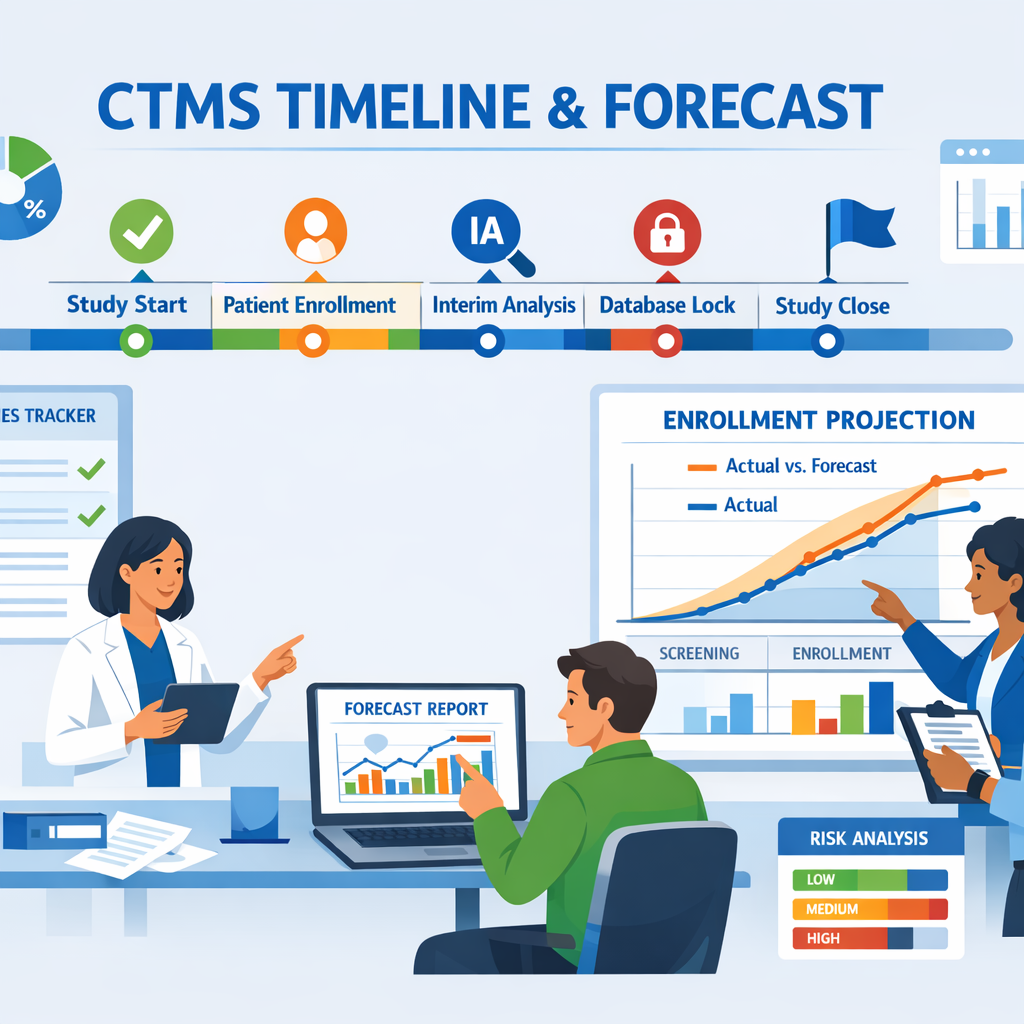
How to use CTMS checkpoints and data patterns to keep clinical trial forecasts realistic and responsive.
Why CTMS-Driven Checkpoints Matter for Trial Forecasts
Forecasting clinical trial costs and cash flows is hard even when protocols are simple and vendor models are stable. In reality, most organizations are managing portfolios where enrollment curves wobble, protocol amendments accumulate, and country mixes shift under regulatory or operational pressure. If forecasts are built only once a year or adjusted infrequently based on invoices, they will almost always be wrong in ways that catch leadership off guard.
The alternative is to treat CTMS as the source of truth for the drivers that move trial financials, and to use those drivers as checkpoints in an ongoing forecasting process. Instead of asking, "What did we spend?" at quarter-end, finance and clinical operations teams ask a more forward-looking question: "What is CTMS telling us about how this trial is unfolding compared to our plan, and what does that mean for cost and cash?"
By defining a small set of milestones and metrics that must be checked before forecasts are rolled forward or major decisions are made, organizations can keep projections realistic without overwhelming teams. External perspectives on clinical trial budgeting and accounting echo the same theme: accurate accruals and forecasts depend on good operational data, consistent methodologies, and disciplined reviews. This article brings those threads together into a practical framework. It explains how to pick the handful of CTMS metrics that matter most for forecasting, where to place checkpoints in the study lifecycle, and how to embed them into governance so forecasts stay aligned with reality as trials evolve.
Designing CTMS Metrics and Checkpoints That Drive Better Forecasts
Once the right CTMS data model is in place, the next challenge is deciding which metrics and checkpoints actually belong in a forecasting process. Too many dashboards and reports leave leaders drowning in numbers without a clear sense of which ones are trustworthy predictors of cost and cash.
The opportunity is to design a small, stable set of CTMS checkpoints that link protocol, operations, and financial expectations in ways both clinical and finance teams can understand. A useful design pattern is to anchor forecasting around three categories of CTMS metrics.
Volume Metrics
Volume metrics capture how much work is expected and completed:
- Planned vs. actual site activations
- Screenings, randomizations, and visits by type and geography
Timing Metrics
Timing metrics track when events occur relative to plan:
- Startup cycle times
- Enrollment curves and visit adherence
- Milestone completion dates
Quality Metrics
Quality metrics measure the friction and rework that often drive hidden cost:
- Protocol deviation density
- Query backlogs
- Unscheduled visit rates
- Data-entry lag
Analysis of clinical trial budgeting and financial automation reinforces why these categories matter for forecast accuracy. Deviations in enrollment, site performance, and amendment frequency are among the strongest drivers of budget variance. The key is to turn these metrics into explicit checkpoints in the forecasting process.
For example, a checkpoint at "X% of planned subjects screened" might require teams to reassess enrollment and visit projections based on actual screen failure and dropout rates. A checkpoint at "first database lock for an early cohort" can trigger a review of monitoring and cleaning assumptions. Each checkpoint pairs CTMS evidence with specific forecast adjustments in CTFM, so that changes in trial behavior flow into budgets and cash views in a structured way rather than as ad hoc overrides.
Embedding CTMS Checkpoints into Governance and Reviews
CTMS checkpoints only improve forecasts if they are baked into governance and routines. Otherwise, they become just another set of tiles on a dashboard. Sponsors, CROs, and biotechs that succeed with forecast reliability make CTMS checkpoints part of how they run reviews, not an optional add-on.
A Milestone-Keyed Review Cadence
One practical approach is to define a simple, repeatable cadence of forecast reviews keyed to operational milestones rather than calendar dates alone. Organizations might hold a structured forecasting review at the following points:
- When 25%, 50%, and 75% of target enrollment has been reached
- When all planned sites are activated
- After the first major protocol amendment goes into effect
In each session, clinical operations and finance sit together in front of CTMS and CTFM dashboards showing the chosen checkpoint metrics: enrollment vs. plan, visit volumes, deviation and query patterns, cost per subject trends, and site payment queues.
Guidance from finance and audit experts stresses that accruals and forecasts should be tied to actual activity data, not just to invoice schedules or percentage-of-completion estimates. CTMS checkpoints operationalize that advice by making clear which activity numbers will be used to update forecasts at each stage.
Defining Ownership and Playbooks
To sustain this model, organizations should define clear ownership around each checkpoint:
- Study managers own the CTMS metrics and explanations
- Finance analysts own the CTFM forecast changes
- Governance councils own the thresholds that trigger escalations, such as when cost per evaluable subject exceeds a defined band
Closing the Loop Over Time
Over time, organizations can benchmark checkpoint behavior across programs: how often forecasts are within tolerance after each checkpoint, how quickly teams react to adverse signals, and which combinations of metrics are most predictive of eventual over- or underspend. That learning closes the loop, steadily improving both the CTMS checkpoint design and the forecasts they inform.
Conclusion
Clinical trial forecasting accuracy is not primarily a modeling problem. It is a data discipline and governance problem. CTMS checkpoints address both by anchoring forecast reviews to operational reality, creating structured moments where clinical and finance teams align on what the data says and what it means for projections. Organizations that build this discipline into their review cadence will spend less time explaining variances after the fact and more time managing trials proactively, with forecasts that reflect what is actually happening in the field.
Subscribe to our Newsletter
