

Request a demo specialized to your need.
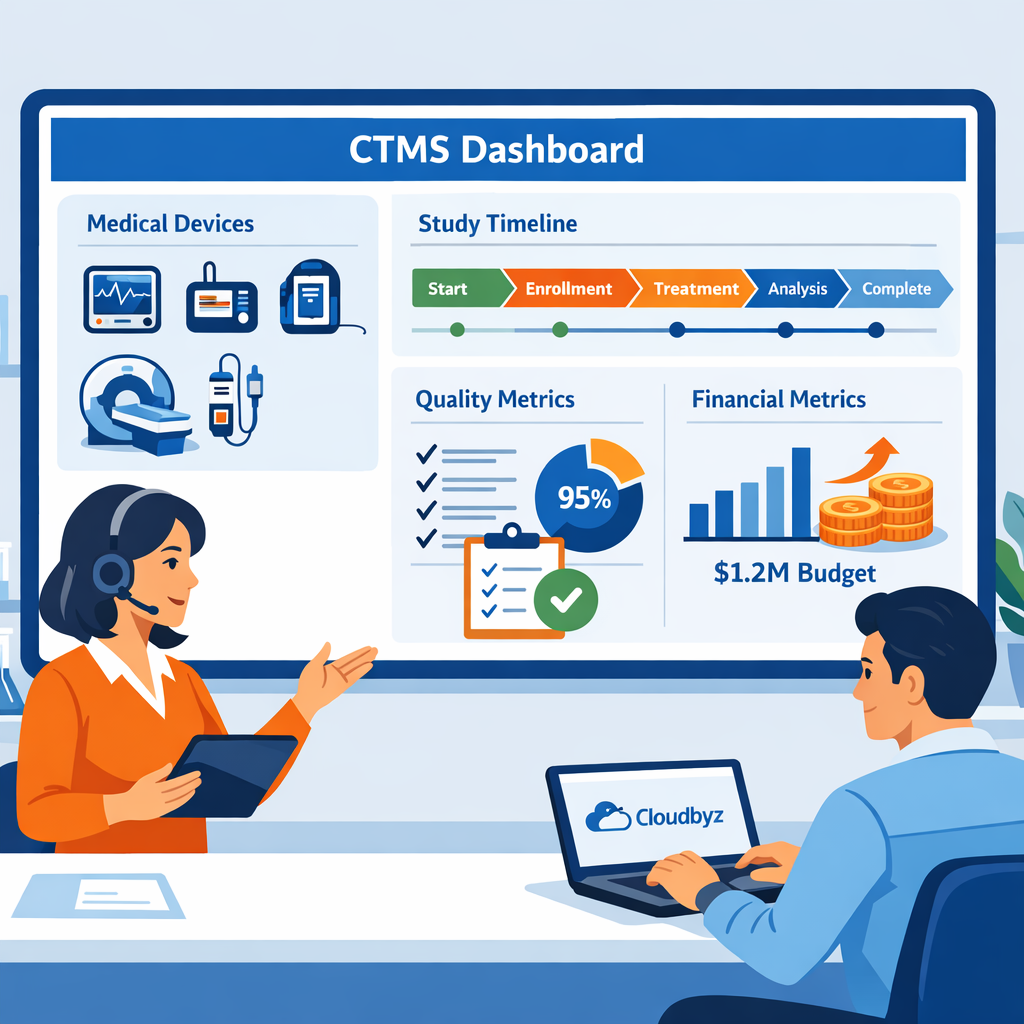
CTMS best practices tailored to medical device sponsors, linking design, evidence, and financial control for device trials.
Why Device Sponsors Need a CTMS Designed for Their Reality
The Problem with Drug-Centric CTMS
Most clinical trial management systems were built with pharmaceutical sponsors in mind. They speak the language of phases, indication portfolios, and multi-arm drug programmes. Medical device companies live in an entirely different world.
Device sponsors navigate IDE decisions, premarket submissions, iterative design changes, software updates, and post-market surveillance requirements that bear little resemblance to a traditional four-phase drug programme. Yet many medtech sponsors are still forcing device trials into CTMS implementations built around drug assumptions, and the friction shows.
Device teams end up tracking pivotal investigations, registries, and post-market clinical follow-up (PMCF) in separate spreadsheets because standard CTMS fields don't capture what they need. Quality and regulatory functions maintain their own records of which device versions are in which studies. Finance struggles to map procedure-based work, specialised imaging, and long follow-up commitments to per-patient cost and cash flow. And when leadership asks for a portfolio view across a multi-device pipeline, teams scramble to merge exports from half a dozen disconnected systems.
This fragmentation isn't inevitable. With the right configuration, a modern CTMS can be shaped around the realities of medical device development while preserving the discipline and auditability regulators expect.
A Different Regulatory Terrain
Understanding why device trials need a different CTMS approach starts with understanding how different the regulatory landscape actually is.
Medical device investigations are structured around early feasibility, pivotal, and post-market stages, not phases I through IV. Risk classification drives evidence depth: high-risk Class III and PMA devices typically require robust pivotal trials, while some 510(k) products need only focused clinical data, and others lean more heavily on performance and bench testing. Evidence expectations also vary significantly across markets, with FDA IDE requirements and EU MDR clinical evidence obligations often pulling in different directions for the same device.
Design iteration adds another layer of complexity that has no real equivalent in drug development. A device may go through multiple revisions between early feasibility and pivotal study completion. Those configuration changes must be traceable. Which patients were exposed to which version is a question regulators will ask, and the answer must be auditable.
A CTMS that can't model these realities forces teams back to workarounds.
Embedding Device-Specific Drivers into CTMS
Study Templates Built for Device Evidence Pathways
The foundation of a device-ready CTMS is a well-designed template library that reflects how device evidence actually develops.
For Class III and high-risk devices, templates should clearly distinguish between early feasibility, pivotal, and post-market study types. Each template can carry default milestone packs, including IDE submission and approval, first-in-human enrolment, design freeze checkpoints, DSMB reviews, and premarket submission handoffs, so teams aren't starting from a blank page on every new protocol.
For 510(k) or De Novo strategies involving smaller, targeted investigations, templates can emphasise enrolment windows, alignment with real-world comparator cohorts, and data cut-offs tied to specific performance claims.
Encoding these templates once delivers consistency across programmes and significantly reduces setup time for new studies.
Configuration and Change Control Visibility
Many medtech sponsors run iterative device versions through a sequence of investigations. If configuration IDs live only in PLM or quality systems, answering basic traceability questions becomes painful.
By adding structured fields for device model, revision, and key configuration parameters into study and subject records, and syncing these with quality and regulatory systems, CTMS can give clinical, QA, and regulatory teams a single common lens. That alignment becomes especially critical when linking CTMS to eTMF, where design dossiers, risk files, and clinical evidence packages must stay in step with the actual device used in the field.
Cost Structures That Reflect Device Trial Economics
Device trials are expensive in ways that standard CTMS cost models don't anticipate. Per-patient costs can range from tens of thousands of dollars to significantly higher once imaging, procedure time, complex follow-up, and device interrogation visits are included.
CTMS should attach those cost drivers directly to study events: procedure-based visit templates for implant or intervention sessions; follow-up schedules linked to imaging or functional testing; and vendor services for core labs, imaging adjudication, or remote monitoring. When CTMS milestones such as "device implantation" or "12-month imaging follow-up completed" fire, financial management systems can accrue costs and trigger site and vendor payments accordingly.
This design lets sponsors see, in one workspace, how choices in eligibility criteria, visit schedules, or imaging burden translate into actual trial economics, before commitments become surprises.
Region-Specific Evidence and Regulatory Milestones
For global device portfolios, CTMS templates should also capture the regional nuances that shape evidence requirements and submission timelines. The same device study may need to report differently against FDA IDE expectations and EU MDR obligations.
By modelling country-level milestones for submissions, approvals, and classification decisions, and tagging sites by region, risk classification, and evidence strategy, sponsors can reuse study structure across markets while still respecting local rules. Dashboards can then surface where enrolment is tracking against evidence needs for each major dossier, or where protocol amendments driven by regulatory feedback are increasing cost and complexity.
Governance, Integrations, and Dashboards
Well-designed templates and data models only deliver value if they're embedded in a working operating model. Without the right cross-functional ownership and data flows, even the best CTMS configuration will slide back into spreadsheets.
Cross-Functional CTMS Governance
A pragmatic starting point is a CTMS governance council that explicitly includes device development, clinical operations, quality/regulatory, and finance. This group owns standard study templates, milestone definitions, and financially critical fields across the device portfolio. Meeting quarterly, it reviews data on start-up timelines, enrolment, evidence delivery, and budget variance, and sponsors configuration or process changes where patterns emerge.
When external guidance shifts, such as new FDA guidance on Bayesian statistics in medical device trials or evolving real-world evidence expectations, the council decides how to reflect those changes in CTMS workflows and metrics. This keeps the system aligned with the regulatory environment rather than lagging it.
Integrations That Make CTMS the Connective Tissue
For medical devices, three integration hubs are typically most important:
- Quality and PLM systems feed device configurations, risk categories, and design-control status into CTMS, linking each study and subject record back to the right device version.
- Regulatory tools feed in submission timelines, post-market commitments, and study obligations, which CTMS reflects as milestones and dashboards.
- Financial and ERP systems consume CTMS study and visit events to run budgets, accruals, and payments, ensuring trial spend and cash flows match operational reality.
The goal isn't to recreate every field across systems. It's to synchronise the identifiers and status flags that matter most, so each function is working from the same ground truth.
Dashboards Tuned to Medtech Decision-Making
On top of an integrated data spine, device sponsors can build dashboards that actually reflect how leadership thinks about the portfolio.
A portfolio cockpit might track, for each investigational device, the status of early feasibility, pivotal, and post-market studies, with tiles for enrolment, protocol deviations, major device-related adverse events, and evidence milestones. Financial views can show cost-per-implant, cost-per-patient, and event-to-cash metrics broken down by geography and study type. For trials using adaptive or Bayesian designs, dashboards can surface where current data sits relative to planned information density and decision points, keeping operational teams aligned with biostatistics and regulatory strategy.
The Outcome: A Repeatable Operating Model
When CTMS is configured around how device development actually works, not how drug development works, the improvisation that currently characterises many medtech operations can be replaced with a repeatable, auditable model.
Device configuration, clinical evidence requirements, and trial budgets meet in one place. Teams stop maintaining parallel systems. Regulators find consistent, traceable records. Boards and investors see a clear picture of spend and time-to-approval across the pipeline.
That foundation doesn't just keep individual studies on track. It positions sponsors to scale their pipeline, respond faster to regulatory change, and demonstrate that both the science and the execution are under disciplined control.
Subscribe to our Newsletter
